
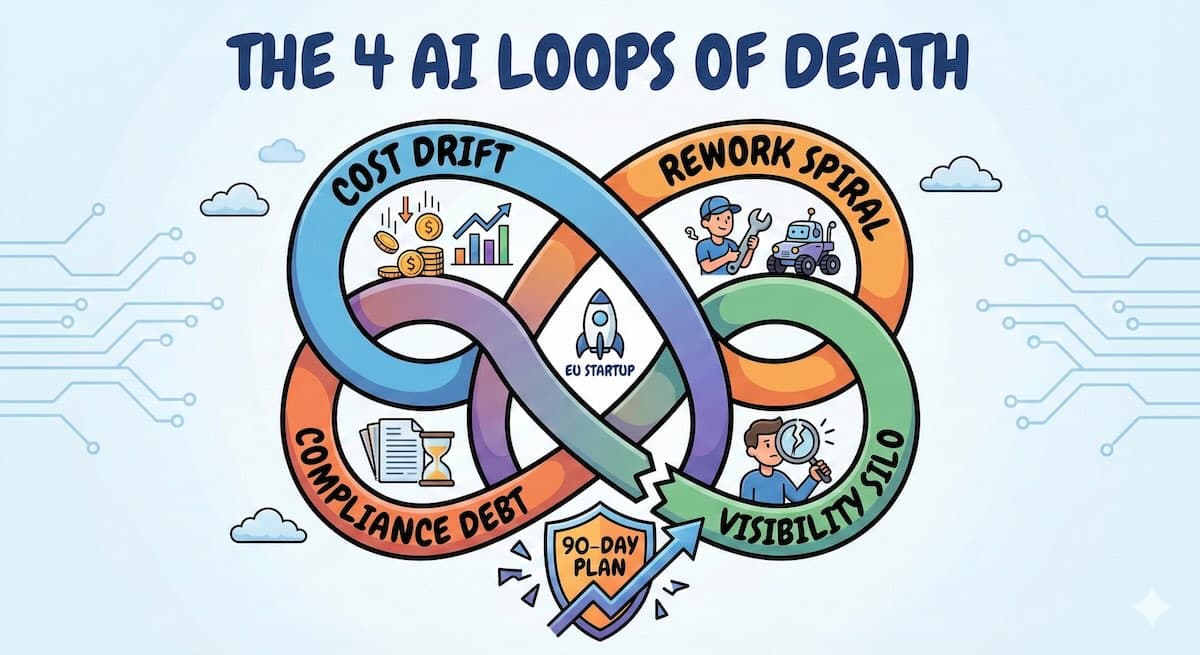
While founders were celebrating cheaper tokens, four invisible feedback loops started silently killing their margins.
If you're an EU startup spending €2k–€50k/month on LLMs, the next six months are brutal. By August 2026, the EU AI Act's high-risk obligations will fully apply. But long before the regulators arrive, you will face a much simpler threat: your own unit economics are upside down.
Gartner estimates that 30% of GenAI projects are abandoned after proof of concept, not because the tech failed, but because the economics and risks don't scale.
Most founders think they have a "model problem." They think that if they switch to the newest Llama or GPT, the hallucinations will stop, and the margins will recover.
They won't.
You have a systems problem.
You are trapped in them, and they quietly compound until margins collapse and roadmap confidence dies. By the time it's obvious, you're firefighting cloud bills, customer incidents, and audit prep in parallel.
This post breaks down those loops and gives you a 90-day plan to stop them.
Loop #1: Token Cost Drift (Cheap Models, Expensive Reality)
The trap starts with a true statement: model prices are crashing. Inference costs for GPT-3.5-class capabilities dropped nearly 280x between late 2022 and 2024. Open models now offer incredible price/performance.
You interpret this as: "Cost pressure is solved."
Then your usage explodes.
What actually happens
Product adds more AI surfaces (support Copilot, internal search, automations).
Prompts get bloated as you shove more context into improve quality.
Retries pile up during provider hiccups.
Agent chains call models multiple times per single user action.
There is no accountabilitybecause nobody tracks the co-feature.
So unit price drops, but total spend rises faster than revenue. You don't notice in time because your dashboards show blended averages rather than burst behavior.
Why tdoes his kill startups
At the seed/Series A stage, cost volatility undermines planning. Investors now care less about flashy demos and more about unit economics. If your gross margin story depends on "we'll optimize later," that's not a story.
What to implement now
Gateway everything: Never call models directly from app code. Use an open-source proxy such as LiteLLM, or a managed gateway such as Helicone or Portkey.
Hard budgets + virtual keys: Assign specific keys to specific product areas or customer tiers.
Semantic + exact caching: Don't pay for the same answer twice.
Model routing: Route easy tasks to Claude Haiku or Gemini Flash; reserve Claude Opus or GPT-4o only for complex reasoning.
The Diagnostic: If you can't answer "What did Feature X cost yesterday?", you're still in this loop.
Loop #2: Quality Rework Spiral (You Save Time, Then Lose It to Cleanup)
Your team loves to report AI speedups. The unreported line item is rework: verification, corrections, rollbacks, and support handling when outputs are wrong. Recent data suggests up to 40% of AI time savings are lost to verification, corrections, and downstream rework.
The reliability gap
Even top models produce domain-risky mistakes. Hallucination rates vary by context, and "demo works" quickly turn into "fragile in production." According to McKinsey, 51% of organizations have already experienced a negative consequence from GenAI, with inaccuracy leading the list.
The hidden multiplier
Every quality miss creates second-order costs that reinforce the spiral:
Engineer time is burned validating outputs manually.
Support load spikes from user confusion.
Trust erodes, leading to more conservative (longer, more expensive) prompts.
Release cycles slow down because nobody trusts the changes.
Quality and cost are not separate problems. They reinforce each other.
What to implement now
LLM eval pipeline in CI/CD: Use tools like DeepEval or Langfuse to run "golden set" tests before every deploy.
Trace every generation: Metadata must include prompt version, model version, and input variables.
Human-in-the-Loop (HITL): For high-stakes flows, insert a manual review step before the user sees the output.
Rollback-ready controls: Treat prompts like code. Version control them so you can revert instantly.
The Diagnostic: If users discover quality incidents before your system flags them, you're in this loop.
Loop #3: Compliance Debt Compounding (The August 2026 Cliff)
Many startups treat the EU AI Act as a future legal project. That's backward.
The deadline for high-risk compliance is August 2, 2026. That is less than six months away. Even if you aren't "high risk" today, enterprise buyers are already demanding governance artifacts.
The cost of ignoring it
The penalties are designed to be existential: up to €35,000,000 or 7% of your total worldwide turnover for prohibited practices, and €15,000,000 or 3% for non-compliance with high-risk obligations.
How debt accumulates
No structured risk logs.
No reproducible trace history.
No clear data lineage for training/RAG assets.
No documented human oversight pathway.
Then one enterprise deal asks for evidence, or a partner audit hits, and your engineering team stops shipping for a month while it reconstructs history from ad hoc logs.
What to implement now
Audit-first telemetry: Logs must be append-only, timestamped, and versioned. Treat them as evidence, not diagnostics.
Risk register: Tie technical controls to specific risks (not just policy docs).
Data lineage: Map exactly which documents fed into your RAG responses.
Conformity-readiness checklist: AssessFeaturefeature against Annex III (risk classification) and Annex IV (technical documentation).
The Diagnostic: If you can't produce a timestamped, versioned trace history on demand for your feature, you're in this loop.
Loop #4: The Visibility Silo (Why You Can't Fix the First Three)
This is the root cause. Cost, observability, and product analytics tooling are usually housed in separate systems with distinct owners.
Infra sees that latency is stable.
Product usage is growing.
Finance sees AI spend spiking.
Legal sees audit readiness as unclear.
The Silo Mechanism
Because these systems don't talk to each other, you can't make trade-offs. You can't see that Feature A is cheap but has a high failure rate (Loop 2), or that Feature B drives revenue but exposes you to compliance risk (Loop 3).
Worse, these silos multiply. Each team owns what they own, nothing more. Integrations never happen because no single team owns the whole stack. So every new AI feature ships with isolated telemetry, deepening the fragmentation.
What to implement now
Define a single Weekly AI Operating Review with shared metrics:
Cost per successful outcome (not per request).
Quality pass rate by feature path.
Top 10 most expensive prompt+route combos.
Governance readiness score (checklist completion %: risk register + trace coverage + lineage).
The Diagnostic: If Engineering, Finance, and Product can't align on one scorecard, you're in this loop.
The 90-Day Survival Plan
You don't need a giant transformation. You need a sequence that dismantles these loops one by one.
Days 1–30: Stop the Bleed (Targeting Loops 1 & 4)
Gateway: Put all model traffic behind a proxy (Helicone/LiteLLM).
Budget: Enable strict budget guards and spend alerts.
Trace: Add tracing for every model call with versions.
Review: Launch a Weekly AI Operating Review with cross-functional stakeholders, starting with just three shared metrics.
Cache: Ship one semantic caching layer on your highest-volume path.
Days 31–60: Stabilize Quality (Targeting Loop 2)
Evals: Add eval gates (DeepEval/Langfuse) for your top 3 customer-facing flows.
Control: Implement prompt/version rollback capability.
Oversight: Introduce Human-in-the-Loop (HITL) for risk-sensitive outputs.
Incidents: Start a weekly quality incident review using root-cause templates.
Days 61–90: Build Compliance Muscle (Targeting Loop 3)
Register: Stand up a risk register mapped to your technical controls.
Lineage: Document data lineage for all RAG/training inputs.
Artifacts: Produce your first "audit-ready" bundle for one core feature.
Mock Audit: Run a mock buyer/compliance review to find gaps before August.
Final Take
The biggest mistake for EU AI startups in 2026 is believing these are separate threads:
Cost optimization
Output quality
Compliance readiness
They are one operating system.
If you solve only one, the other two drag you backward. If you design for all three together, you create a moat: better margins, faster shipping confidence, and stronger enterprise trust before the pressure peaks.
The winners won't be the teams with the fanciest model stack.
They'll be the teams that eliminated the four loops before those loops eliminated them.
If you want to see how these loops look in your own stack, PromptMetrics gives you the unified view of cost, quality, and compliance in one place.
Sources & Further Reading
EU AI Act Timeline & Penalties: https://digital-strategy.ec.europa.eu/en/policies/regulatory-framework-ai
AI Inference Cost Analysis: https://hai.stanford.edu/ai-index/2025-ai-index-report
AI Governance Effectiveness: https://www.biztechreports.com/news-archive/2026/2/17/global-ai-regulations-fuel-billion-dollar-market-for-ai-governance-platforms
State of AI & Risk: https://www.mckinsey.com/capabilities/quantumblack/our-insights/the-state-of-ai