
At PromptMetrics, we spend our days embedded with engineering teams, working to make AI outputs traceable, observable, and, most importantly, defensible.
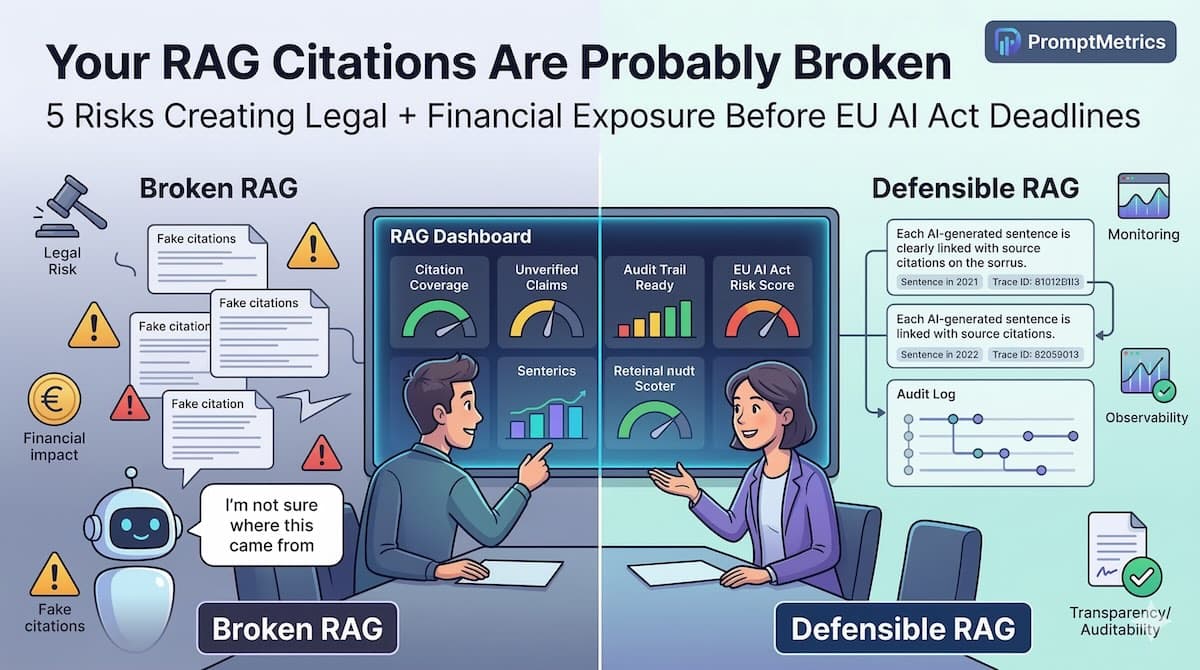
If you think a standard RAG pipeline protects you from hallucinations, you're likely sitting on significant legal and financial exposure. Between a New York lawyer being fined $5,000 for "ChatGPT-law" and Air Canada being held liable for its chatbot's "hallucinated" bereavement policy, the precedent is clear: Your AI's mistakes are your legal reality.
With the EU AI Act taking full effect on August 2, 2026, the stakes are rising. Infringements can now cost up to €35 million or 7% of global turnover.
Here are the five critical failures we see in production RAG systems, along with the architectural shifts required to fix them.
1. RAG Doesn't Kill Hallucinations; It Just Landscapes Them
The industry pitch is simple: ground the LLM in your data, and it stops lying. The reality is far more stubborn.
The Data: While RAG can reduce hallucinations by 42–68%, GPT-4 class models still hallucinate roughly 28.6% of the time, even with retrieval.
The Danger: A Stanford HAI/RegLab study found hallucination rates as high as 82% on complex legal queries. In medical contexts, 47% of ChatGPT's references were entirely fabricated.
The Fix: Treat citation as a deterministic post-generation step. Stop asking the LLM to "self-cite." Instead, use Python packages like rag-citation or SentenceTransformers to mathematically map sentences to source chunks via cosine similarity. Pair this with SpaCy NER to flag "phantom" entities (dates or figures) that appear in the output but don't exist in your source.
2. "Dumb" Chunking is Destroying Your Evidence
Most teams discover this three months into production: their citation accuracy craters because their data engineering is too basic.
The Problem: Arbitrary token-based splitting destroys semantic hierarchy. If a table is split across three chunks, the revenue is in Chunk A, the date is in Chunk B, and the caption is in Chunk C. A citation engine can't link what it can't see in one piece.
The Fix: Move to context-aware, multimodal chunking. Keep tables with their captions, prepend section headers to every child chunk, and use hybrid retrieval (combining vector search with BM25 keyword lookups) to ensure specific terms aren't lost in the "math" of embeddings.
3. "LLM-as-a-Judge" is a Costly Security Blanket
Using an LLM to verify another LLM is the "Inception" of bad architecture. It's slow, expensive, and ironically prone to its own hallucinations.
The Trap: You're paying for the context window twice to have a probabilistic system check another probabilistic system.
The Fix: Build a tiered verification architecture. Use NLP-based, deterministic logic (NER and similarity scores) as your primary filter.r Reserve LLM-based verification only for highly synthesized, multi-source answers. If your "fallback rate" to the LLM is high, your chunking strategy is likely the culprit.
4. The EU AI Act is Turning "Transparency" into Infrastructure
Articles 12 and 13 of the EU AI Act have shifted the focus from "nice-to-have UI" to a "mandatory audit trail."
The Requirement: High-risk systems (used in HR, credit, or legal) must be "sufficiently transparent" to allow humans to interpret outputs. Under Article 73, serious incidents must be reported within 15 days (or 10 for safety-critical failures).
The Fix: Your Infrastructure must serve two masters: frontend transparency (inline links for users) and backend auditability (logs linking every claim to specific vector IDs). If a regulator knocks, you need an execution trace, not a "vibe check."
5. Citations Without Observability are "Compliance Theater."
Models are stochastic. OpenAI, Anthropic, and Google update weights and APIs constantly. These "silent updates" can degrade citation accuracy without ever triggering an error in your traditional APM stack.
The Blind Spot: If you aren't benchmarking against domain-specific suites like ALCE (citation precision) or FinanceBench, you're flying blind.
The Fix: Deploy continuous LLM observability track, prompt drift, and citation coverage. If the percentage of deterministic source links drops, you need to know before a customer relies on a hallucinated claim.
Your 90-Day Roadmap to Verifiable AI
The era of the "Black Box" is over. Here is how to spend your next three months:
Month 1: Map your RAG systems against EU AI Act risk categories and move from LLM-based to deterministic citation logic.
Month 2: Implement Article 12-aligned logging and establish citation coverage baselines.
Month 3: Benchmark against domain-specific suites (like PubMedQA or FinanceBench) and run a "dry-run" compliance audit.
Want to see where your RAG system stands? PromptMetrics helps teams track citation coverage, version prompts, and maintain the audit trails required for the next generation of AI.