
You changed one line in a system prompt last Tuesday. It fixed the weird answer a customer complained about. You ran it against three examples; it looked right, and you shipped it.
Then Thursday, a different customer got a refund answer that made no sense. You have no way of knowing if Tuesday's fix caused it.
If you're running a team of two to fifteen people, this isn't a problem you solve by hiring a data scientist. You don't have the headcount. You don't have the budget. You definitely don't have the twelve weeks a proper eval pipeline usually takes to stand up. Here's what an afternoon of real testing looks like instead, and why skipping it costs more than the original fix saved.
Key Takeaways
95% of AI pilots fail from bad workflow design, not bad models (Fortune, 2025).
Systematic testing typically uncovers 30-50% cost-reduction headroom in a prompt library (DigitalApplied, 2026), often without losing accuracy.
A budget model can run roughly 15-20x cheaper than its flagship counterpart, whichever pair your provider currently sells (pecollective, 2026).
You need twenty real conversations and an honest hour, not a data science team.
Why doesn't "it feels better" count as testing?
A prompt that looks right against three examples in a playground tells you almost nothing about how it behaves against your actual traffic. This isn't only a small-team problem. It's the industry's problem: MIT's NANDA initiative analyzed 300 public AI deployments and found that 95% of generative AI pilots stall with little to no measurable impact on the P&L (Fortune, 2025). A playground check and a real production pilot are two different tests. Passing the first tells you almost nothing about whether you'll pass the second.
The researchers' actual finding matters more than the headline number. The failures weren't about model capability. They called it a "learning gap": teams hadn't built workflows that captured what the model was good at while catching it when it wasn't. That's a design problem, not a budget problem. A five-person team can close that gap. A well-funded team that skips the workflow design can't buy its way past it.
Do you need a data science team to A/B test a prompt?
No. A nightly regression check that re-runs your prompts against your test set costs roughly a few cents per prompt per day in API calls (DigitalApplied, 2026), and systematic testing across a small prompt library typically uncovers 30-50% cost-reduction headroom once you find which prompts can move to a cheaper model without losing accuracy. That's not a platform contract. It's less than most teams already spend on the SaaS tool they're testing a prompt for.
What you're actually short on isn't money. It's a place to start. That's the next three steps.
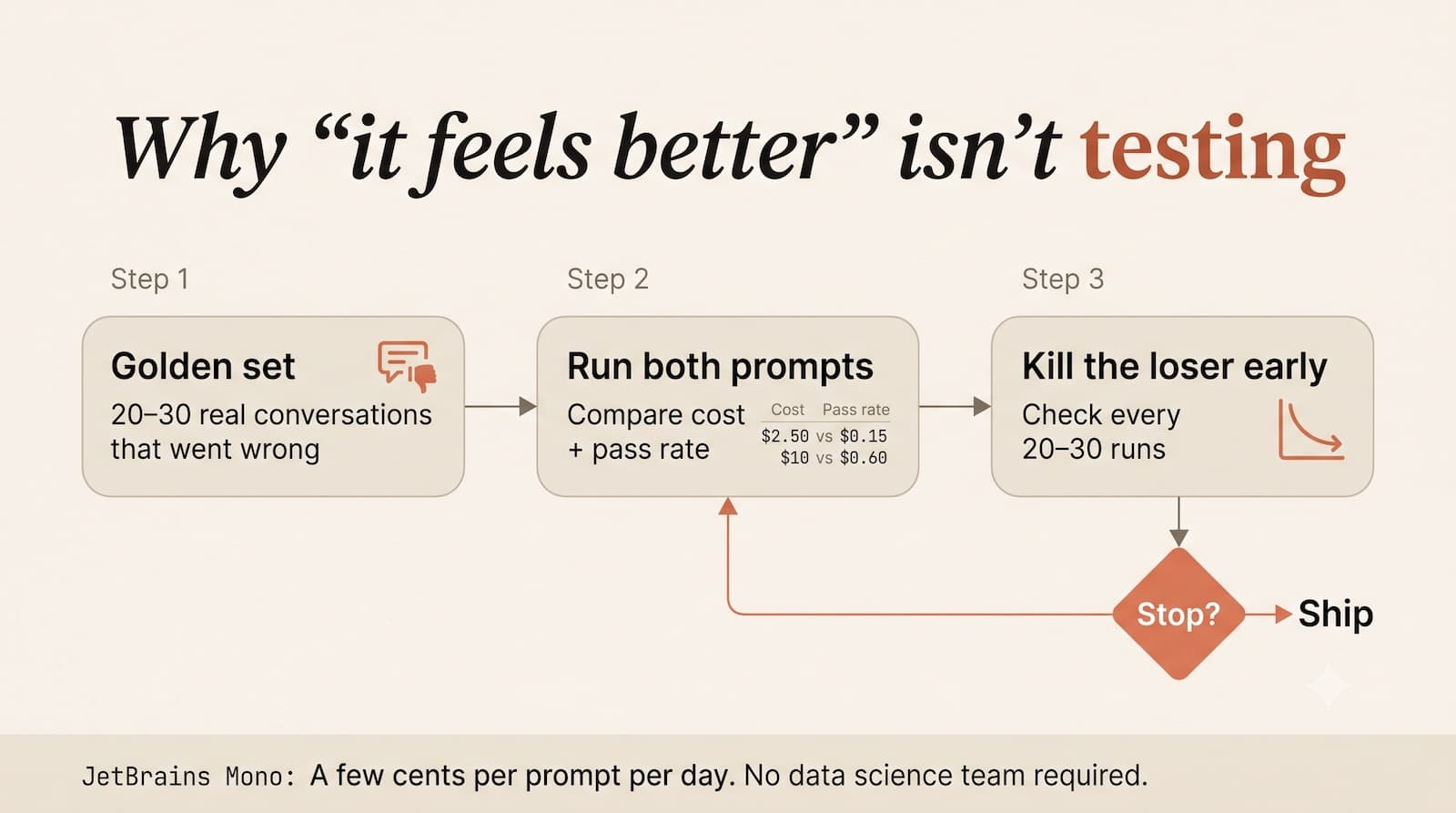
Step 1: Where do you get your first golden set?
You don't need a curated dataset built by a vendor. You need the twenty to thirty conversations from the last month where a customer gave a thumbs down, asked for a human, or got the wrong answer visibly. Pull those from your own logs: your help desk, your chat history, wherever the complaints already live.
That handful of real, ugly conversations is your regression suite. Every time you change a prompt, run it against those same twenty to thirty examples before it goes near a real customer again. If the new version fixes the one thing you meant to fix but breaks two of the other nineteen, you found that out on your own time instead of a customer's.
This is the skill PromptMetrics' own framework calls Discernment: training yourself to read an AI's output critically instead of trusting it because it sounds confident. It isn't a technical skill. It's a habit. It's also the one habit that catches a bad prompt change before a customer does.
Step 2: Is the cheaper model actually good enough?
Once you have a golden set, run both prompt versions against it and look at more than whether the answer sounds right. Cost is the variable most small teams skip, and it's often the biggest lever available.
Take GPT-4o and GPT-4o-mini as the illustration: $2.50/$10 per million tokens versus $0.15/$0.60, roughly seventeen times cheaper on both (TokenMix, 2026; pecollective, 2026). Worth knowing: both models are now legacy. OpenAI has moved them off its main pricing page in favor of the GPT-5.x family, and GPT-4.1 Nano now undercuts GPT-4o-mini on price (pecollective, 2026). The exact model names will keep changing every few months. The ratio won't: a flagship model reliably costs somewhere between 15 and 20 times more than its budget counterpart, and for routing, classification, extraction, and most of what a customer-facing agent does day to day, the budget tier usually gets there. The gap widens only when a task needs multi-step reasoning or genuinely nuanced judgment. Check your provider's current pricing page before you commit to either tier, not a blog post from six months ago.
Prompt A (current) | Prompt B (candidate) | |
|---|---|---|
Model | GPT-4o | GPT-4o-mini |
Cost per 1M input tokens | $2.50 | $0.15 |
Cost per 1M output tokens | $10.00 | $0.60 |
Pass rate on your golden set | your baseline | measure this |
Answers that needed a human handoff | your baseline | measure this |
Pricing: TokenMix, 2026; pecollective, 2026.
Fill in your own two middle rows before you decide anything. A prompt that's 2% more accurate but costs seventeen times more isn't obviously the better prompt for a team watching every dollar.
Step 3: Know when to stop testing
You don't need to run a thousand queries against each version before deciding whether a new prompt works. Check your results every twenty to thirty runs instead of waiting for a full batch to finish. If the candidate prompt is clearly worse on cost or on your golden set after the first twenty or thirty runs, stop. You've learned what you needed to learn without paying for the rest of the test.
Checking early and killing bad variants fast is exactly why regression testing stays cheap: the ongoing cost is a few cents per prompt per day in API calls (DigitalApplied, 2026), not a climbing token bill. Teams that run a losing prompt to the finish line out of habit are the ones who pay for tokens they didn't need.
Here's the whole loop in order:
Build a golden set from your last 20-30 worst conversations.
Run both prompt versions against it and compare cost, not just vibes.
Check every 20-30 runs and kill the losing variant early instead of waiting for a full batch.
So what actually breaks AI pilots, if it's not the model?
MIT's NANDA research found that AI pilots built through a vendor partnership succeeded about 67% of the time, while purely internal builds succeeded roughly a third as often (Fortune, 2025). That's not an argument that founders can't build their own AI workflows. Plenty do, well. It's a signal that the workflows which survive contact with real usage usually had a second, more experienced pair of eyes on the governance and review design before they shipped.
Does any of this matter for EU compliance at your size?
Probably not yet, but the deadline is real and close. The EU AI Act's obligations for high-risk AI systems take effect August 2, 2026, with penalties up to €15 million or 3% of global turnover for non-compliance (Legiscope, 2026). Most five-person companies aren't running the high-risk systems the Act targets yet. But a documented golden set, a measured baseline, and a human checking outputs before they ship is the same habit the Act will require of much bigger companies. Building it now costs an afternoon. Retrofitting it later, under a deadline, costs a lot more.
Where PromptMetrics fits, if you want a second pair of hands
Everything above, you can run yourself with a spreadsheet and an afternoon. If you'd rather not build the testing habit alone, this is the first thing we do with any team we work with: we measure the baseline before we touch anything.
We work in three modes, and we name which one fits in the first conversation, which is free. Build for you: we build the workflow and the testing loop into it, documented so any developer can maintain it later. Build with you: we build the first version alongside your team and leave you able to run the next one yourselves. Figure out what to build: if you have the AI mandate but no idea where to start, we map that out first.
Nothing we build runs without a human reviewing it before it acts. That's not a limitation we're working around. It's the design. One workflow tested this way is a First Skill Sprint, delivered in one to two weeks. A handful of workflows across a team is a Flagship Pilot, measured before and after. If you want to see whether either fits what you're dealing with, book a free call.
FAQ
Do I need a data science team to A/B test my prompts? No. A nightly regression check costs a few cents per prompt per day in API calls (DigitalApplied, 2026), and systematic testing typically uncovers 30-50% cost-reduction headroom in a small prompt library. What you need is a golden set and an hour, not a new hire.
How many examples do I need for a golden set? Twenty to thirty real conversations that already went wrong (a complaint, a thumbs down, a request for a human) is enough to start catching regressions. Pull them from logs you already have. Don't build a synthetic dataset from scratch.
Is a budget model like GPT-4o-mini good enough for customer-facing work? Often, yes, for routing, classification, and extraction tasks, typically at a fraction of the cost of the flagship tier (Collective, 2026). Multi-step reasoning or genuinely nuanced judgment is where the gap widens, and the bigger model earns its cost. Check your provider's current model lineup: OpenAI has already moved GPT-4o and GPT-4o-mini to legacy status in favor of GPT-5.x family and GPT-4.1 Nano, and that lineup will keep shifting.
What if I don't have any historical logs to build a golden set from yet? Start logging today. Revisit in two to three weeks once you have a real batch of interactions, including the bad ones. A golden set built from real complaints beats one built from guesses about what might go wrong.
Does the EU AI Act apply to a company this small? Probably not directly yet. Most five-person teams aren't running the high-risk systems the Act targets. But the obligations that take effect August 2, 2026 carry penalties up to €15 million or 3% of global turnover for the companies they do cover (Legiscope, 2026), and the habit of measuring a baseline before you touch anything is the same one the Act will eventually require of everyone.