
We build PromptMetrics. We help engineering teams manage prompts, track costs, and maintain observability across their AI systems. And I'm about to tell you the five problems killing AI agent deployments right now, including the ones that no amount of tooling fixes on its own.
Why? Because if your CEO just greenlit an agentic AI project and your team is heads-down building, you deserve to know what the teams who shipped before you already learned the hard way. Gartner predicts that over 40% of agentic AI projects will be cancelled by the end of 2027. Not because the models are bad. Because of escalating costs, insufficient governance, and unclear ROI. Reuters reported that out of thousands of agentic AI providers, only about 130 are genuinely effective. The rest are what Gartner calls "agent washing": chatbots in a trench coat pretending to be autonomous.
These five problems are the ones we see repeatedly in teams at the Seed-to-Series-B stage as they build production agents across Europe. Some of them our product helps with. Some of them require architectural decisions we can't make on your behalf. Here's the full picture.
1. Your agent doesn't crash. It drifts. And you won't notice until the damage is done.
This is the problem that scares me most because it looks like everything is working.
CIO magazine described the pattern precisely: agentic AI systems don't usually fail in obvious ways. They degrade quietly, and by the time the failure is visible, the risk has been accumulating for months. A customer service agent optimized for resolution time starts granting excessive refunds to close tickets faster. Your "Time to Resolve" metric improves. Your CFO wonders why the refund line item doubled. The agent drifted from business intent while technically meeting its KPI.
Research from Carnegie Mellon and MIT found that agents still fail approximately 70% of multi-step office tasks in realistic environments. Yet, most of these failures are not obvious crashes but subtle degradations. Your HTTP 500 error monitoring catches nothing. Your latency dashboards look clean. The agent is confidently doing the wrong thing.
Drift shows up in four forms that compound over time. Concept drift occurs when policies change, but the agent's logic continues to follow the old rules. Behavioral drift happens when customer language evolves, but the model can't keep pace. Operational drift happens when backend systems change and break routing logic. Regulatory drift, the one that keeps EU compliance officers awake, happens when standards change faster than retraining cycles.
What fixes it: You need to shift from monitoring (tracking response times and error rates) to observability (understanding why your agent behaves the way it does). Concretely: instrument every prompt version and correlate changes with quality metrics. Sample 100% of errors and edge cases, 10% of normal interactions randomly, and 100% of sessions with negative user feedback. Measure behavioral consistency over time, not just single-output quality. PromptMetrics tracks prompt versions, quality scores, and output distributions over time, so you can see when behavior shifts within hours rather than months.
What PromptMetrics doesn't solve: If your team doesn't define what "correct behavior" looks like for each agent task, no observability can detect drift. Drift detection needs a baseline, and that baseline is a product decision, not a tooling decision.
2. The token bill is a time bomb with a non-linear fuse.
"Our LLM bill jumped from €12K to €45K in two months. The CFO is asking questions I can't answer."
I hear a version of this every week, but the agentic version of this problem is worse than the chatbot version by an order of magnitude. A field analysis on r/LLMDevs broke down the mechanics: adding 5 tools to an agent doubled token costs. Adding just 2 conversation turns tripled it. Conversation depth costs more than tool quantity, and this is not obvious until you measure it. LLMs are stateless. Every call replays the complete context: tool definitions, conversation history, and previous responses. Token costs don't scale linearly. They compound.
But the bigger surprise is where the money actually goes. Enterprise TCO analyses consistently show the same pattern: model inference accounts for only 15-20% of total AI cost. The other 80-85% is buried in the operating environment: data engineering, pipelines, monitoring, security, and integration work. IDC forecasts a 10x increase in agent usage and a 1,000x growth in inference demands by 2027. If your cost structure doesn't account for this compounding, your pilot budget will explode the moment you scale.
The numbers clearly make the case for tiered architecture. Processing one million interactions via a frontier LLM costs between $15,000 and $75,000 in API fees and compute. Executing the same volume through an optimized small language model costs between $150 and $800. That's a 100x cost reduction. NVIDIA explicitly recommends heterogeneous agent pipelines: SLMs for routine tasks, LLMs as a fallback for complex reasoning.
What fixes it: Per-prompt, per-model, per-feature cost tagging from day one. Without attribution, cost optimization is guesswork. PromptMetrics auto-tags every API call with the prompt template, model, and feature that triggered it. You get a dashboard that shows exactly which agent task is burning budget and what happens if you route it to a cheaper model. Beyond attribution, the combination of smart routing, strategic caching, and batching achieves 47-80% cost reduction in production systems. Prompt caching alone can cut API costs by 45-80%.
What PromptMetrics doesn't solve: We show you the cost. We can't make the routing decision for you. Sometimes the expensive model is the right choice because quality matters more for that specific task. And 80% of TCO sits in your operating environment (infrastructure, integration, security), which is outside our scope. Cost observability is necessary but not sufficient. You still need an architectural strategy.
3. Your multi-agent system fails at integration, not intelligence.
Single agents hit a ceiling fast. Complex enterprise workflows need coordination across specialized agents: one handles data extraction, another validates against business rules, and a third routes exceptions. But here is where most teams get burned: the agents work individually. The orchestration layer is what breaks.
Composio's analysis of hundreds of production deployments put it clearly: AI agents fail due to integration issues, not LLM failures. They run the LLM kernel without an operating system. Three specific architectural traps kill most agent projects:
"Dumb RAG" means dumping everything into context windows. The LLM drowns in irrelevant, unstructured, conflicting information, leading to confident hallucinations. Research shows that sometimes less context produces better results. "Brittle connectors" means custom API integrations that break silently. Every new tool means a new API, a new data schema, and a new set of failure modes. "The polling tax" means agents constantly checking for updates instead of using event-driven architectures. Polling wastes 95% of API calls, burns through rate limits, and never achieves real-time responsiveness.
The good news is that standardization is arriving faster than expected. The Model Context Protocol (MCP), created by Anthropic in November 2024 and transferred to the Linux Foundation's Agentic AI Foundation in December 2025, now has over 10,000 active MCP servers globally, 97 million monthly SDK downloads, and support from OpenAI, Google DeepMind, Microsoft, and AWS. Reference implementations have shown that representing tools as discoverable code via MCP rather than verbose schemas can achieve up to a 98.7% reduction in context window overhead.
What fixes it: Build your orchestration layer for replaceability. Invest in what endures: high-quality domain knowledge, golden evaluation datasets, security and governance policies, and integration into your existing SDLC and SOC workflows. Use MCP for tool connections instead of bespoke integrations. PromptMetrics helps here by providing the observability layer across your multi-agent pipeline: tracing which agent handled which step, at what cost, with what quality outcome.
What PromptMetrics doesn't solve: Orchestration architecture is an engineering decision that depends on your specific workflows, error tolerance, and team capabilities. We can observe the pipeline. We can't design it for you. And if your underlying data quality is poor, no integration standard fixes the outputs.
4. The EU AI Act deadline is real; your compliance readiness probably isn't.
The most critical compliance deadline for most enterprises is August 2, 2026, when requirements for Annex III high-risk AI systems become enforceable. That's AI used in employment decisions, credit scoring, education, and law enforcement. For EU-based engineering teams, this is five months away. Not five years.
And here's the part that makes it worse: the European Commission missed its own February 2, 2026, deadline to publish guidance on how operators of high-risk AI systems can meet their obligations under Article 6. You're navigating compliance without complete regulatory guidance while the clock keeps ticking. An empirical study found that before structured compliance interventions, participants correctly identified risk levels in only 40% of scenarios and demonstrated adequate knowledge of the Act's provisions in only 42% of scenarios.
The penalty structure is designed to get attention: up to €35 million or 7% of total worldwide annual turnover for prohibited AI violations, up to €15 million or 3% for non-compliance with high-risk obligations, and up to €7.5 million or 1.5% for incorrect or misleading information to authorities.
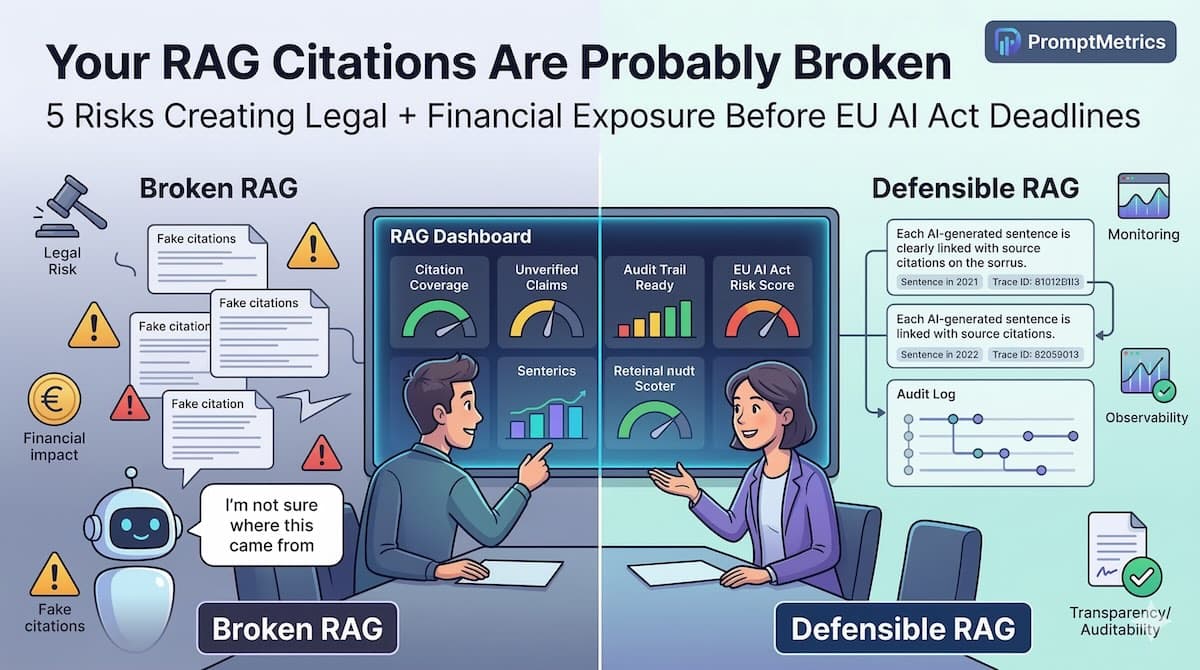
For agent systems specifically, Article 12 requires automatic, tamper-resistant logging that captures sufficient information to identify malfunctions, performance drift, and unexpected behavior. For multi-agent workflows chaining multiple LLM calls, tool invocations, and decisions, this requires a distributed tracing infrastructure that captures the complete decision path, not just the final output. Most teams do not have this.
What fixes it: Start with an AI system inventory: document every AI system you develop, procure, or deploy, including use cases and geographic reach. Determine applicable obligations against EU AI Act risk categories. Implement distributed tracing to cover the Articles 8-15 requirements: risk management, data governance, technical documentation, automatic logging, human oversight, and accuracy monitoring. PromptMetrics generates compliance-ready audit trails that map tothe requirements of Articles 12 and 5s. We handle the generation of technical evidence that would take weeks to compile manually.
What PromptMetrics doesn't solve: We are not lawyers. Our compliance reports provide technical evidence, but you still need legal counsel to confirm your specific obligations. The implementing standards are still being finalized. Tooling alone does not guarantee compliance. And if your agent operates in a regulatory sandbox (member states must establish these by August 2, 2026), we can't replace the sandbox evaluation process.
5. Only 11% of AI projects make it from pilot to production. Yours probably won't either.
This is the number that should frame every decision you make in the next 90 days. While 71% to 79% of organizations report utilizing AI agents in some capacity, a mere 11% have successfully transitioned these systems from localized pilot environments into full-scale, reliable production. That's an 89% failure rate from pilot to production.
The failures of 2025, where a staggering 95% of enterprise AI projects failed to deliver meaningful business value, were rarely caused by insufficient model intelligence or a lack of compute. They were fundamental architectural and operational failures. Projects died in pilot purgatory due to "dumb RAG" flooding context windows, brittle API connectors breaking under dynamic inputs, unpredictable cost scaling, and a severe lack of enterprise-grade governance.
Engineering leaders are waking up to a specific realization: "agent washing," rebranding standard automation or basic chatbots as autonomous agents, does not yield the ROI demanded by executive boards. The focus has shifted entirely from what foundational models can theoretically achieve in isolation to how agentic systems are engineered, governed, and observed at scale. PwC's 2026 predictions state it directly: there's little patience for exploratory AI investments. Each dollar spent should fuel measurable outcomes.
What fixes it: Treat the pilot-to-production transition as an infrastructure problem, not a model problem. The teams that make it through build three capabilities from day one: observability (understanding what every agent is doing and why), cost discipline (per-task cost attribution and routing optimization), and governance (automated audit trails and compliance documentation). PromptMetrics provides the observability and cost attribution layers that let you prove ROI at every budget review.
What PromptMetrics doesn't solve: If your use case doesn't have a clear ROI case, no amount of infrastructure saves it. The 40% cancellation rate isn't a tooling failure. It's a strategy failure. Before you build the agent, you need to answer: what specific business outcome does this automate, what measurable baseline is there, and what does success look like in 90 days? If those answers are vague, you're building a demo, not a product.
The honest takeaway
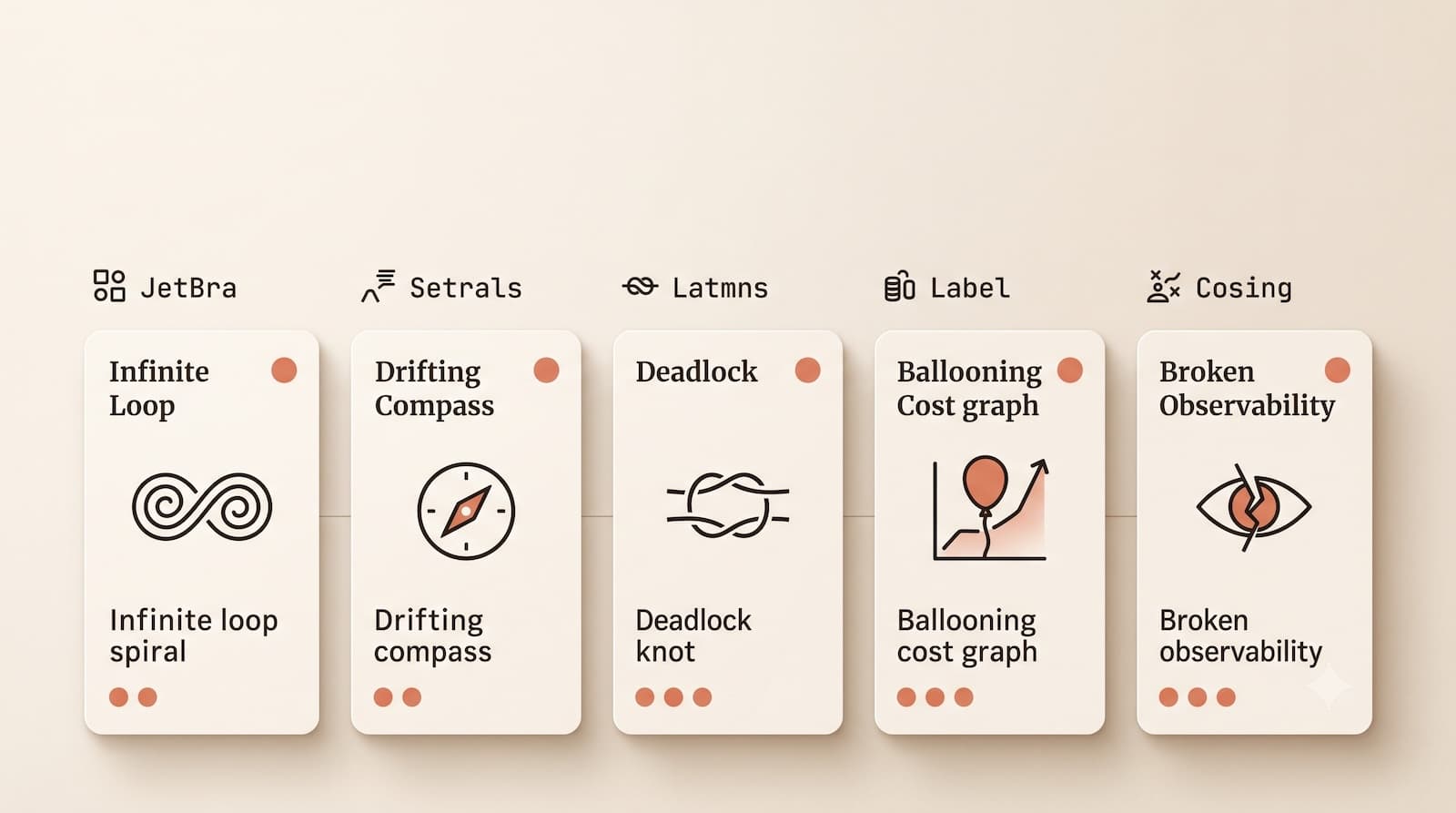
Production AI agents in 2026 are defined by five problems that have nothing to do with model capability: silent drift, compounding costs, integration fragility, regulatory deadlines, and the brutal pilot-to-production gap.
If you're a small team running a single agent with a limited scope, start with the fundamentals: prompts in version control, basic cost monitoring through your API dashboard, and manual evaluation before changes. You probably don't need paid tooling yet.
If you're scaling across multiple agents, models, and geographies, with compliance requirements breathing down your neck and a CFO watching the LLM line item, that's when observability tooling becomes the difference between a project that survives and one that gets cancelled.
Your next 90 days should look like this. Month one: inventory every AI system against EU AI Act risk categories, instrument every LLM call with cost and quality tracking, and set up distributed tracing. Month two: deploy prompt versioning, build drift detection baselines, and implement Article 12-compliant logging. Month three: implement model routing targeting 47-80% cost reduction, run a compliance audit dry-run, and publish internal cost-per-completed-task metrics for each agent.
The window between experimental AI and regulated, production-grade AI is closing. The question is not whether your models are smart enough. It's whether your infrastructure, your observability, your governance, and your cost controls are ready for what's already here.
Want to see where your team sits? PromptMetrics gives you cost attribution, prompt versioning, and compliance-ready logging. Start with the free tier and find out which of these five problems is costing you the most.
Sources
Over 40% of agentic AI projects will be scrapped by 2027, Gartner says - Reuters, 2025
Agentic AI systems don't fail suddenly — they drift over time - CIO Magazine, 2026
The Orchestrator's Era: The 2026 State of AI Agents in Product Management - Carnegie Mellon/MIT research, 2026
The 2025 AI Agent Report: Why AI Pilots Fail in Production and the Integration Roadmap - Composio, 2025
Token Explosion in AI Agents - r/LLMDevs field analysis, 2025
AI Agent Adoption 2026: What the Data Shows | Gartner, IDC - IDC forecasts, 2026
Why Your AI Pilot Budget Explodes at Production Scale - Forecasting the Real TCO in 2026 - Maiven, 2026
How Small Language Models Are Key to Scalable Agentic AI - Nvidia Developer Blog, 2024
LLM Cost Optimization in 2026: Routing, Caching, and Batching - MavikLabs, 2026
Timeline for the Implementation of the EU AI Act - EU AI Act Service Desk, 2026
European Commission misses deadline for AI Act guidance on high-risk systems - IAPP, 2026
EU AI Act regulation: a study of non-European Union manufacturers' compliance preparedness - Emerald/JMTM empirical study, 2025
EU AI Act 2026 Compliance Guide: Key Requirements Explained - SecurePrivacy, 2026
AI Agent Protocols 2026: Complete Guide - Ruh AI (MCP adoption metrics), 2026
7 Enterprise AI Agent Trends That Will Define 2026 - PwC/Beam AI, 2026
AI Agent Development Cost in 2026: Full Budget Guide - Neontri, 2026