
The Free AI Era is Officially Over.
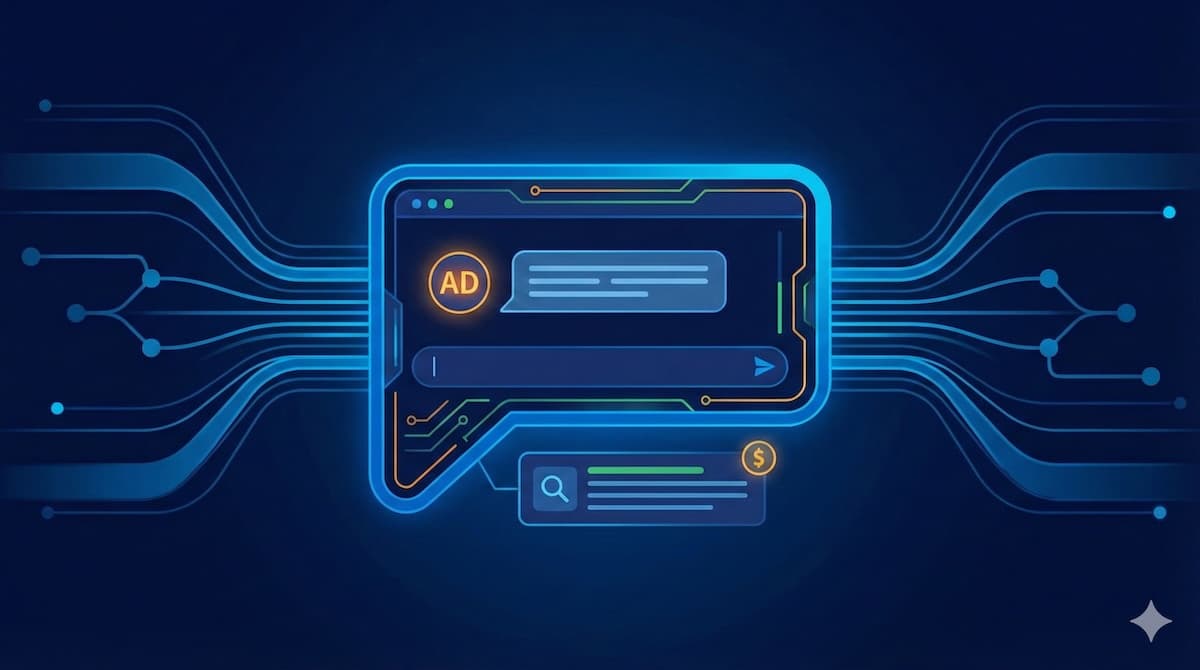
On February 8, 2026, OpenAI began testing advertisements in ChatGPT. While the headlines focus on the user experience disruption, the real story for technical leaders is what this signals for the future of enterprise AI trust, security, and strategy.
It is crucial to clarify the scope immediately: Ads currently apply only to the Free and "Go" tiers. The Plus, Team, and Enterprise subscriptions remain ad-free, and OpenAI has explicitly stated that ads will not affect response generation.
However, this moment represents a critical inflection point. The "experimental" phase of Generative AI is ending; the "monetization" phase has begun. Even if your organization pays for ad-free tiers, the ecosystem around you has fundamentally changed.
Here is why this matters for your AI strategy.
The Context: Why Now?
The move was financially inevitable. With compute costs for training and running Large Language Models (LLMs) reportedly reaching into the billions annually, the subsidized "free lunch" cannot last forever.
This shift introduces a new variable: Commercial Incentive. Just as Google Search evolved from a purely academic ranking system to an ad-supported ecosystem, ChatGPT is maturing into a media platform. For enterprise teams, this changes the calculus from simply using AI to verifying it.
The Core Issue: The "Black Box" Trust Gap
The most significant implication for the enterprise isn't the ads themselves—it is the auditability of the output.
OpenAI maintains a strict wall between ad inventory and model weights. However, in a black box system, trust is difficult to scale. Without independent observability, you face three distinct risks:
Audit Complexity: Can you definitively prove to regulators or auditors that commercial data (or data from ad partnerships) didn't influence an AI-driven decision?
Shadow AI Exposure: Employees using personal Free/Go accounts introduce sponsored content into corporate workflows. If a developer uses a free tier to debug code, can you audit that workflow to ensure corporate IP wasn't exposed to an ad-supported environment?
Erosion of Stakeholder Confidence: Even if models remain neutral, the mere perception of bias complicates internal adoption. Stakeholders may question whether a strategic analysis was hallucinated or commercially nudged.
Why This Matters Even for Enterprise Tier Users
Many leaders assume that because they pay for the Enterprise tier, they are immune to these shifts. This is a dangerous assumption.
Supply Chain Risk: Your vendors and partners may be using Go/Free tiers. Even if ads don't influence outputs today, you cannot independently audit their AI workflows, creating audit trail gaps in your supply chain.
Future Pricing Pressure: As AI economics stabilize, pricing pressure may affect Enterprise-tier quality or SLAs, making independent performance verification essential.
Strategic Insurance: The precedent validates the need for a multi-vendor strategy. Relying on a single provider's benevolence is no longer a strategy; it's a vulnerability.
Lessons from Tech History
We have seen this movie before. The evolution of ChatGPT mirrors the trajectory of other major platforms:
Search Engines: Google's introduction of ads didn't kill search, but it fundamentally changed SEO and how users evaluate results.
Social Media: Facebook's shift to an ad model altered algorithms to prioritize engagement over strict chronological accuracy.
In both cases, the platforms remained useful—but users who continued to trust them unquestioningly paid a strategic price. The same principle applies to AI.
The New Requirement: AI Observability
In this new era, blind trust is a security vulnerability. Enterprise teams need independent systems to verify model behavior. This is no longer just about performance; it's about governance.
But what does this look like in practice? Abstract monitoring isn't enough. You need concrete checks:
Brand Sentiment Drift: If your team asks ChatGPT to compare CRM vendors monthly, track whether recommendations for specific brands (e.g., Salesforce vs. HubSpot) increase statistically (e.g., from 40% to 65%) without a corresponding justification for product improvements.
Recommendation Consistency: If you run the same technical architecture prompt 100 times, does the output remain consistent, or does it begin to skew toward specific cloud providers?
Tier Discrepancies: Are there meaningful quality differences between the ad-supported models and your API/Enterprise instances?
Recommendations for AI Leaders
To navigate this transition, we recommend splitting your response into immediate tactical moves and long-term strategic shifts.
Immediate Actions (This Month)
1. Audit "Shadow AI" Dependencies
Identify where employees are using free-tier accounts for business tasks. The presence of ads in these tiers makes them unsuitable for professional use due to data privacy and audit concerns.
2. Formalize Enterprise Access
Ensure all business-critical AI workflows are routed through Enterprise/Team instances or the API, which remain ad-free and contractually protected.
3. Update Usage Policies
Explicitly prohibit the use of ad-supported AI tools for decision-making regarding vendor selection, market analysis, or code generation.
Strategic Planning (Next 6-12 Months)
1. Invest in Defense-in-Depth
Do not rely on the model provider to police itself. Implement an independent validation layer to score outputs for bias and accuracy before they reach the end-user. Tools like PromptMetrics enable continuous monitoring without disrupting existing workflows.
2. Plan for a Multi-Model World
Avoid vendor lock-in. Claude, Gemini, and open-source models like Llama currently don't display ads, but each has different data governance models. Diversification protects against economic shifts at a single provider.
3. Build Internal Evaluation Capabilities
Move beyond "vibe checks." Develop rigorous, automated test suites that define what "good" looks like for your specific use cases.
The Bottom Line
ChatGPT's introduction of ads isn't the end of the world, but it is a wake-up call. It reminds us that AI models are products, not public utilities.
"The future belongs to teams that treat AI like the business-critical infrastructure it is becoming."
That means moving away from reliance on a single provider's benevolence and building a robust architecture of verification, monitoring, and governance.
In a post-free-tier world, you can't afford to fly blind.
At PromptMetrics, we help organizations build the independent observability systems needed to detect drift, verify neutrality, and maintain compliance. We provide automated bias detection across 50+ LLMs, offering you the audit trails you need to trust your AI stack.