
On the day Salesforce and Anthropic announced Claudeforce, Jim Cramer asked Dario Amodei on CNBC whether Anthropic was about to kill SaaS. Dario's answer: "We're not interested in destroying anyone." Fine. The architecture behind the announcement is more interesting than the quote.
Three different things now get sold as "AI in your CRM." A connector. Embedded AI. And now an agent harness. They have different capabilities, different security profiles, and billing models so different you can't put them on one chart. If you run RevOps on Salesforce, HubSpot, or Pipedrive, someone will ask you which one to buy. Probably this quarter.
I've spent 12 years inside HubSpot as a partner, and we build orchestration layers on these exact connectors for clients. Here's the teardown.
The short version: Claudeforce isn't another CRM connector. In October 2025, Anthropic became the first LLM provider fully integrated inside Salesforce's VPC via Amazon Bedrock, and in August 2026 the partnership added a Salesforce plugin inside Claude with 37 prebuilt sales skills (Salesforce, 2026). Breeze sells countable outcomes at menu prices. Claudeforce meters tokens across two contracts. Different units of work, so don't compare the prices. Compare the use cases: countable single-system outcomes go to Breeze; cross-tool judgment work under business rules needs a harness.
The Quick Comparison
Category | Claudeforce | MCP connectors (HubSpot / Pipedrive) | HubSpot Breeze |
|---|---|---|---|
What it is | Claude embedded in Salesforce + Salesforce plugin in Claude | An open door from your AI assistant into the CRM | HubSpot's own AI, inside HubSpot only |
Best for | Cross-tool judgment work under business rules | Ad-hoc CRM Q&A and record updates you build on | Countable outcomes: tickets, lead research |
Model | Claude, named and swappable | Whatever assistant you connect | Undisclosed, no choice |
Guardrails | Business rules enforced (validation, approvals) | Your user permissions only | Vendor-controlled, closed |
Prebuilt workflows | 37 sales skills at launch | None. Blank slate | Fixed 3-agent catalog |
Data leaves the CRM vendor? | No. Runs inside Salesforce's VPC via Bedrock | Yes, to the AI vendor you connect | No, but it's a black box |
Pricing | Unannounced. Two contracts, tokens metered | Free (connector); you pay your AI plan | $0.50/resolution, $1/lead, $0.10/lookup |
Availability | Open beta September 2026 | GA, all accounts/plans | Live, agents need Pro/Enterprise hubs |
Sources for every row are in the source block at the bottom. Now the parts that don't fit in a table.
What Is Claudeforce, Actually?
Claudeforce is a two-way embedding, announced on August 26, 2026, with the Salesforce-in-Claude half entering open beta in September 2026 (Salesforce press release, 2026). Claude becomes the reasoning engine inside Agentforce and the default AI in Slack. And Salesforce ships as a plugin within Claude, carrying 37 prebuilt sales skills: meeting prep, deal-health review, and pipeline review, with dashboards generated live from your data.
Salesforce claims Slackbot drives "8.1M hours of annualized productivity gains" internally (Salesforce, 2026); ecosystem coverage adds an 83% internal adoption figure (Apex Hours, 2026). Vendor numbers. Treat them as marketing until someone outside Salesforce reproduces them.
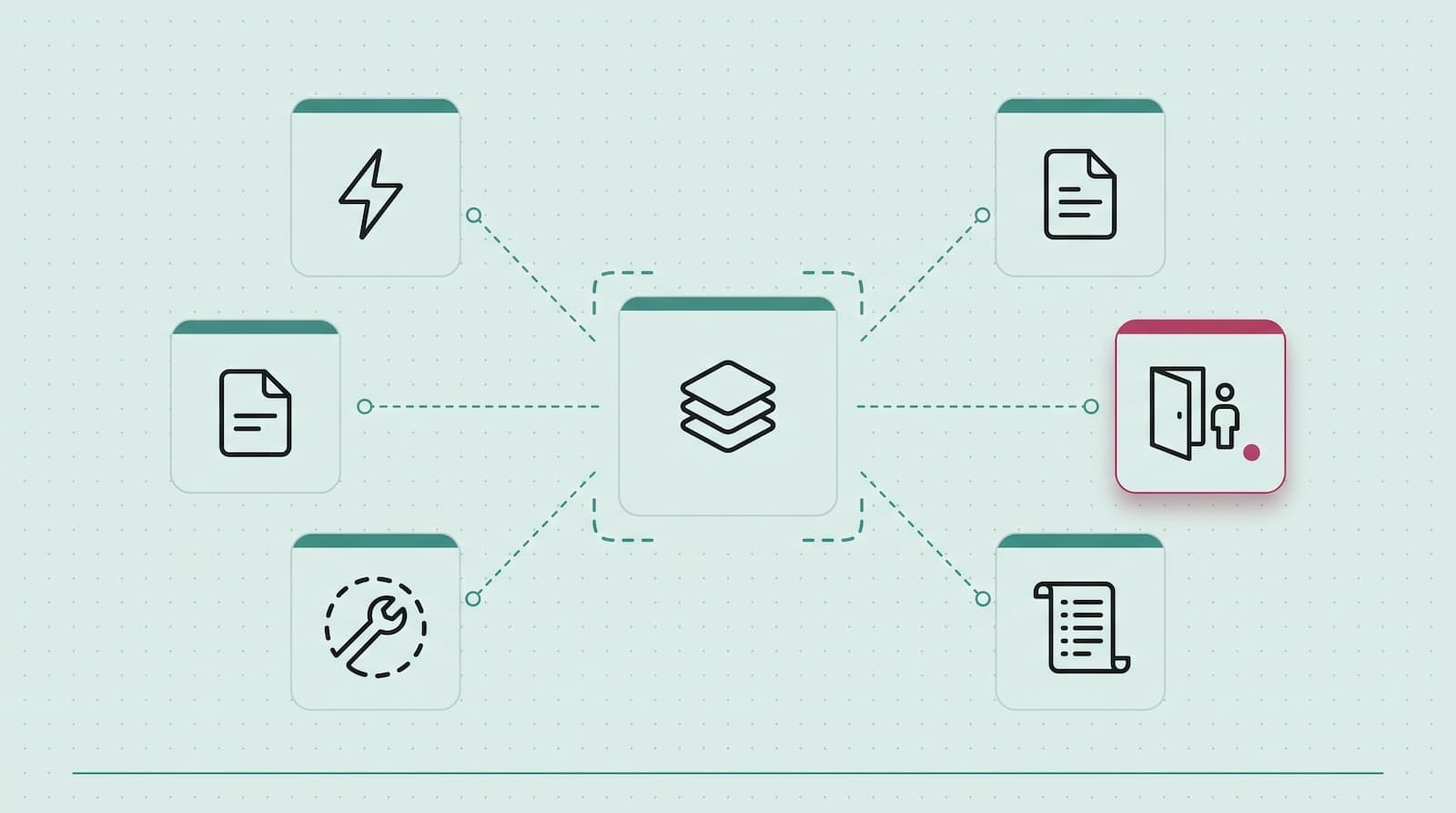
Here's the part almost nobody says out loud: under the hood, the Salesforce-in-Claude plugin runs on an MCP server. The Apex Hours teardown documents the toolset (discover, describe, dispatch), and BERI's consumption analysis confirms the plumbing: those MCP tool calls draw from the same Salesforce API allocation as any other integration (Apex Hours; BERI, 2026). The same class of pipe HubSpot and Pipedrive ship. So the pipe isn't the product. The product is the harness wrapped around the pipe: prebuilt skills, enforced business rules, a single org-level authentication, and hosting within a trust boundary. Keep that frame. It makes every comparison below simpler.
Dario said the quiet part on CNBC: Anthropic built this because it worked internally first. "This is the first time that we've really been able to incredibly accelerate our go-to-market efforts within Claude" (CNBC interview, August 2026). Coders got Claude Code. Sellers get this.
Read → The PoC is easy, the integration is the hard part
How Is Claudeforce Different From an MCP Connector?
An MCP connector is an open door with your name on it. In 2026, both major SMB CRMs shipped one: HubSpot's remote MCP server went generally available on April 13 for all accounts, and Pipedrive launched its native MCP server on June 30 across all plans (HubSpot changelog; Pipedrive, 2026). Your AI assistant walks through the door, reads and writes records, logs notes, and converts leads. Everything it does runs under your own user permissions: it can see and change exactly what you can, nothing more.
All three approaches handle that baseline equally well. The differences start above it.
Claudeforce adds four things a bare connector doesn't have.
Business rules: every action passes through Salesforce's validation and approval workflows, not just your permissions.
Ready-made workflows: 37 sales skills that work on day one.
Simpler setup: one admin connects the whole org, and each seller automatically gets access matching their own permissions.
Cross-tool context: a single skill run combines CRM records, activity history, and Slack threads into one answer.
The bare connectors also have hard limits, and you'll hit them fast. Take HubSpot's, per its own 2026 documentation. The assistant can read your custom objects but can't write to them: creating and updating only works for contacts, companies, deals, tickets, line items, and products. It can't delete anything. And if your account has sensitive data turned on, it loses access to all activity objects (calls, emails, meetings, notes, tasks) and conversation data (HubSpot MCP docs, 2026). To be fair: no delete is a safety feature. The short write list isn't. That one's a gap.
We run both connectors inside client orchestration layers. The pattern repeats: the demo works in an afternoon, then the build stalls exactly where the connector ends. One client tracks licenses as a custom object. Their assistant can report on licenses, but it can't create or update a single record: custom objects sit outside the connector's write list.
Read → What one governed skill looks like in practice
How Is Claudeforce Different From HubSpot Breeze?
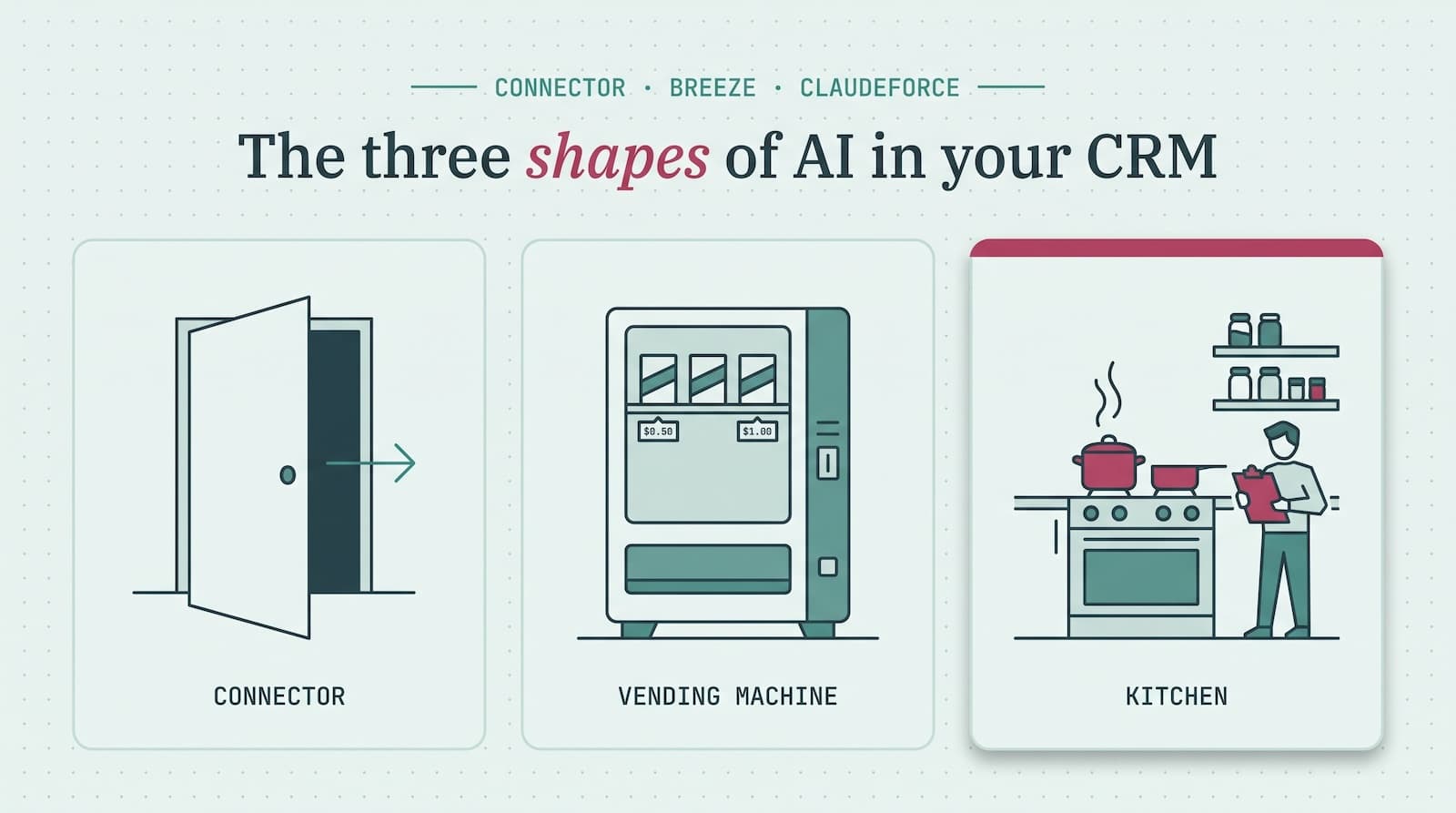
Breeze is the closer comparison, because Breeze and Claudeforce are AI embedded inside the CRM, sold by the CRM vendor. The difference is a vending machine versus a kitchen.
Breeze gives you a fixed menu. Three agents (Customer, Prospecting, Data), a free assistant on every tier, and no say in what runs underneath. As of 2026, HubSpot's own Breeze documentation doesn't name the model powering it, and there's no setting to switch it (see HubSpot's Breeze pages; independent guides note the same gap, e.g. SwyftRev, 2026). The agents require Professional or Enterprise hubs. What's on the menu works. What's not on the menu doesn't exist at any price.
Claudeforce is a kitchen. You know which model does the thinking (Claude, by name), you can swap it for a different model inside Agentforce, and you can build agents around your own sales process instead of picking from a fixed list. It also works in both directions: Claude runs inside Salesforce, and Salesforce runs as a plugin inside Claude.
Breeze has no answer to that second part. There's no "HubSpot inside Claude" product. If you want HubSpot data inside your AI assistant, you're back to the bare MCP connector.
So which is better? Neither, on its own. If the thing you need is on Breeze's menu, the menu is faster and cheaper. If it isn't, no amount of money adds a new dish. Only the kitchen cooks to order. The use-case section below settles which situation you're in.
What Does the Trust Boundary Mean for Data Security and EU Compliance?
In October 2025, Salesforce announced that Anthropic is the first LLM provider fully integrated inside the Salesforce Trust Boundary: Claude runs through Amazon Bedrock within Salesforce's virtual private cloud, and Claude traffic stays inside the Salesforce environment (Salesforce, 2025). In plain terms: the CRM data your agents reason over doesn't leave the perimeter your security team already approved.
That's the structural difference from every connector setup. With HubSpot or Pipedrive MCP, your CRM data travels to whichever AI vendor you connected. Fine for most SMBs. A dealbreaker for a bank. Which is why the named early adopters are who they are: RBC Wealth Management runs Claude-powered meeting prep inside Agentforce, and CrowdStrike is live on it (Salesforce, October 2025).
For EU operators, the Bedrock piece matters beyond Salesforce. As of 2026, Claude models run in-region on Bedrock in Stockholm, Ireland, and London, and Bedrock offers an EU-geography inference profile that routes across eight EU regions while keeping prompts inside EU infrastructure. AWS processes the data and does not share it with Anthropic (Cloud2, 2026).
Now the honest part, because this is where vendors oversell. The trust boundary answers where the model runs. It does not make you GDPR compliant. You still own the lawful basis, the DPAs, and data minimization. And "EU geo" means your prompts move between EU data centers, not that they sit in one. Architecture answers the location question. Compliance is still your job.
Read → Governance is the new RevOps job
Two Budget Shapes: Priced Outcomes vs. Metered Ingredients
These two bills price different units of work. A $0.10 Breeze Data Agent answer is a shallow, single-tool response. A Claudeforce skill run assembles CRM records, activity history, and Slack context into one governed workflow. Comparing the totals is apples to oranges, and we won't pretend there's a calculation. What you can compare is the shape of each budget.
The Breeze bill: quotable in advance
Since April 14, 2026, HubSpot bills outcomes first-party: $0.50 per conversation the Customer Agent resolves without human help, $1 per recommended lead, from a credit pool at $10 per 1,000 credits (HubSpot, 2026; HubSpot Credits). Data Agent answers and research lookups run about $0.10 each, and plans include roughly 500 to 5,000 monthly credits by tier (Resolve247, 2026).
One gotcha: past your allowance, pay-as-you-go billing charges each extra credit at $0.01 automatically (HubSpot Credits, 2026). Nothing stops at the cap. Check your overage settings before your first busy month.
The Claudeforce bill: two meters, no price list
Salesforce said in August 2026 that pricing is unannounced; industry analysis put it plainly: "you can't buy this on one piece of paper" (BERI, 2026). Two meters run instead. Salesforce throttles: skill calls draw from your org's shared daily API allowance. Anthropic bills: an Enterprise contract with a 20-seat minimum, plus tokens at API rates, uncapped.
Our finding: We modeled a 15-seller team running 4 skill invocations per day (using BERI's published per-run token profile and Anthropic's official September 2026 price list). Annual cost: roughly $9,800 with Sonnet routing and 80% cache hits, up to roughly $37,300 with Opus routing and no caching. Same team. Same usage. A ~4x spread, decided entirely by model routing and prompt caching. We haven't found published numbers at this scale; the only public model we know of covers 200 sellers ($101K to $649K a year).

Notice what kind of levers those are. Cache-hit rates and model routing are engineering decisions. Until now, no RevOps budget owner has had to care about them. On Claudeforce, they're the difference between a tolerable line item and a nasty surprise.
The Breeze budget, for contrast, in one picture:

One more difference matters here. Breeze's predictable bill comes with a ceiling on capability, not just on cost: no amount of extra credits makes it do the deeper work, like pulling CRM and Slack together under your business rules. Claudeforce's open-ended bill is the price of exactly that deeper work. You're not paying more for the same thing. You're paying for a bigger unit of work.
Are Permissions Enough of a Guardrail?
The connectors enforce one thing: your existing user permissions. Both HubSpot and Pipedrive scope every MCP action to what the connected user can already see and edit, and both log the changes (Pipedrive, 2026). Sounds fine. It isn't, at scale. An assistant writing as you can write garbage exactly as fast as you can, and much faster than you would.
Claudeforce routes actions through Salesforce itself, which, in Salesforce's own words, helps "ensure business rules are always enforced when an action is taken" (Salesforce, 2026). Validation rules, approval workflows, required fields. The agent can't skip a deal stage or set a discount your admin's rules forbid, even when the human asking technically could.
Breeze sits in between: guardrails exist, but they're HubSpot's, closed and non-negotiable. And every embedded-AI product shares one failure mode that no guardrail fixes. AI on top of a dirty CRM produces confident wrong answers. With outcome pricing, you pay $1 for each lead recommended off your stale, duplicated records. A billable mistake, per mistake.
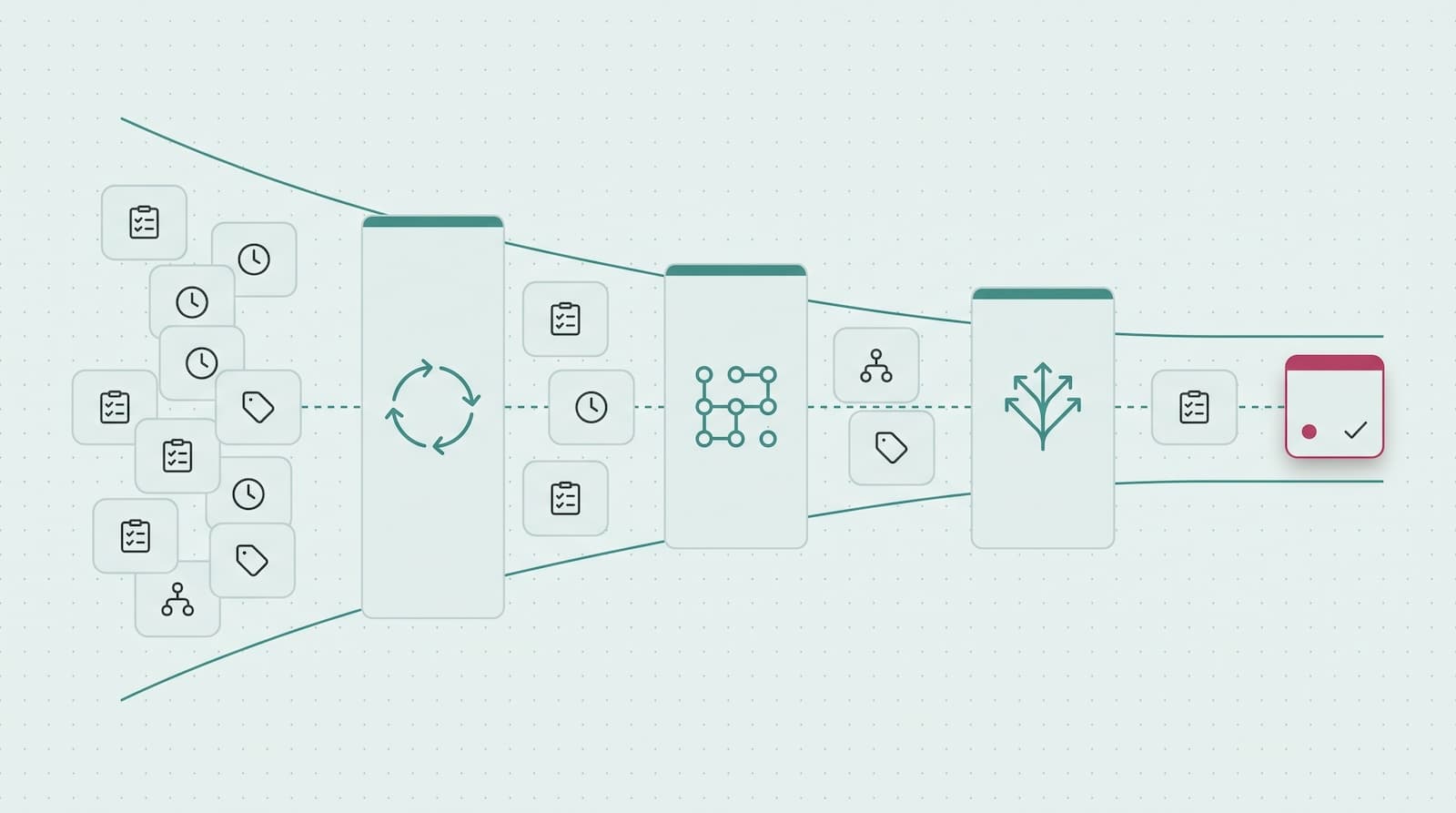
This is why we insist clients run hygiene before any agent goes live. The gate belongs inside the tool: draft first, human approves, then it writes. Every implementation we ship works that way, whatever the platform.
Read → Evals as unit tests for your company brain
Which One Fits Which Use Case?
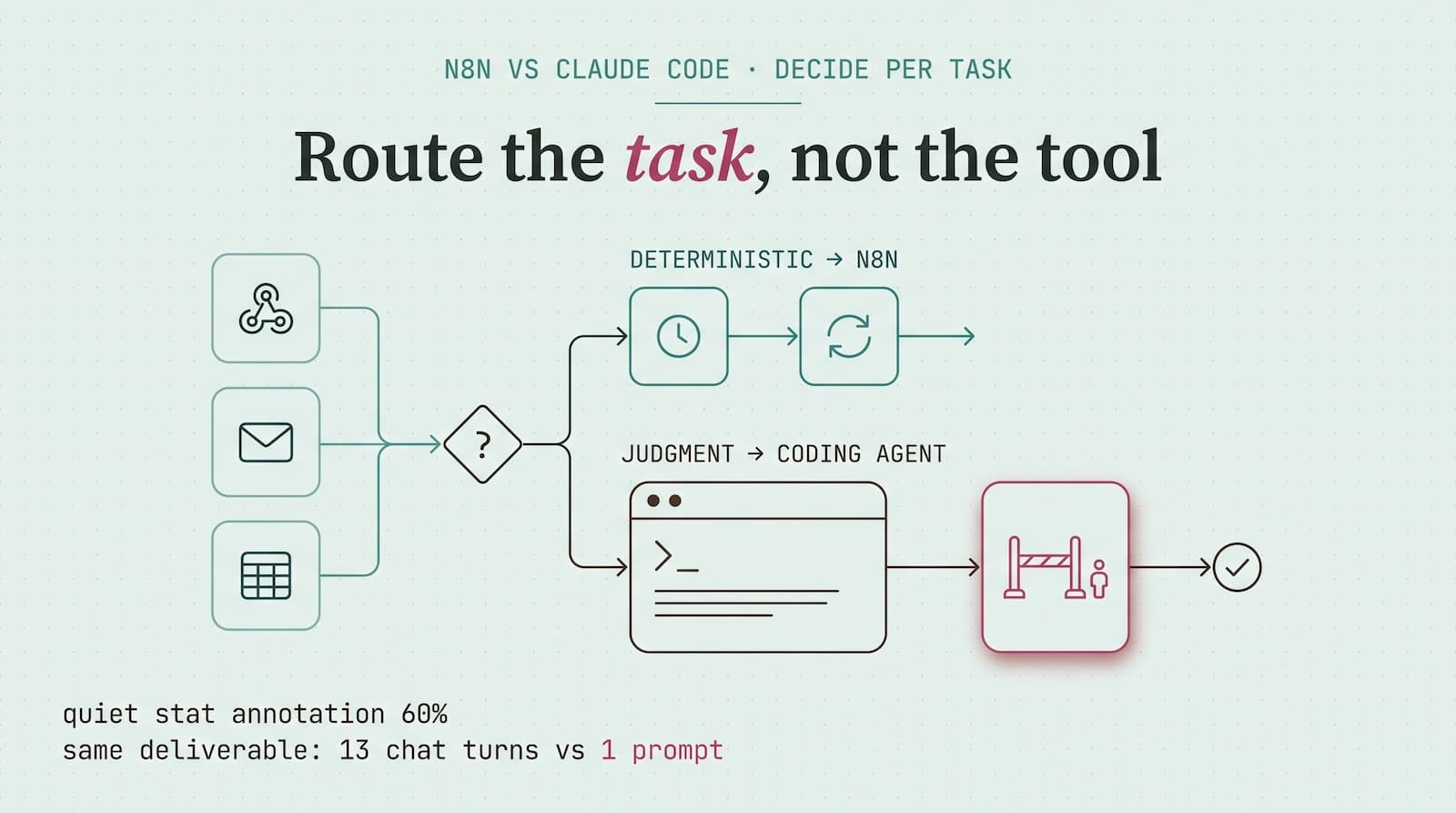
Pick by unit of work, not by price. If you can count the outcome before you buy, Breeze does the job at a quoted price. If the outcome is judgment work assembled from several systems under business rules, only a harness does it. Shipped as Claudeforce on Salesforce. Built on MCP everywhere else.

Breeze wins these: tier-1 support deflection is its strongest case, FAQ-grade tickets resolved at $0.50 each with no human handoff. Lead research at $0.10 a lookup. Prospecting recommendations at $1. The fit: a HubSpot shop on standard objects, no engineering capacity, one predictable line item on the existing bill, live this week (both flagship agents carry 28-day trials).
Breeze's hard stops: custom objects and unstructured data. Any workflow touching a second system. Any process not on the three-agent menu. Any requirement to know or choose the model.
Claudeforce wins these: meeting prep that assembles the account, the activity history, and the Slack threads into a generated dashboard. Deal-health and pipeline reviews. Custom agents on your own process in Agentforce. And its clearest unique case, regulated work: RBC Wealth Management's meeting prep runs inside the trust boundary, data never leaving the approved perimeter (Salesforce, October 2025). The fit: a Salesforce shop with someone who'll own routing and caching decisions, and procurement that tolerates two contracts and an unquoted meter.
Claudeforce's hard stops: it's Salesforce-only. The Salesforce-in-Claude half is still in beta as of September 2026. And there's no advance quote.
Everyone else: you run HubSpot or Pipedrive and want the same kind of workflows. Nobody ships the harness for you. You build it. The MCP connector is the pipe, and on top of it goes the layer Claudeforce bundles for Salesforce shops: the business rules, the skills, and the human review gates. All of that is buildable today. It's the work we do.
The timing case for starting now comes from Dario himself. Coders adopted agents first, and he expects sales and go-to-market to follow: "I think we're going to see a similar spike in other areas" (Dreamforce, Salesforce Events). His evidence that the curve moves fast: in 18 months, Claude went from succeeding at roughly 5% of real GitHub pull requests to roughly 77%. When that curve reaches sales workflows, the teams with a harness already in place are the ones who collect.
Read → One god agent vs. a team of scoped agents
Frequently Asked Questions
Is Claudeforce just an MCP connector?
Underneath, yes: the Apex Hours teardown documents an MCP server (discover, describe, dispatch tools). But the product is the harness around it. In 2026 that means 37 prebuilt skills, enforced business rules, one org-level authentication, and hosting inside Salesforce's trust boundary. The pipe is commodity. The harness isn't.
How much does Claudeforce cost?
There's no published price as of September 2026. You pay two meters: your existing Salesforce licenses (skill calls draw on the org's daily API allowance) plus a separate Anthropic Enterprise contract, 20-seat minimum, with tokens billed at API rates and no cap (BERI, 2026). Our 15-seat model lands between ~$9,800 and ~$37,300 a year.
How is HubSpot Breeze priced?
Since April 14, 2026: $0.50 per resolved conversation and $1 per recommended lead, billed only when the task completes, from a credit pool at $10 per 1,000 credits (HubSpot, 2026). Data Agent answers and lookups run about $0.10 (Resolve247, 2026). The agents require Professional or Enterprise hubs, with 28-day trials.
Does CRM data leave your environment with Claudeforce?
No. Since October 2025, Claude runs through Amazon Bedrock inside Salesforce's VPC, and Claude traffic stays within the Salesforce trust boundary (Salesforce, 2025). With plain MCP connectors, the opposite: your CRM data travels to whichever AI vendor you connected to.
Is Claudeforce GDPR compliant out of the box?
No architecture makes you compliant by itself. The hosting answers the location question: as of 2026, Bedrock runs Claude in-region in Stockholm, Ireland, and London, plus an EU-geography profile across eight EU regions (Cloud2, 2026). Lawful basis, DPAs, and data minimization stay your job.
The Verdict
Question | Answer |
|---|---|
Countable, single-system outcomes on HubSpot | Breeze |
Ad-hoc CRM Q&A you'll build on | MCP connector |
Cross-tool judgment work under rules, on Salesforce | Claudeforce |
Same work, on HubSpot or Pipedrive | Build the harness on MCP |
Regulated data that can't leave the perimeter | Claudeforce (today) |
A connector is a door. Breeze is a vending machine. Claudeforce is a kitchen with a compliance officer standing in it. None of them is "the winner"; they're different units of work at different prices, and the expensive mistake is buying one shape when your problem has the other shape.
As of September 2026, the three options split cleanly: HubSpot Breeze bills fixed outcomes ($0.50 per resolved conversation), MCP connectors ship free on all HubSpot and Pipedrive plans with permissions-only guardrails, and Claudeforce runs Claude inside Salesforce's trust boundary with no published price. The deciding factor is the unit of work, not the bill.
One point outlasts this news cycle. The model isn't the new integration layer. The harness is: the skills, the business rules, and the human review gates wrapped around the model. Salesforce just showed everyone what that looks like at enterprise scale. On HubSpot or Pipedrive, nobody ships it for you.
That's the work we do, one governed skill at a time, review gates included. Start with What one governed skill looks like. Or bring your stack to the Operator Stack community, and we'll pressure-test your first use case together.