
It usually starts with a Slack message: "Why did our AI bill triple last month?" This post answers that question directly: whether fine-tuning, RAG, or the governance layer around both is your real cost driver, and how to tell which one before you spend on any of them.
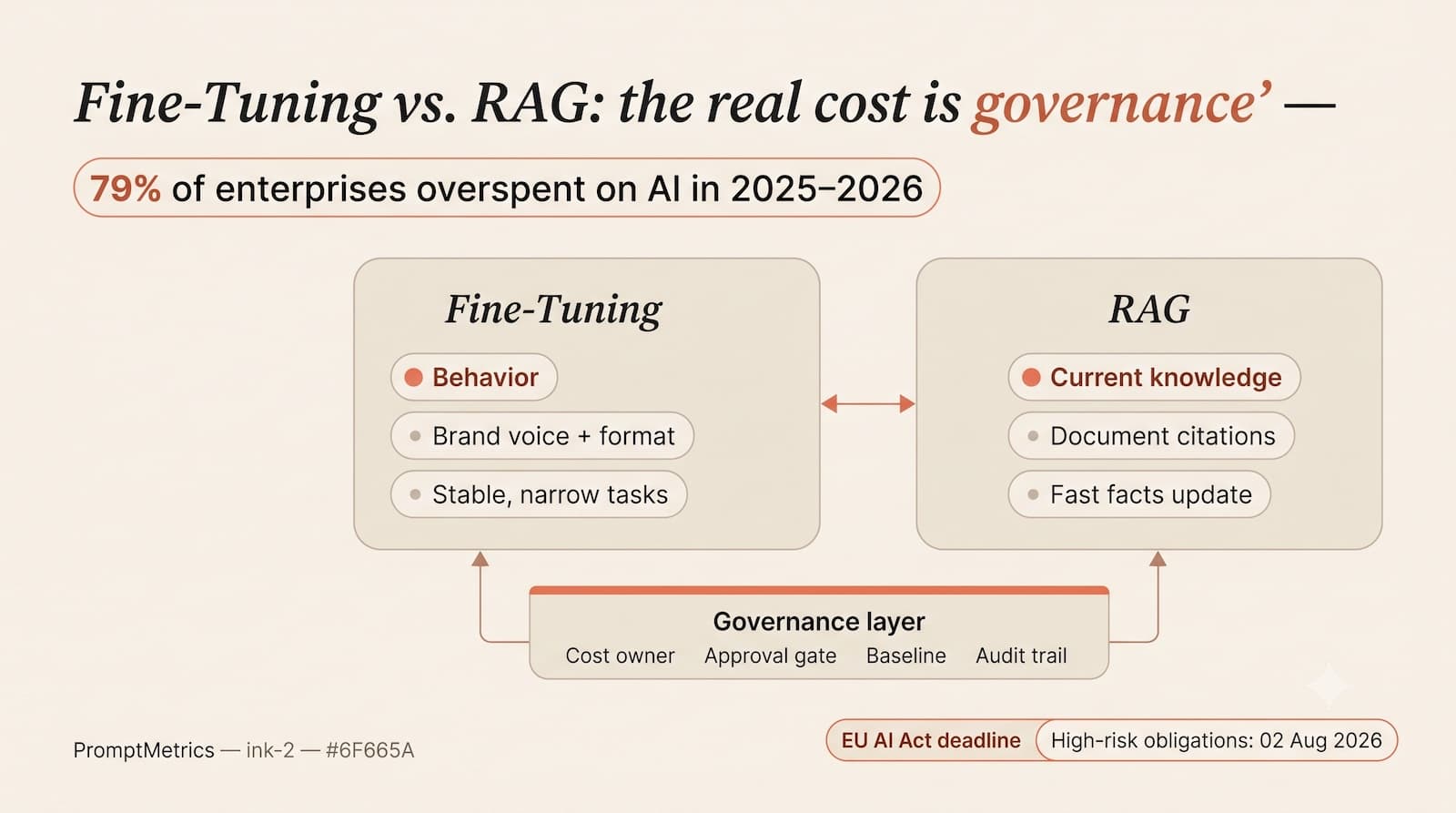
If you're the person who got that message, you're not alone, and you're probably not the problem. 79% of enterprises experienced AI cost overruns in the past 12 months, according to a February 2026 survey of 500 finance leaders by Sapio Research, commissioned by DoiT (DoiT, "Why 79% of Enterprises Overspent on AI in 2026", accessed Jul 24, 2026). The counterintuitive part: the organizations with the most mature cost-tracking practices reported the highest overruns, at 89%, because they're the only ones instrumented well enough to catch it.
We've watched this pattern before it was called agentic AI. Before PromptMetrics existed, we built and open-sourced an LLM observability tool for exactly this problem: teams that could see their model was working but couldn't see where the money was going. What we learned then still holds. The cost overrun is rarely the model. It's the missing governance layer around it.
Key Takeaways
Fine-tuning buys consistent behavior; RAG buys current knowledge. Picking one instead of matching each to its job is what causes cost surprises.
79% of enterprises overspent on AI in the past year, worst among the best-instrumented teams, because they're the only ones who could see it (DoiT/Sapio, 2026).
EU AI Act high-risk fines reach €15M or 3% of global turnover; auditability is a design decision, not a bolt-on.
Why do AI bills blow up in growing companies?
The pattern in the DoiT/Sapio data is structural, not technical: accountability for AI spend splits almost evenly between technology (55%) and finance (53%) leadership, with no single owner in most organizations, and only 15% of finance leaders can calculate AI ROI without significant bottlenecks (DoiT, 2026). Nobody's job is to notice the bill until it's already a board question.
Agentic workflows make this worse, not better. Gartner forecasts that over 40% of agentic AI projects will be canceled by the end of 2027, "due to escalating costs, unclear business value or inadequate risk controls" (Gartner, "Gartner Predicts Over 40% of Agentic AI Projects Will Be Canceled by End of 2027", Jun 2025, accessed Jul 24, 2026). The models aren't failing. The business management around them is: no cost owner, no approval gate, no baseline measurement before the rollout started.
Part of that business-management failure is vendor-driven. Gartner also estimates that only about 130 of the thousands of agentic AI vendors on the market today build systems with real agentic capability, the rest are existing chatbots and RPA tools rebranded to ride the hype, a practice Gartner calls "agent washing" (same source). Buying the rebrand instead of the capability is its own line item in next quarter's overrun.
This is the moment we build for. Not "should we fine-tune or use RAG" in the abstract, but: your team is already running AI-powered workflows, the bill just moved, and you need to know exactly why before you can defend the budget or fix the leak.
What do fine-tuning and RAG actually buy you?
Before pricing anything, it's worth being precise about what you're buying, because the two are frequently pitted against each other when they solve different problems.
Fine-tuning takes a pre-trained model and trains it further on your data, changing its weights so it internalizes your terminology, tone, and formats. You're buying behavior: a model that already sounds like you and outputs in the shape you need, every time.
RAG (Retrieval-Augmented Generation) keeps the model generic and gives it access to your data through a retrieval layer, typically a vector database. You're buying knowledge that stays current: the model reasons over documents it's handed at query time instead of trying to remember everything.
Neither is "the AI." Both are components you'd choose, combine, or skip depending on what the workflow actually needs, which is a decision we make with clients in the first working session, not something we sell as a package.
What are we actually optimizing for?
We evaluate the fine-tuning vs. RAG trade-off against three things, because these are the three things that turn into board questions:
Capital efficiency. Not just inference cost, but the ongoing labor of keeping data and evaluations current, what we've started calling the CFO Test: can you show clear unit economics, predictable spend, and an explainable driver for every dollar.
Determinism and auditability. Can you show why the system gave that specific answer? This is the EU AI Act question, not a nice-to-have.
Change tolerance. What happens the week your knowledge base changes, your pricing changes, or your policy changes? Some architectures absorb that in minutes. Others need a retraining cycle.
Fine-tuning: strong for behavior, expensive for facts
Fine-tuning earns its keep on relatively stable, well-defined tasks: enforcing brand voice, strict output formats like JSON or SQL, and narrow tasks where a small tuned model can outperform a much larger general-purpose one, provided you're running it efficiently.
It struggles the moment the underlying facts move. If you fine-tune a model on this quarter's pricing or last year's HR policy, the model doesn't know it's wrong. It just keeps confidently giving you last year's answer, and there's no clean way to trace that answer back to a source document, because it's baked into the weights, not stored as a citable fact. Naively retraining to fix it risks catastrophic forgetting: degrading behavior the model already had right.
Use it for: brand voice, formatting, narrow and stable tasks. Don't rely on it for: anything that changes on a schedule shorter than your retraining cycle.
RAG: strong for facts, adds moving parts
RAG shifts most of your spend to usage, tokens and retrieval, rather than training runs. Updating the knowledge base is a database write, not a training job, which is why it tends to win when your underlying facts move faster than a retraining cycle. It's also the architecture that gives you something to point to when someone asks "why did the model say that": a retrieved document, with a citation, that you can show an auditor.
The trade-off is real: you're feeding documents into every prompt, which adds token cost that compounds on long conversations, and you're now maintaining a vector database and retrieval logic as permanent infrastructure, not a one-time build.
Use it for: enterprise search, support bots, policy assistants, anything where the facts change and you need to prove where an answer came from. Lower priority for: open-ended creative work where external grounding doesn't add much.
Head-to-head: fine-tuning vs. RAG
Fine-tuning wins on tone and format consistency but needs a retraining cycle, days to weeks, to absorb a knowledge change. RAG updates in minutes via a database write and produces the document-level citations an audit needs, at the cost of higher ongoing token and retrieval spend. Here's the full comparison:
Dimension | Fine-Tuning | RAG |
|---|---|---|
Knowledge freshness | Retraining cycle (days–weeks) | Database update (minutes) |
Auditability | Weights are opaque; relies on logging | Document-level citations, when designed for it |
Tone & format consistency | Strong | Depends on prompting discipline |
Ongoing cost driver | Retraining + evaluation | Tokens + retrieval infra |
Best fit | Stable behavior, brand voice | Changing facts, compliance trail |
Neither column wins outright. Very high, stable-volume workloads can favor fine-tuning on unit economics alone. Everything else, which is most real teams, favors RAG or a hybrid.
Should you choose fine-tuning or RAG, or combine them?
The teams getting this right aren't picking a side. They're treating fine-tuning as the layer for behavior and RAG as the layer for facts, and running both:
RAG holds the truth. Policies, product specs, customer data live in a retrieval layer, kept current with a database write, not a training run.
A small fine-tuned model holds the style. An 8-14B open-weight model (or a provider's fine-tunable mini tier) tuned only on voice and formatting, cheap to run, cheap to retrain.
They're wired together, not bolted on: RAG retrieves, passes a compact structured context to the tuned model, and the output comes back with both consistent voice and a traceable source.
This is also where the human-in-the-loop question gets answered concretely: every retrieval and every generation step is a place to put a review gate, not a place to hope the model got it right. Nothing here has to be a black box, and any developer inheriting the system should be able to read what it does.
Does RAG alone satisfy EU AI Act requirements?
Not automatically. RAG gives you the raw material for compliance: citable sources and a data layer instead of opaque weights. But the EU AI Act's high-risk system obligations (enforceable from August 2, 2026, with fines up to €15 million or 3% of global annual turnover under Article 99) require logging, human oversight, and documented conformity, not just a retrievable source (Holland & Knight, "U.S. Companies Face EU AI Act's Possible August 2026 Compliance Deadline", Apr 2026, accessed Jul 24, 2026). Worth noting: a European Parliament vote to delay parts of this timeline was pending as of that article, so treat the date as "plan for it," not "wait and see."
A RAG pipeline with good logging and an approval gate gets you most of the way there. RAG with no governance layer on top gets you a citable hallucination, which is not the same thing as compliance. See how we structure that governance layer on our EU AI Act page and our security and data-flow overview.
How does PromptMetrics build this with clients?
We don't sell "fine-tuning or RAG" as a product. We work in one of three modes, named clearly in the first conversation, which is free:
Build for you: we implement the governed pipeline. Connectors, retrieval, a fine-tuned style layer where it earns its cost, human review gates, documented so any developer can maintain it.
Build with you: we build the first workflow alongside your team and leave you able to build the next one without us.
Figure out what to build: when the mandate is clear but the architecture isn't, we hand you a plan you can execute or hand to a developer, not a slide deck you can't action.
See the full service ladder for how these three modes work end to end.
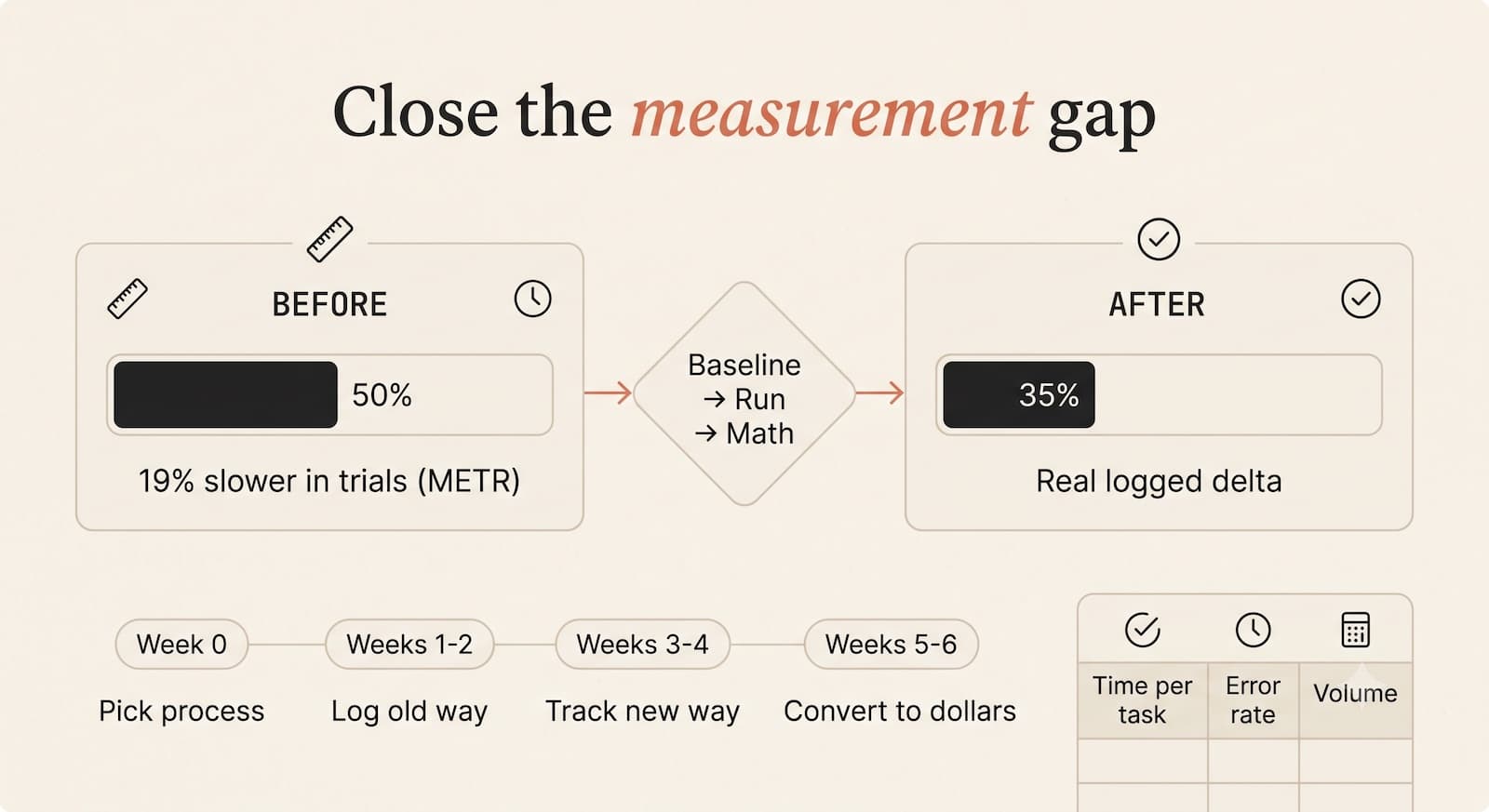
We measure the baseline before we touch anything. That's not a compliance step, it's how you find out whether fine-tuning, RAG, or neither is actually your cost problem before you spend on either one.
If your AI bill moved and you can't fully explain why, book a free call and we'll help you find the driver before you commit to an architecture.
FAQ
Is RAG always cheaper than fine-tuning?
Not always, but usually for workloads where facts change faster than a retraining cycle. RAG shifts cost to ongoing tokens and retrieval infrastructure instead of training runs, which tends to win below very high, stable query volumes.
Can I use both fine-tuning and RAG together?
Yes, and for most enterprise workloads it's the stronger design: a fine-tuned small model for voice and format, fed structured context from a RAG layer for facts, so you get consistent tone and traceable answers together.
Does fine-tuning make a model more auditable?
No. Fine-tuning changes model weights, which are not inspectable, so you can't natively trace a specific output back to a source document. RAG's retrieved-document trail is what supports an audit request; fine-tuning's consistency does not substitute for it.
What actually causes AI cost overruns, if not the model choice?
Governance gaps, most often. DoiT/Sapio's 2026 survey found split accountability between technology and finance teams and no consistent cost baseline, which is a structural problem no architecture choice fixes on its own.