
Your legal team handed you a 40-page GDPR policy. Your DPO signed off. Your privacy page looks great. And none of it matters, because your LLM just echoed a customer's home address back to the wrong user.
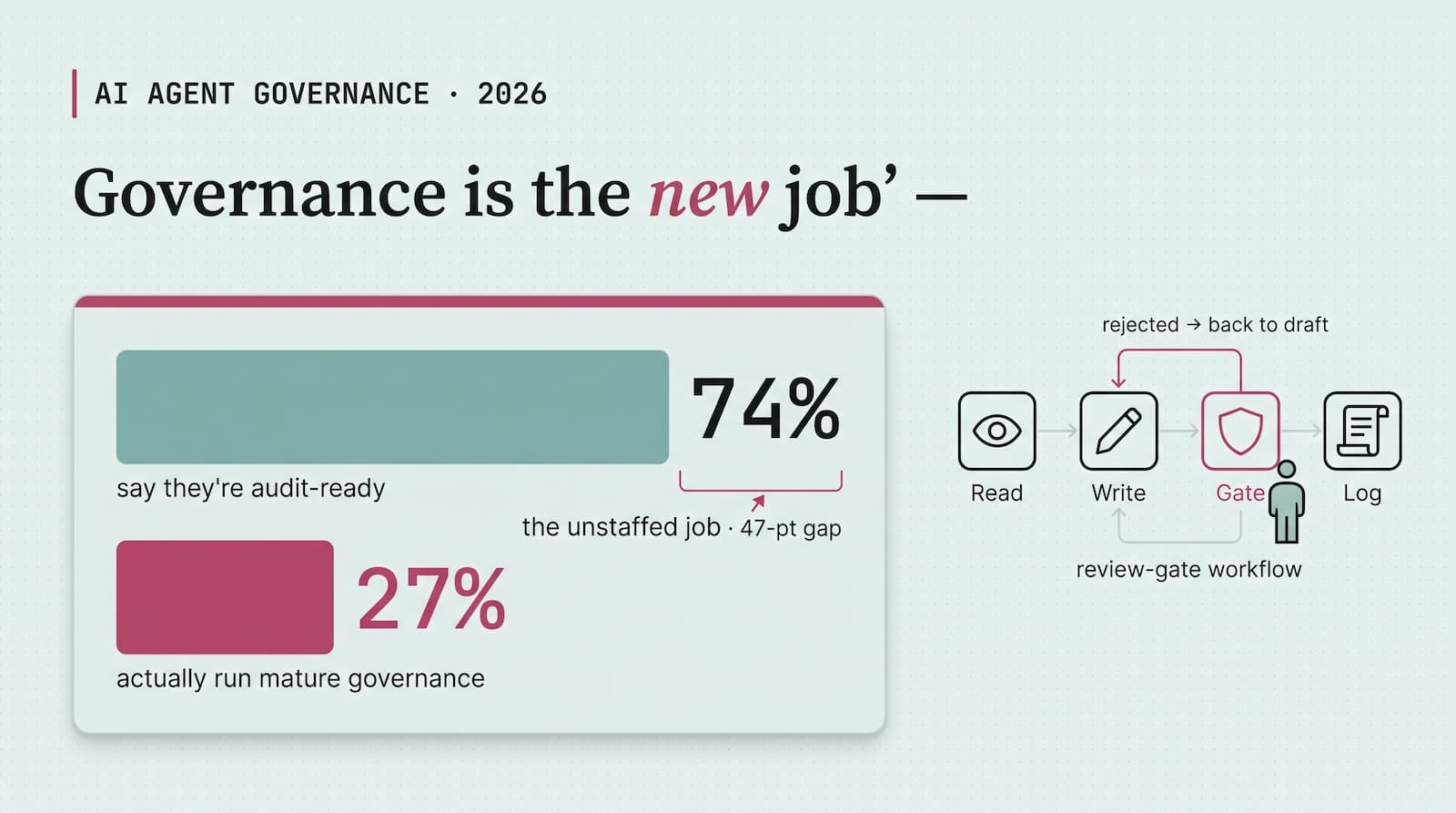
Here's the uncomfortable truth: 88% of organizations now use AI in at least one business function, but only 8% maintain a comprehensive AI governance framework (Aon AI Risk 2026; Economist Impact / Kyocera Future of Work Study, 2025-2026). Fewer than half of organizations monitor their production AI systems for accuracy, drift, or misuse at all, and that drops to just 9% among small companies (Pacific AI / Gradient Flow 2025 AI Governance Survey, 351 respondents, retrieved July 2026).
That's not a policy gap. That's an engineering gap.
Key takeaways
GDPR fines have hit EUR 6.11 billion across 2,685 recorded cases as of March 2026 (CMS GDPR Enforcement Tracker Report), and enforcement against AI systems specifically is already underway.
Single-layer PII detection (just regex, or just NER) misses the messy, multilingual cases that actually leak data. You need both, plus allow-lists, running as middleware.
You can't delete data out of model weights. If you've fine-tuned on user data, separate reasoning from knowledge with RAG so deletion is a database operation, not a research problem.
Vector embeddings are not anonymous. Filter by permission before you search, not after.
Compliance is a monitored signal, not a one-time setup. Precision that looked fine at launch can quietly decay for months before anyone notices.
What this post is (and isn't)
In this post, I'm not going to rehash legal checklists. I'm going to show you the five biggest engineering failures I see in "GDPR-compliant" LLM or agentic AI systems, and the architectures that actually fix them. If you're the one who got the AI mandate but you're not the one writing the code, the "How to Fix It" section under each problem is exactly what to hand your engineer or ask them about directly.
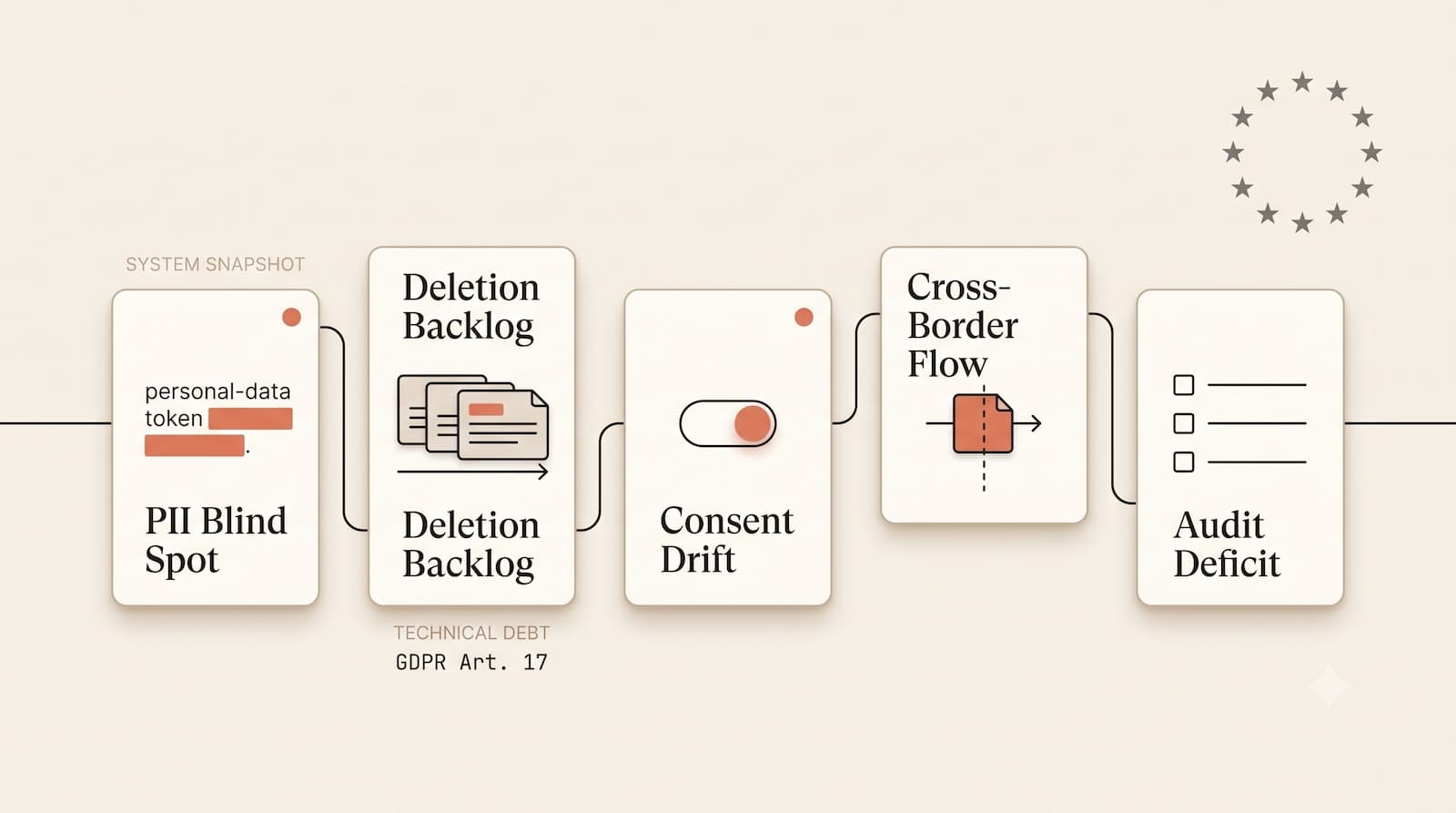
1. Your PII Detection Has Blind Spots You Don't Know About
The Short Version: Single-layer regex or NER approaches cannot keep up with messy, multilingual production traffic.
The Problem
Most teams bolt on a basic PII scanner and call it done. A regex catches email addresses. Maybe a Named Entity Recognition (NER) model flags obvious names. But production data is messy, multilingual, and full of edge cases that deterministic rules miss entirely.
A customer writes, "My daughter Sophie starts school at Karlstadsskolan in August," in a support chat. That's a minor's name, a school name, and an implied location, none of which your regex will catch. That prompt gets sent to your LLM provider's API, logged in their system, and now you've transmitted a child's personal data to a third party without consent.
The Real-World Impact
The gap between "we have PII detection" and "our PII detection actually works" is where fines live. GDPR fines have reached EUR 6.11 billion across 2,685 recorded cases as of the CMS GDPR Enforcement Tracker Report's March 2026 cut-off (CMS Law), and regulators are increasingly targeting the mishandling of sensitive user data in automated systems, including AI systems specifically: the CMS report cites a EUR 5 million fine issued by the Italian DPA in an AI-related case.
How to Fix It
Stop relying on a single detection method. Production-grade PII detection needs three layers working together:
NER models (spaCy, Hugging Face transformers) for context-dependent entities like names, locations, and organizations.
Pattern matching (regex + checksum validation) for structured identifiers like IBANs, credit card numbers, and email addresses.
Allow-lists for terms that look like PII but aren't (e.g., your CEO's name in a public press release, your company's support address).
In practice, this runs as a middleware layer between your app and your LLM provider, so nothing crosses the network without passing the PII firewall.
The combination matters more than any single method. A July 2025 study on hybrid PII detection for financial documents, combining rule-based NLP with NER models, reported 94.7% precision and a 91.1% F1 score on test data (Scientific Reports, 2025) — well above what regex or NER manage alone. Separate research on multilingual PII detection found that a hybrid regex-plus-context-aware-LLM approach outperformed fine-tuned NER models by 82% and zero-shot LLMs by 17% in weighted F1 score across 13 low-resource locales (arXiv, October 2025). In our experience, teams that treat this as a one-time integration rather than a tuned, monitored system are the ones who get surprised six months later.
Crucially, this applies to both sides of the call: you need to scan prompts before they leave your system and scan generated responses before they reach the end user. Track precision and recall over time and alert when performance drifts; otherwise your "PII firewall" silently turns into a sieve.
2. Data Deletion Requests Break When Models Memorize Data
The Short Version: You cannot DELETE FROM model_weights WHERE user_id = 456.
The Problem
A user exercises their Right to Erasure under Article 17. Simple enough, delete their data. Except their data was used to fine-tune your model three months ago, and it's now entangled in billions of parameters.
Machine unlearning is still experimental. Techniques like gradient ascent on target data can cause catastrophic forgetting (degrading the model's overall performance) or leave residual traces. Full retraining is prohibitively expensive; you can't spend hundreds of thousands of dollars retraining a 70B parameter model every time a user deletes their account.
The Real-World Impact
This is one of the hardest technical challenges in GDPR-compliant AI. If you've fine-tuned on user data, you may be unable to honor deletion requests, which means you're non-compliant by design.
How to Fix It
Use the Erasure-Safe RAG Pattern.
By default, stop fine-tuning on PII. Fine-tune for style, tone, format, and reasoning patterns, never for knowledge that contains personal data. Instead, separate your model's reasoning from its knowledge using Retrieval-Augmented Generation (RAG), and store user data in a vector database where you can apply normal CRUD operations.
User deletion request
-> query vector DB for all chunks tied to user_id
-> delete matched vectors
-> run verification query (expect zero results)
-> log event to compliance ledger
When a deletion request comes in, run that four-step loop. Now, when a regulator or DPO asks, "Can you prove you deleted this user's data?" you can point to a verifiable query plan instead of hand-waving about model weights. Even if regulators ever require proof beyond your query plan (e.g., model extraction tests), your life is much easier when user data isn't in the weights to begin with.
3. "Privacy by Design" Is Treated as a Checkbox, Not an Architecture
The Short Version: Vector embeddings are not anonymous, and your database needs row-level security.
The Problem
Article 25 mandates Privacy by Design (PbD). Most teams interpret this as a document they write before launch. But PbD is an architectural requirement, and getting it wrong is expensive: IBM's 2025 Cost of a Data Breach Report found that 13% of organizations reported breaches of AI models or applications, and 97% of those breached organizations lacked proper AI access controls at the time of the incident (IBM, 2025).
The most common failure we see is engineers assuming vector embeddings are anonymous because they're arrays of floating-point numbers. They aren't. Research demonstrates that high-dimensional embeddings can be inverted to reconstruct the original text or infer sensitive attributes.
The Real-World Impact
If your mental model is "embeddings are anonymized so we don't need strong access control," you're already violating Privacy by Design. This leads to "leakage via relevance," where an unauthorized but relevant document surfaces in a search result just because it semantically matches the query. That is precisely the access-control gap IBM's breach data points to.
How to Fix It
Build access control into your retrieval layer, not around it. The engineering pattern here is "Filter First, Search Second":
Extract the user's permissions from their session (role, department, region).
Apply metadata filters to your vector DB before running the semantic search.
Only return chunks the user is authorized to see, and only assemble those into the LLM context window.
And log the filters you applied and the index used, so you can later prove that unauthorized content never entered the context window.
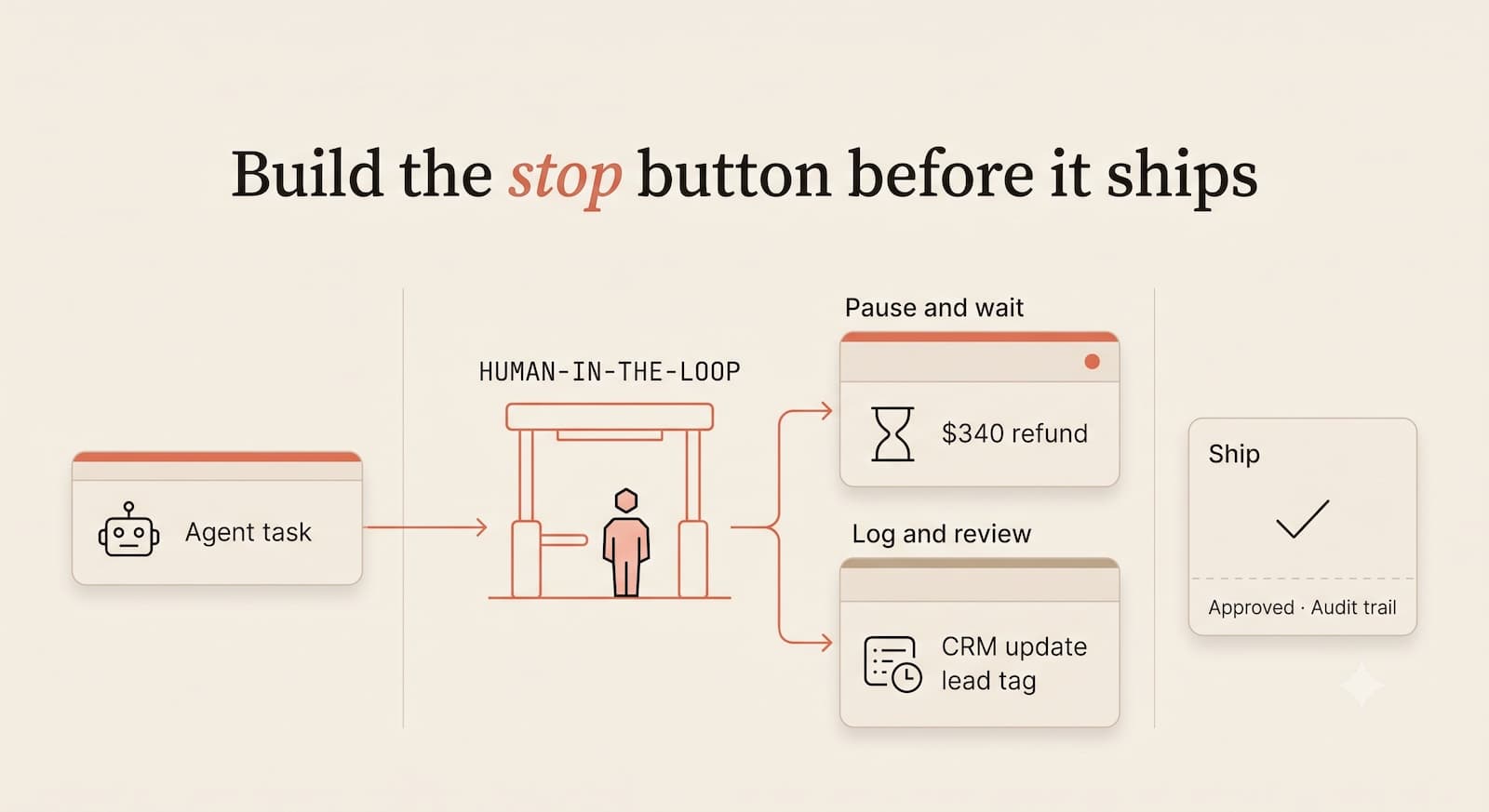
PbD isn't just about keeping data away from vendors; it's also about ensuring one internal user can't see another user's data just because the embedding is "similar." Under the hood, this means proper row-level security and tenant isolation on your vector store. This is exactly the kind of human-gate check we build into every implementation: a governed retrieval layer that a person can audit, not a black box that trusts the embedding.
4. Audit Trails Don't Survive a Regulator's First Question
The Short Version: Spreadsheets don't scale. If you can't prove it with logs, it didn't happen.
The Problem
Article 30 requires a Record of Processing Activities (ROPA). Most teams maintain this in a static spreadsheet. Their logging captures application errors but misses compliance events.
When a Data Protection Authority (DPA) shows up, they don't want to see your policy documents. They want evidence: the exact lineage of a decision, and proof that PII was masked before it hit a third-party API.
The Real-World Impact
For large enterprises, GDPR programs routinely cost in the high six- to seven-figure range annually, much of it wasted on manually reconstructing audit trails after the fact rather than capturing evidence as it happens. Companies that can't produce evidence quickly during an investigation face longer, more invasive audits.
How to Fix It
Automate your ROPA through your CI/CD pipeline using tools that scan for data sinks and third-party flows. For AI-specific logging, you need to capture:
The sanitized prompt sent to the LLM (proving PII was masked before it left your boundary).
Classification tags documenting what was detected ("2 emails, 1 IP address").
The policy/config version active at the time of processing.
Consent/legal-basis verification results (proving why you were allowed to process it at all).
Retention/deletion events that show data was actually removed when the policy said it should be.
Define explicit retention periods for compliance logs (e.g., 3-5 years) and enforce them like any other data retention policy. Store these logs in an append-only, tamper-evident system (think WORM storage or hash-chained ledgers). If logs can be edited, they aren't evidence; they're fiction.
5. Compliance Degrades Silently Between Audits
The Short Version: Compliance is a signal you monitor, not a state you achieve.
The Problem
Here's what most content gets wrong: it treats compliance as a one-time setup. But AI systems are dynamic. Models get updated. Data sources change. Isn't that the whole point of shipping AI quickly in the first place? It is, and it's exactly why compliance can't be a one-time gate.
If your PII detection model had 94% precision at deployment, it can drop meaningfully after months of distribution shift. Fewer than half of organizations monitor production AI for exactly this kind of drift, and that number falls to 9% among small companies (Pacific AI / Gradient Flow 2025 AI Governance Survey). If you aren't monitoring it, you won't know you're leaking data until the fine arrives.
The Real-World Impact
The gap between audits is where violations happen. Without observability, you are operating in the dark between quarterly reviews, and the survey above puts a number on how common that blind spot is.
How to Fix It
Treat compliance as a monitoring problem. Privacy needs SLOs and dashboards, not just Confluence pages. You need to monitor:
PII detection rate trends: A sudden spike or drop means something changed upstream.
Guardrail latency: If your PII scanner adds 800ms to every request, developers will quietly route around it in the next sprint.
Privacy incident rate: How often PII shows up in places it shouldn't (e.g., outputs, non-PII logs).
Jailbreak attempts: Adversarial prompts that attempt to extract PII require real-time flagging.
Set SLOs (e.g., minimum detection precision, maximum guardrail latency) and alert when you blow past them. The moment you see those metrics move, you have a chance to fix the issue before it turns into a regulator's case file.
The Pattern Is Clear: Compliance Is an Engineering Problem
Every problem on this list comes back to the same root cause: the gap between what your policies say and what your systems actually do. Legal documents don't prevent data leakage. Architecture does. Policies don't prove compliance. Monitoring does.
The good news: these are solvable engineering problems. RAG architectures make deletion provable. PII firewalls make masking deterministic. Automated ROPA keeps documentation in sync with reality.
The teams that get this right don't just avoid fines; they ship faster. When you can prove to your internal risk committee that your AI system is safe, you spend less time in review and more time in production.
This is exactly what a First Skill Sprint looks like in practice: we build one governed workflow around your actual PII and audit-trail requirements, hand you the markdown skill with the human review step already built in, and you own it outright, no lock-in, no black box. We measure the baseline before we touch anything, and we stay until it works.
You don't have to rebuild your architecture from scratch. You do need someone to build the first governed piece of it with you. Book a free call →
FAQ
Are vector embeddings personal data under GDPR? Yes, when they can be linked back to an identifiable person or inverted to reconstruct source text. Research on embedding inversion shows high-dimensional vectors can leak the original content, so they need the same row-level access control as the source data, not looser controls because they "look" anonymous.
Can I ever fine-tune a model on user data and stay GDPR-compliant? You can fine-tune on style, tone, and reasoning patterns without issue. Fine-tuning on data that contains PII is what creates the erasure problem, since you cannot selectively delete a user's contribution from model weights. Keep personal data in a retrievable store (RAG) instead, where deletion is a normal database operation.
What's the difference between a ROPA and an AI audit log? A ROPA (Article 30) documents your processing activities at a policy level, typically what data, why, and for how long. An AI audit log is the technical evidence underneath it: the sanitized prompt, what was detected and masked, the policy version active at the time, and the deletion events that followed. Regulators ask for the second one.
How often should I re-check my PII detection precision? Continuously, not annually. Distribution shift in production traffic can quietly erode precision over months. Set a minimum-precision SLO and alert on drift the same way you'd alert on any other production metric, rather than waiting for the next scheduled audit to find out.