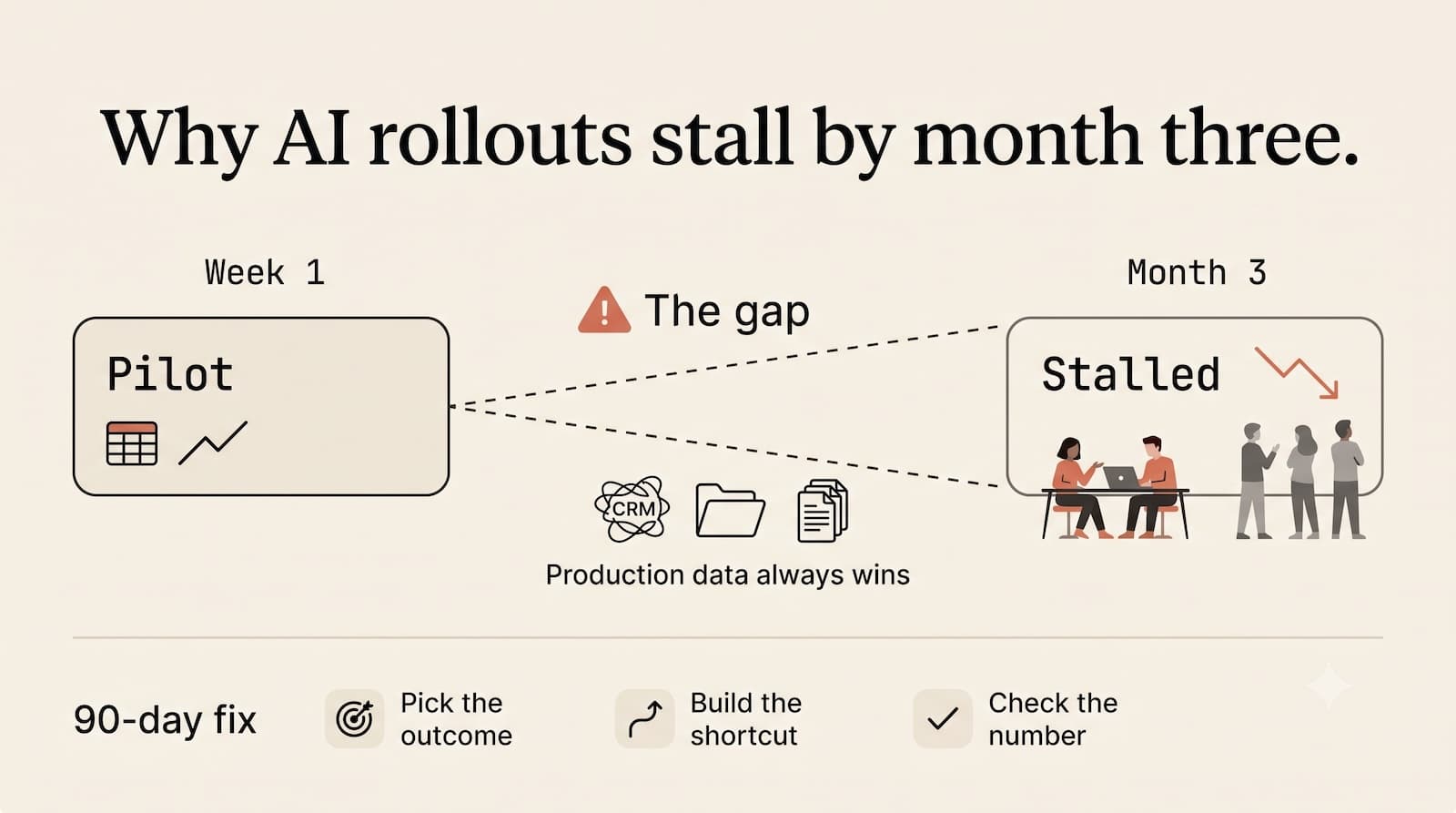

Only 24% of revenue teams have embedded AI into their core workflows (Gong, 2026; Momentum.io, 2026). The other 76% are doing AI theater. Buying tools, running pilots, generating dashboards, nobody acts on them. The problem isn't the AI, it's that most teams spend 80% of their energy on tool selection (the 10% of AI success that comes from algorithms) while neglecting the 70% that actually matters: people and process change (BCG, 2025).
This guide walks through what it actually takes to build a model-driven RevOps roadmap, where AI isn't bolted onto broken processes but is embedded in how your revenue team operates, forecasts, and makes decisions. If your CRM data isn't AI-ready and your processes still depend on spreadsheets stitched together in Slack, you don't have an AI strategy. You have a software subscription.
Key Takeaways
The 10-20-70 rule governs AI success: 10% algorithms, 20% tech and data, 70% people and process change (BCG, 2025). Most RevOps teams invest in reverse.
AI leaders achieve 3.6x higher total shareholder return and 2x revenue growth compared to laggards not through better tools, but through operating model transformation (BCG, 2025).
Only 7% of B2B sales orgs hit 90%+ forecast accuracy. An autonomous revenue stack closes this gap through data readiness and process redesign, not more software.
You don't need a perfect data foundation to start, but 76% of CRM users say less than half their data is usable (Validity, 2025). Fix data quality before scaling AI.
RevOps fundamentals guide → pillar page on building a modern revenue operations function
Why Most AI RevOps Initiatives Fail to Move the Needle
88% of organizations use AI in at least one function, but only about a third are scaling it across the enterprise. Only 39% can attribute any EBIT impact to their AI investments (McKinsey, 2025). That's a lot of money chasing very little measurable return.
The pattern is predictable. A CRO reads a Gong report, buys three AI point solutions, and asks the RevOps team to "figure out the AI thing." Six months later, the tools sit half-adopted. CRM data remains unreliable. The forecasting process hasn't changed at all. Sound familiar?
When we audited CRM data quality at a Series B SaaS company preparing for an AI forecasting deployment, we found 43% of opportunity close dates were aspirational rather than real. Pipeline stages were months out of date. The AI model would have been trained on fiction. We pulled the plug on the deployment, spent three months fixing data hygiene, and only then ran the pilot. The result was a 22% improvement in forecast accuracy in the first quarter post-deployment. Without the data remediation, that number would have been zero.
The gap isn't tool selection. The gap is in organizational readiness. BCG's research on 1,250 senior executives found that AI leaders in the top 5% achieve 2x revenue growth, 1.4x greater cost savings, and 3.6x higher total shareholder return compared to laggards (BCG, 2025). The difference isn't that leaders have better AI. It's that they treat AI as an operating model change, not a software upgrade.
BCG's 2025 study distilled the success formula into three numbers: 10% algorithms, 20% technology and data infrastructure, and 70% people and process transformation. Most RevOps teams spend 80% of their AI energy shopping for tools, the 10% slice, while neglecting the 70% that actually determines whether anything changes. That's the mistake.
What Does "AI-Native RevOps" Actually Mean?
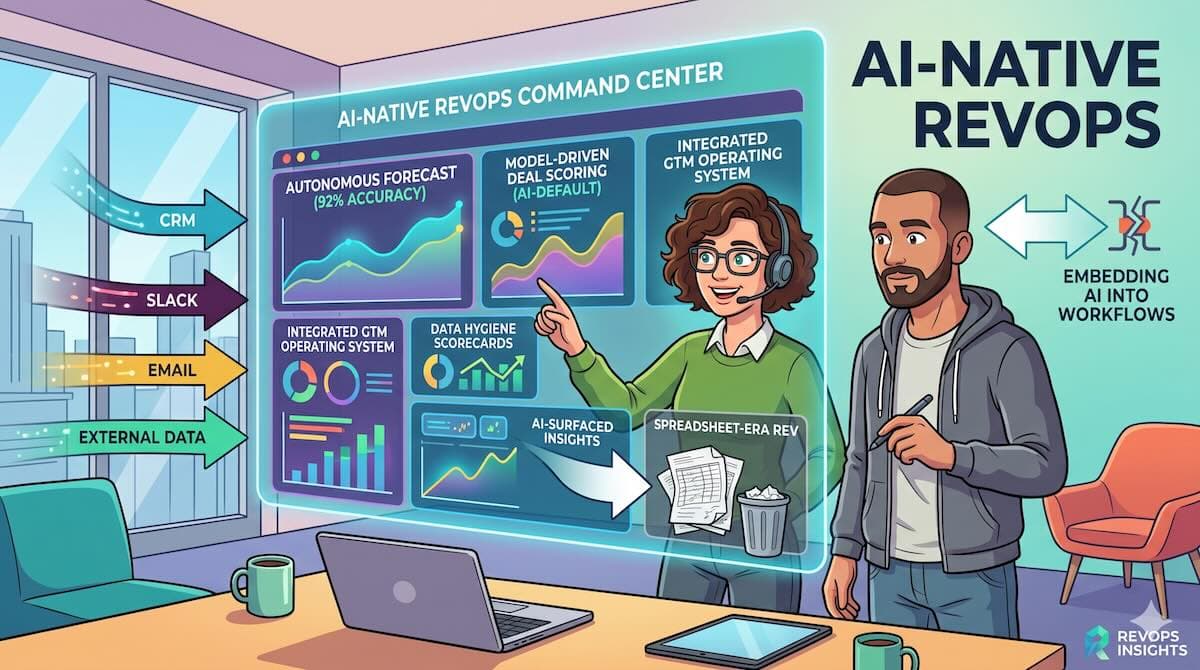
AI-augmented RevOps means AI assists existing workflows: helping write follow-up emails, suggesting pipeline stages, and flagging at-risk deals. AI-native RevOps goes further. AI becomes the operating system, not a feature. Your forecasting process assumes AI-generated predictions as the baseline. Pipeline reviews start with AI-surfaced insights instead of reps defending their gut instincts. Deal scoring, territory design, and capacity planning run on models that update continuously, not quarterly; rather, the distinction matters because the organizational lift changes at each level. Only 39% of organizations can attribute any EBIT impact to their AI investments (McKinsey, 2025). The gap isn't the AI; it's whether the operating model changed around it. Companies that treat AI as an organizational transformation achieve 2.6x higher commercial impact compared to those running limited pilots (Gong, 2026).
Think of it as the difference between adding cruise control to a car versus redesigning for electric. You can't get Tesla-level efficiency by bolting a battery onto a combustion engine chassis. Most RevOps teams are still bolting models onto spreadsheet-era processes. That's not AI-native. That's AI-painted.
Planning the transformation vs. building the engine: This guide covers the strategic roadmap, maturity model, and organizational change framework for AI-native RevOps. If you need the detailed architecture the 4-layer engine model, tool stack tiers with pricing, and workflow design patterns start with our AI revenue engine architecture guide.
How Do You Assess Your Current AI Maturity?
Before building a roadmap, you need an honest baseline. Most teams skip this step and jump straight to tool evaluation. That's how five AI tools end up deployed with no measurable lift.
Here's a four-stage maturity framework to self-assess:
Stage 1: Foundational. CRM data is inconsistent. Forecasting lives in spreadsheets. AI tools are in pilot or absent. KPIs are reactive and reported monthly. 87% of enterprises missed 2025 revenue targets, and 48% say revenue data isn't AI-ready (Clari, 2026). If that describes your org, you're here.
Stage 2: Operational. Some workflows are automated (lead routing, basic scoring). CRM hygiene is managed but reactive. You might have one or two AI tools in production. Forecast accuracy sits at 70-79%, the B2B median (Gartner, 2025). AI is helpful but not embedded.
Stage 3: Strategic. AI drives forecasting, pipeline analytics, and territory planning. Data governance is formalized. Sales teams with AI are 1.3x more likely to see revenue increase (83% with AI vs 66% without) (Salesforce, 2024). The org pushes toward 90%+ forecast accuracy.
Stage 4: AI-Native. AI is the default operating layer. Forecast predictions, deal health scores, and rep coaching recommendations are AI-generated and continuously updated. 25% of leaders report AI has a transformative effect on their company, double the rate from the prior year (Deloitte, 2026). The gap between human and AI-driven decisions narrows, with clear governance on where AI has autonomy.
RevOps AI Maturity Model: Four Stages Across Four Dimensions. A four-stage maturity model from Foundational to AI-Native across Data Readiness, Process Automation, Forecasting Accuracy, and AI Governance. Foundational Operational Strategic AI-Native Data Readiness Low Reactive Governed Real-time Process Auto. Manual Some auto AI-assisted AI-default Forecast Acc. <70% 70-79% 80-89% 90%+ AI Governance None Informal Formalized Mature Source: Adapted from Deloitte (2026), Gong (2026), Gartner (2025)
Score yourself honestly across four dimensions: data readiness, process automation maturity, forecasting accuracy, and AI governance. If you're Stage 1 in data readiness but evaluating Stage 4 tools, you have your first action item. Stop shopping. Start cleaning.
What if your team scores differently? That's data too. Have each RevOps team member independently score the org on each dimension, then compare their scores. In our experience, the spread between self-assessments reveals more dysfunction than the averages do. When a VP of Sales scores the org as Strategic and a RevOps manager scores it as Foundational, you've found the conversation that needs to happen before tools get bought.
Team exercise: Have each RevOps team member independently score the org on each dimension, then compare. The spread between self-assessments is often more revealing than the averages.
How Do You Build the Data Foundation for AI-Native RevOps?
Here's the stat that should keep every RevOps leader awake: 76% of CRM users say less than half of their CRM data is inaccurate, and 37% rrevenueosing revenue directly from poor data quality (Validity, 2025). You can't build a model-driven revenue operation on dirty data. The models will confidently give you wrong answers, and you'll make decisions on those answers.
42% of revenue organizations lack formal data governance entirely (Clari, 2026). That's not a tooling problem. It's a process and accountability problem. No vendor can fix that for you.
Start with a data audit across these dimensions:
Completeness: What percentage of required fields are populated on accounts, contacts, and opportunities?
Accuracy: How often do close dates, amounts, and stages reflect reality versus aspiration?
Timeliness: What's the median lag between a rep activity and CRM entry?
Consistency: Do different teams use the same fields, picklist values, and definitions?
The fix isn't a one-time cleanse. High-performing revenue teams prioritize data hygiene at nearly 1.5x the rate of underperforming teams: 79% vs. 54% (Salesforce, 2024). Build data hygiene into your operating cadence. Automated enrichment, field-level validation rules, and a data stewardship rotation where each team owns one data quality dimension per quarter. It's boring work. It's also what separates the 24% who've embedded AI from the 76% who haven't.
According to Validity's 2025 State of CRM Data Management study of 602 CRM users, fewer than half of organizations have CRM data accurate enough to trust for AI-powered decision-making. Before any AI deployment, revenue leaders should run a completeness audit on the 15-20 fields their models will consume, enforce mandatory field policies for deal-critical data, and establish a monthly data hygiene scorecard owned by RevOps, not IT. If IT owns your CRM data quality, nobody owns it.
What Should Your 12-Month AI-Native RevOps Roadmap Look Like?
A real roadmap has phases, swimlanes, and measurable gates. Not a feature wishlist. Here's a 12-month framework organized across four swimlanes: Data, Process, Technology, and People.
Phase 1: Foundation (Months 1-3)
Data: CRM field audit, mandatory field enforcement, enrichment pipeline set up. Target: 85%+ completeness on AI-critical fields. Process: Document and standardize core workflows (lead-to-opportunity, forecast submission, pipeline review). Start measuring process adherence. Technology: Audit current AI tools. 73% of teams are less likely to evaluate new tools beyond a 4-tool threshold (Momentum.io, 2026). Consolidate before adding. People: Identify AI champions in RevOps and sales. Run an AI literacy baseline assessment. Get executive sponsorship documented. Without a sponsor at the VP level or above, Phase 3 will fail. Gate: CRM data quality scorecard baseline established. AI tool audit complete.
Phase 2: Pilot AI in One Workflow (Months 4-6)
Data: Automated enrichment live on top 20 accounts and opportunities. The data quality scorecard is published monthly. Process: Select one high-impact workflow to automate first. Forecasting, pipeline health scoring, or rep coaching recommendations. Run AI and humans in parahumans. Compare outputs. Technology: Deploy one AI tool into production for the selected workflow. Integrate with CRM. Don't build a separate dashboard. Put the AI output where people already look. People: Train power users. Create an AI feedback loop (weekly 15-min retrospective on AI outputs). Share wins internally. Early wins keep the budget alive. Gate: AI-generated forecast compared to human forecast for 2+ cycles. Qualitative feedback from 5+ users.
Phase 3: Embed and Scale (Months 7-9)
Data: The data governance council is active. All Ais I-critical fields above 90% completeness. Process: AI becomes the default for forecasting, deal scoring, and pipeline reviews. Human override requires justification. If you're still debating gut feel vs. model output at this stage, you didn't actually finish Phase 2. Technology: Add a second AI workflow. Integrate AI insights into existing dashboards and Slack. Never build separate "AI dashboards" nobody checks. People: RevOps team restructured around AI operations (model monitoring, data quality, process design). Sales managers trained on AI-assisted pipeline reviews. Gate: Measurable KPI improvement vs Phase 1 baseline. Pick one: forecast accuracy, pipeline velocity, or rep productivity. Don't wait for all three to move before calling it success.
Phase 4: AI-Native Operations (Months 10-12)
Data: Real-time data quality monitoring with automated remediation. Process: AI handles forecasting, territory design, capacity planning, and deal risk scoring autonomously. Humans focus on exceptions and strategy. That's the whole point. Technology: Agentic AI workflows live. Only 21% of organizations have mature agent governance today (Deloitte, 2026). Build your governance framework before deploying agents, not after. People: RevOps operating model transformed. New roles emerge: AI operations manager, revenue data steward, GTM process architect. Gate: 15-25% forecast accuracy improvement. 77%+ revenue-per-rep delta vs. pre-AI baseline. AI-native operating rhythm established. If you hit these numbers, the board funds Phase 5 without a fight.
Budget Reality Check
High-growth B2B SaaS firms now allocate 4-6% of total ARR to GTM AI tooling, with AI spend shifting toward 8-12% of total GTM operating budget (Golden Door Asset, 2026). Meanwhile, GTM headcount as a share of the budget is dropping from 65% to 40%. That's not a headcount reduction panic story. It's a productivity story: fewer but more capable reps, supported by AI infrastructure that gets better every quarter.
GTM Budget Reallocation: Traditional vs. AI-Native Operating Model. Two donut charts comparing GTM budgets. Traditional: 65% headcount, 35% tools. AI-native: 60% AI+tools, 40% headcount. Traditional GTM AI-Native GTM 65% headcount 60% AI+tools Headcount Tools AI + Tools Headcount → Source: Golden Door Asset, 2026 GTM AI Tooling Spend Benchmark
[INTERNAL-LINK: RevOps budget planning template → annual planning framework with AI investment benchmarks]
How Do You Measure Success and Prove ROI?
If you can't measure it, your CFO won't fund Phase 2. CFOs don't fund vibes. Here's the KPI framework to track from day one:
Leading Indicators (Weeks 1-12)
CRM data completeness score (target: 85%+ on AI-critical fields)
AI tool adoption rate among target users (target: 60%+ weekly active users)
Process adherence rate on standardized workflows
Number of AI-generated insights acted on per week
Lagging Indicators (Months 3-12)
Forecast accuracy: AI-driven forecasting improves accuracy by 15-25% over spreadsheet-based methods (Eagle Rock CFO, 2026). Track category-level and rep-level accuracy separately. Aggregates hide the signal.
Revenue-per-rep: frequent AI users earn more revenue per rep than non-users (Gong, 2026). Measure this as a cohort metric. Don't compare absolute values across uneven cohorts.
Pipeline velocity: Time from opportunity creation to close. Target reduction: 15-20%.
Win rate: Track win rate delta between AI-assisted and non-AI-assisted deals. Important caveat: AI gets assigned harder deals first. Don't compare absolute rates.
Governance Gates
92% of sales professionals already use AI tools, and 84% say AI saves them time (HubSpot, 2025). But 75% plan to deploy agentic AI within two years, while only 21% have mature governance (Deloitte, 2026). That's a governance gap that will produce failures. Bet on it.
Establish three gates before scaling: an AI usage policy covering what data models can access, a human-in-the-loop rule for any revenue-committing action, and a monthly model performance review cadence. Skip the governance, and you'll be the case study in next year's "why AI initiatives fail" report.
The Eagle Rock CFO 2026 research found that AI-driven forecasting improves accuracy by 15-25% compared to spreadsheet-based methods, with revenue forecasting seeing the largest gains at 20-30%. Organizations that combine AI forecasting with formal governance review cycles capture roughly twice the accuracy improvement of those that deploy models without an oversight cadence. Governance isn't bureaucracy. It's how you make the model trustworthy enough for the board to stop asking for the spreadsheet version.
Revenue Performance Delta: AI-Powered vs Non-AI Revenue Teams revenue bar chart revenue revenue+31%, Revenue per rep +77%, Win rate uplift +17pp, TSR 3.6x. Sources: Gong 2026, Salesforce 2024, BCG 2025. Revenue Growth Revenue per Rep Win Rate Uplift Total Shareholder Return +31% +77% +17pp 3.6x Gong 2026 Gong 2026 Salesforce 2024 BCG 2025 Sources: Gong (2026), Salesforce (2024), BCG (2025)
What's Next for AI-Native Revenue Operations?
The roadmap above gets you to AI-native operations in 12 months. What comes after is already taking shape, and it's moving faster than most revenue leaders expect.
Agentic AI will move from pilot to production. Instead of AI recommending which deals to focus on, agents will autonomously research accounts, draft outreach, and route qualified leads. Humans approve exceptions, not every action. The orgs that built governance first will scale agents safely. The ones that didn't will have a very expensive incident.
Autonomous forecasting will shift from "AI-assisted" to "AI-default." Reps will still input close dates and deal amounts. But the forecast that goes to the board will be the AI model's call, with commentary on where it differs from human judgment and why. Board members won't miss the spreadsheet version. They'll prefer the model that doesn't sandbag or cheerlead.
AI-driven deal strategy will become standard operating procedure. Deal reviews stop being "tell us about your deals" and become "the AI flagged these three deals as at-risk. Let's discuss the intervention plan." Pipeline reviews shrink from 60 minutes to 15, for everyone.
The revenue org chart will look different, too. The traditional RevOps role, a hybrid of data analyst, Salesforce admin, and process designer, has split into specialized functions. AI operations managers monitor model drift and output quality. Revenue data stewards own the integrity layer that feeds the models. GTM process architects design the collaboration workflows between humans and AI.
This isn't a headcount reduction story. It's a reallocation. Repetitive work shrinks. Strategic work expands. The RevOps professionals who thrive won't be the ones who know the most tools. They'll be the ones who know how to design a system in which humans and AI each do what they do best. And they'll be the ones who can prove it with numbers.
Frequently Asked Questions
How long does it take to become AI-native?
A realistic phased roadmap takes 12 months to reach AI-native operations, with the first measurable improvements appearing in months 4-6. The timeline depends more on data readiness and change management than on technology deployment. You can deploy tools in weeks. You can't deploy culture change in weeks (BCG, 2025).
What's the first step if our CRM data is a mess?
Run a completeness audit on the 15-20 fields your AI tools will consume. Then enforce mandatory field policies and automated enrichment. 76% of CRM users say less than half their data is accurate (Validity, 2025). Fix the fields that feed the models first. Everything else is downstream of data quality.
How much should we budget for AI-native RevOps?
High-growth B2B SaaS companies allocate 4-6% of ARR to GTM AI tooling, trending toward 8-12% of total GTM operating budget (Golden Door Asset, 2026). Start with one workflow pilot before scaling the budget. Prove it works, then ask for more.
Do we need to hire new roles for this?
Eventually, yes. AI-native orgs need AI operations managers, revenue data stewards, and GTM process architects. But the first six months can be run by existing RevOps team members, with protected time allocated to the AI initiative. 70% of AI success is people and process, not new headcount (BCG, 2025).
Which workflow should we automate first?
Forecasting tends to produce the clearest ROI and stakeholder buy-in, with accuracy gains of 15-25% over spreadsheets (Eagle Rock CFO, 2026). Pipeline health scoring and rep coaching are strong alternatives if your CRM data is ready for forecasting. Pick the workflow revenue, a revenueble improvement directed to revenue. Everything else can wait.
Conclusion
Most revenue teams are doing AI theater—buying tools, running pilots, generating slides. The 24% who've embedded AI into core workflows aren't winning because they picked better vendors. They're winning because they treated AI as an operating system change, not a software upgrade.
The roadmap above gives you the framework. The hard part isn't picking tools or building models. It's the 70%: getting your data foundation right, redesigning processes so AI outputs replace rep anecdotes, and bringing your team through the change. Start with the maturity assessment. Score yourself honestly. Pick one workflow. Run the pilot. Measure everything. Scale what works. Cut what doesn't.
The gap between AI leaders and laggards is widening. A 3.6x higher TSR doesn't happen just by watching what competitors do first.