

We've all been there. The quarterly board meeting is going well until the CFO points to a line item that has doubled since the last meeting: AI Infrastructure & API Costs.
The room goes quiet.
The questions that follow are predictable and uncomfortable: "Why did our OpenAI bill jump from €15k to €45k?" "Are we actually getting more customers from this, or just burning cash?" "Is this compliant with that new EU AI Act?"
If you're answering with metrics like "token throughput," "latency in milliseconds," or "deployment frequency," you've already lost the room. The board doesn't speak Engineering; they talk to Risk, Margin, and Revenue.
Here is the hard truth: Most AI CTOs are currently reporting defensive metrics. You are justifying costs rather than demonstrating value.
To change the narrative from "AI is an expensive experiment" to "AI is our primary growth engine," you need to change your dashboard. You need to bridge the gap between your engineering reality (debugging, prompt chains, model drift) and the board's strategic priorities.
Here is the framework I recommend to my clients for turning that awkward board conversation into a strategic win.
The Strategic Narrative: Defend, Optimize, Grow
Before we get to the specific numbers, we need to set the stage. Your board deck shouldn't just be a list of stats; it needs a narrative arc that addresses the three core fears of every director:
Downside Risk: Are we safe? (Defend)
Unit Economics: Are we profitable? (Optimize)
Upside Growth: Are we winning? (Grow)
Instead of overwhelming them with technical jargon, we're going to focus on four "North Star" KPIs that answer these questions directly.
KPI 1: Cost Per Successful Outcome (CPSO)
The Question it Answers: "Are we wasting money on inefficient tech?"
Most teams track "Cost Per Token." This is a trap. It incentivizes you to use cheaper, dumber models that might fail half the time.
Instead, you should report Cost Per Successful Outcome (CPSO).
What is it?
This is the total cost of AI inference divided by the number of successful user goals achieved. A "successful outcome" isn't just a completed API call; it's a resolved support ticket, a unedited report, or a code snippet the user accepted.
Why it works
It proves to the CFO that you are optimizing for value, not just cheapness.
Bad Metric: "We spent €0.03 per query." (The board asks: "Was the query useful?")
Good Metric: "It costs us €0.12 to resolve a support ticket via AI, compared to €8.50 via human agents."
Note: While that €0.12 figure represents an optimized benchmark scenario, showing a downward trend in unit economics relative to human labor costs is key to winning the unit economics argument.
The Target
You want to see this trending downward quarter over quarter. For example, moving from €0.45 per outcome to €0.28 as you refine your prompts and implement model caching.
KPI 2: AI-Influenced Revenue (AIR)
The Question it Answers: "Where is the ROI?"
You need to move beyond "cost savings" and start showing "revenue generation." If you are building features that matter, the customers using them should be worth more to the business.
What is it?
There are two ways to track this:
Direct Attribution: Revenue from SKUs that are purely AI-driven (e.g., a premium "AI Analytics" add-on).
Cohort Comparison: The Net Dollar Retention (NDR) of customers who use AI features frequently vs. those who don't.
Why it works
It aligns you with the CEO's growth goals. If you can show that "Heavy AI Users" retain at 120% while "Non-Users" retain at 90%, you have just justified your entire budget.
The North Star Goal: While typical software ROI varies, high-performing AI teams often set an ambitious target of 45:1 ROI, aiming to generate or recover €45 in business value for every €1 spent on compute. Even getting halfway there changes the conversation from "cost" to "investment."
KPI 3: Production Reliability Score (PRS)
The Question it Answers: "Will this embarrass us?"
Boards are terrified of "hallucinations" and brand damage. But "hallucination rate" sounds scary and abstract. "Reliability" sounds like "Uptime," which they understand.
What is it?
A single "Trust Score" (0-100%) that aggregates technical errors, hallucinations, and safety refusals. Formula: (1 - [Hallucination Rate + Refusal Rate + Error Rate]) * 100
How to measure it
You can't rely on user reports alone. You need "LLM-as-a-Judge" evaluators running in the background, sampling your production traffic and scoring it for faithfulness and safety.
The Target
For narrow, critical paths (like data extraction or classification), the aspirational target is >99%. Note: Open-ended chat experiences will naturally have lower scores due to ambiguity, but separating "critical failures" from "creative variance" is key to building board trust.
KPI 4: Compliance Readiness Index (CRI)
The Question it Answers: "Are we exposed to regulatory risk?"
With the EU AI Act coming into full force, compliance is no longer a "nice-to-have "; it's an existential requirement. While maximum fines for prohibited practices can reach €35M or 7% of global turnover, even standard non-compliance for high-risk systems carries significant penalties. Your CISO is losing sleep over this.
What is it?
The percentage of your high-risk AI systems that have complete, audit-ready technical documentation. This serves as a strong proxy for your overall compliance posture.
Do you have a prompt version history?
Do you have proof of data residency (e.g., data remained in Frankfurt)?
Do you have risk assessments on file?
Why it works
It turns a qualitative anxiety ("Are we compliant?") into a quantitative progress bar.
Q1 Report: "CRI is 60%. We have gaps in logging."
Q2 Report: "CRI is 100%. Our documentation is audit-ready."
The "CTO Slide": Defending Your Team's Time
While the metrics above are for the board, you also need to defend your engineering capacity. This is where you report on Operational Velocity.
The Problem: The Debugging Tax
In our work with AI startups, we frequently see teams spending up to 40% of their time debugging black-box failures before implementing proper observability. They are hunting down why a prompt broke, why costs spiked, or why an agent entered a loop. That is millions of Euros in wasted salary.
The Metric: Ratio of Debugging vs. Shipping
Clearly report how you are buying back time. "Before implementing observability, we spent significant cycles fixing. Now, we aim for a split of 10% fixing and 90% shipping."
This justifies investment in tooling not just for "tech's sake," but for labor efficiency.
Moving from Spreadsheets to Systems
If you are reading this and thinking, "Great, but I don't have the data to calculate these numbers," you are not alone.
Most CTOs are trying to pull this data from scattered spreadsheets, billing dashboards, and ad-hoc SQL queries the night before the board meeting. That's not sustainable and not scalable.
To report with confidence, you need a System of Record for your AI.
This is where a platform like PromptMetrics becomes essential. It's not just a developer tool; it's your board reporting engine.
It tracks cost per interaction automatically (solving CPSO).
It runs background evaluations on production traffic (solving PRS).
It maintains audit logs and version history (solving CRI).
You move from "guessing" to "knowing."
The Takeaway
The difference between a cost center and a growth engine isn't just in the code; it's in the communication.
By shifting your reporting to Cost Per Outcome, Revenue Attribution, Reliability, and Compliance, you stop apologizing for your budget and start leading the strategic conversation.
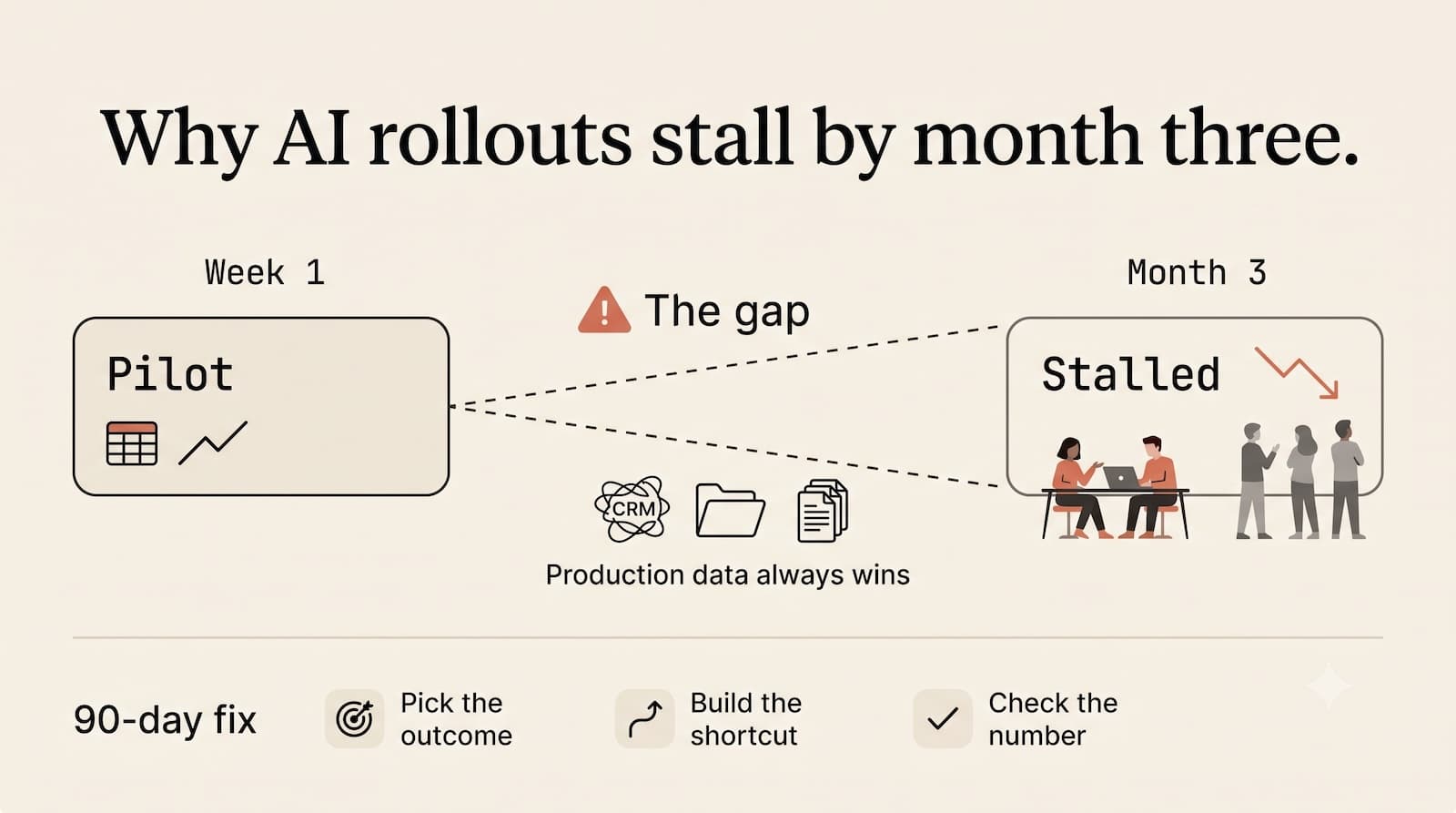
Expected payback: Implementing this reporting framework usually clarifies ROI within 90 days. Critical path: Audit your current metrics → Implement an observability layer (like PromptMetrics) → Present the "North Star" dashboard at your following quarterly review.
Don't let the "awkward silence" happen again.
Sign up to PromptMetrics today to ensure your board reporting is automated and audit-ready.