

Your demo crushed it. Your Series A pitch landed. Now your LLM bill is eating your runway alive, and you still don't know why.
Building an LLM prototype takes hours. Surviving in production takes a fundamentally different architecture. According to Gartner, only 48% of AI projects reach production. A separate analysis found that 42% of companies now abandon the majority of their AI initiatives before reaching production, up from 17% the year before. The failures are rarely algorithmic. They're architectural.
This post is for CTOs and VPs of Engineering at EU-based AI startups spending roughly €2–50K/month on LLMs.
For startups in this bracket, these mistakes don't just hurt margin,s they're existential. Model API spending doubled from $3.5B to $8.4B between late 2024 and mid-2025. Here are the seven architecture mistakes that we see repeatedly killing startups and exactly how to fix each one.
1. Treating Your LLM API Like a Microservice
An LLM is not a deterministic REST endpoint. It's probabilistic, expensive, rate-limited, and latency-heavy. Yet most teams design around it as if it were another stateless microservice.
LLM interactions, particularly in agentic applications, require continuous state and memory management. Treating the model's context window as an unstructured data dump (what practitioners call "Dumb RAG," like dumping an entire Confluence space into every query) directly leads to context flooding. The context window functions like RAM: overload it, and you get what is effectively "cognitive thrashing" rather than reasoning. The result? High-confidence hallucinations and degraded instruction following.
The fix: Make every LLM call asynchronous. Use job queues (Celery, BullMQ, or cloud-native equivalents). Implement timeout fallbacks and graceful degradation.
Crucially, stream responses via Server-Sent Events. This isn't just about perceived latency. Streaming enables your orchestration layer to parse output in real time. You can terminate generations early when you detect hallucinations, safety violations, or looping behavior, saving output tokens and preventing cascading failures.
2. Ignoring Token Economics
At prototype scale, token usage feels cheap. At the production scale, it becomes your largest cost center.
Here's the pricing dynamic most startups miss: output tokens often cost 3–10x as much as input tokens in popular commercial models. For a standard conversational agent generating twice as much output as input, the actual blended cost can be up to 9x higher than the advertised baseline.
Rule of Thumb: If you aren’t explicitly controlling output length, expect your real cost to be 2–3x your naive estimate.
Real-world example: A support chatbot handling 500,000 monthly requests at an average of 1,500 tokens on GPT-4 pricing costs roughly $18,000/month for a single feature. Without instrumentation, there's no way to tell which tickets actually needed GPT-4 and which were simple FAQ questions that could have run on a model costing 100x less.
It gets worse. It is common to see a runaway agent loop execute unconstrained tool calls, transforming a request meant to cost pennies into a multi-dollar spike enough to drain a €20,000 monthly budget in days.
The fix: Set explicit max_tokens limits on every call. Constrain output in the prompt ("Answer in 50 words"). Summarize chat history every 10–15 exchanges to keep context under 1,000 tokens. Use LLMLingua for prompt compression up to 20x compression with minimal quality loss.
3. No Caching Strategy
Every identical question paying full inference cost is money on fire. Research shows that 31% of enterprise LLM queries are semantically similar to previous requests.
A production deployment processing 45,000 requests over 30 days achieved a 40% cache hit rate, saving $76 and 14,400 seconds of latency. Cache hits returned in ~50ms versus 1.2s for misses, a 24x speedup.
The fix: Implement a three-tier caching stack:
Layer | Mechanism | Latency | Savings |
Exact-match | Redis key-value | < 1ms | Eliminates duplicate calls |
Semantic | Vector embeddings + cosine similarity | ~50ms | 40–70% cost reduction |
Provider | Anthropic/OpenAI native caching | N/A | 50–90% on system prompts |
Critical caveat for EU startups: Semantic caching introduces cross-tenant data exposure risks. If similarity thresholds are improperly tuned, User A could retrieve a cached response containing User B's proprietary data, resulting in an immediate GDPR compliance failure.
Mitigation: For anything touching personal or proprietary data, segment caches per tenant or risk class. Use stricter similarity thresholds for sensitive data (e.g., ≥0.95 for customer data vs ≥0.75 for public FAQs).
4. Over-Reliance on Prompt Engineering
Many teams try to solve every problem by writing increasingly massive, monolithic prompts. This tightly couples application logic with AI instructions, creating brittle systems that break when a model provider updates weights.
There's also a performance ceiling. Research on long-context utilization shows that LLMs suffer from a "lost in the middle" phenomenon, where answer accuracy drops 20–30% when relevant information sits in the middle of a massive prompt rather than at the edges.
The fix: Move business rules, routing, and tool execution out of the prompt and into a deterministic orchestration layer.
Don't: Write a 4-page mega-prompt describing every business rule.
Do: Encode rules in code and keep the prompt to task-specific instructions.
5. No Observability
As Pluralsight puts it, running LLMs without observability is "like running a restaurant kitchen where you can't see which chef is cooking which dish... and only discover you're over budget when the supplier bill arrives."
Most teams discover costs are out of control only when an invoice lists a single line item: "OpenAI API – $47,832," with no breakdown. Traditional APM tools can't track prompt degradation or token utilization per feature.
The fix: Implement the "Meter Before You Manage" framework. At minimum, you must log: model, provider, prompt template version, input/output tokens, latency, cost, and evaluation signals. In practice, this often means using a gateway (LiteLLM or Helicone) plus an observability backend (Langfuse or PromptMetrics) as your standard stack.
The tooling landscape in 2026:
Platform | Pricing Model | EU Data Residency | Best For |
Helicone | Per request | EU-friendly (Region support) | Gateway with caching + rate limiting |
Langfuse | Per unit (ingested event) | Yes (Self-hostable) | OpenTelemetry-native teams |
LangSmith | Per trace/seat | US/Cloud | LangChain ecosystem users |
PromptMetrics | Usage/Feature-based | Yes | Cost governance + EU AI Act compliance |
6. One Model for Everything
The price spread across models in February 2026 is staggering. There's an up to ~600x gap between GPT-OSS-20B ($0.05/M tokens) and frontier models like Grok-4 ($30/M tokens). Using Claude Opus 4.6 for simple text summarization is like hiring a surgeon to apply band-aids.
A well-implemented cascade starts 80–90% of queries with smaller models, escalating only when needed.
FrugalGPT (Stanford): up to 98% cost reduction matching GPT-4 quality.
RouteLLM (UC Berkeley): 85% cost reduction while maintaining 95% quality.
Real-world impact: In one benchmark, moving from "all GPT-4" to a cascade where 90% of traffic went to a cheaper model cut monthly costs from ~$8,500 to ~$1,200 for a 10K MAU SaaS.
The fix: Deploy a model router.
Default Policy: Try the cheap model first. Escalate to the expensive model only if a simple classifier (or a heuristic) flags low confidence, or if the user explicitly requests "deep analysis."
7. Designing for Intelligence, Not Infrastructure
Teams optimize for model capability while neglecting the mechanical realities: rate limiting, circuit breaking, retry logic, and compliance logging.
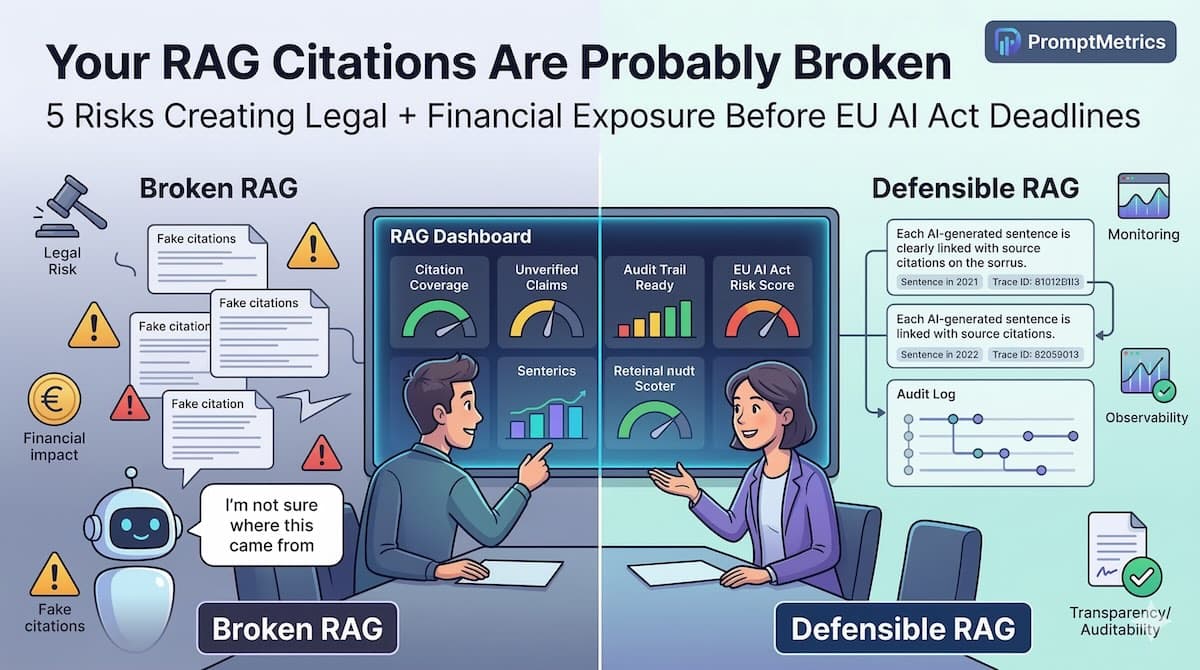
This is especially dangerous for EU startups building systems that could be classified as High-Risk under Annex III of the EU AI Act. Not every LLM app is high-risk, but if you touch sectors like credit scoring, hiring, healthcare, or critical infrastructure, you are likely in scope.
The EU AI Act isn't theoretical anymore for these companies:
Article 9 (Risk Management): Mandates continuous risk management across the lifecycle.
Article 12 (Record-Keeping): Requires record-keeping and logging capabilities for high-risk systems to enable post-market monitoring. Practical engineering for compliance means logging model version, prompt, context, data sources, and exact output.
Article 72 (Post-Market Monitoring): Providers must actively collect and analyze performance data throughout the system's lifetime.
A startup relying on standard console logs without capturing full LLM trace data will struggle with conformity assessments, risking fines of up to €35 million or 7% of global annual turnover for the most serious infringements.
The fix: Implement circuit breakers that monitor real-time token consumption. Set fanout limits on automated tool calls. If an agent enters an infinite loop, the breaker halts execution. Embed compliance-grade observability from day one, regulators increasingly expect logs to be robust and tamper-evident.
The Production-Ready Stack: A Practical Blueprint
For a Seed-to-Series-A EU startup, here's the recommended progression:
Weeks 1–2 (Quick Wins → 20–30% savings):
Deploy LiteLLM as a unified LLM gateway.
Add Langfuse or Helicone for cost attribution.
Set
max_tokenslimits on every call.Enable provider-level prompt caching (Anthropic: 90% savings on system prompts).
(Teams routinely see 20–30% savings just from this phase before touching routing or RAG).
Weeks 3–6 (Model Strategy → additional 30–50% savings):
Implement model routing: GPT-5 mini for simple tasks, Claude Sonnet for complex reasoning.
Deploy semantic caching with Redis vector search.
Build query classification logic (intent detection → model selection).
Set per-team/per-feature budget guardrails.
Months 2–3 (Infrastructure → up to 80% total savings):
Implement RAG with semantic chunking to reduce context tokens by 70%+ (and drop per-request costs proportionally).
Add EU AI Act compliance logging (trace retention, risk metrics, audit exports).
Consider self-hosting open-weight models if the spend exceeds €50K/month.
Should You Self-Host?
The open-source vs API question comes up constantly. Here's the real math:
Annual API Spend | Recommendation | Why |
< $50K | API only | Self-hosting overhead exceeds savings. |
$50K–$500K | Hybrid | Route 80% to self-hosted 7B, 20% to premium API. |
> $500K | Self-host primary* | GPU cluster + LoRA fine-tune wins on unit economics. |
*Note: This assumes at least one H100-class cluster and 1–2 dedicated MLOps engineers; smaller setups won't move the needle much at enterprise API prices.
For many workloads, the break-even point relative to mainstream API pricing is in the low hundreds of millions of tokens per month. For most early-stage startups in the €2–50K/month range, our strong recommendation is to start with APIs and intelligent routing. The operational complexity of self-hosting requires dedicated MLOps talent; at the early stage, that headcount is better spent on product.
The Bottom Line
The architecture that scales isn't the one with the smartest model; it's the one with the smartest infrastructure around the model.
Decouple application logic from AI logic.
Cache aggressively; semantic caching alone can cut costs by 40–70% in high-overlap workloads.
Route intelligently, 90% of queries don't need your most expensive model.
Observe everything you can't optimize; what you can't measure, you can't optimize.
Build for compliance with the EU AI Act record-keeping requirements, which are a legal mandate for high-risk systems and increasingly a de facto expectation for serious AI products in regulated sectors.
The startups that treat LLM cost management as a core product concern, not an afterthought, are the ones that survive long enough to find product-market fit.
PromptMetrics helps AI startups track LLM costs per feature, detect runaway agents in real time, and generate trace exports that align with EU AI Act record-keeping expectations, with EU-hosted infrastructure by default for data residency peace of mind.