

It happens without a changelog, and usually on a Tuesday morning.
One day, your prompt works perfectly. Next, the model refuses to output strict JSON, becomes overly verbose, or suddenly returns a "cannot fulfill this request" error due to a backend safety filter tweak. The API status page stays green, but for your enterprise application, the feature is dead.
We saw this during the infamous "Lazy GPT-4" summer of 2023, and the pattern continues in 2026 as providers rush to roll out distilled reasoning models.
For organizations treating AI as a "set and forget" black box, these silent updates are a fire drill. For the best-prepared engineering teams, tit'sjust a Slack notification
Here is why traditional monitoring fails in Enterprise AI, and how you can survive the shift from experimental to operational.
Why Traditional Monitoring Fails for LLMs
In traditional software, we monitor uptime and latency. If the server responds, the system is "up." In the era of probabilistic software, "uptime" is a vanity metric.
If you are only tracking HTTP 200 responses, you are missing the three specific failure modes that actually kill user experience:
Schema Drift: Your prompt asks for strict JSON. After a silent backend update, the model decides to add a polite conversational preamble ("Here is the data you requested:"): your JSON parser chokes, and the app crashes.
Semantic Drift: The model answers the question, but the tone shifts. We recently saw a legal tech company whose contract summarization prompt began including cautious, liability-dodging disclaimers after a safety update that was technically correct but useless for their lawyers.
Latency Distribution Shifts: The average latency remains 800ms, but the P99 spikes to 15 seconds because the model is now "thinking" longer on complex queries, timing out your frontend.
The Cost of Invisibility: A $10k Weekend
Beyond quality, the lack of observability is a financial liability.
One engineering team we spoke with recently shared a nightmare scenario involving an autonomous customer support agent. A minor model hallucination caused the agent to enter a "clarification loop," repeatedly querying the LLM for context it already had. Because the team lacked cost-per-session monitoring, the loop ran for 48 hours.
They burned $10,000 in API credits over a single weekend.
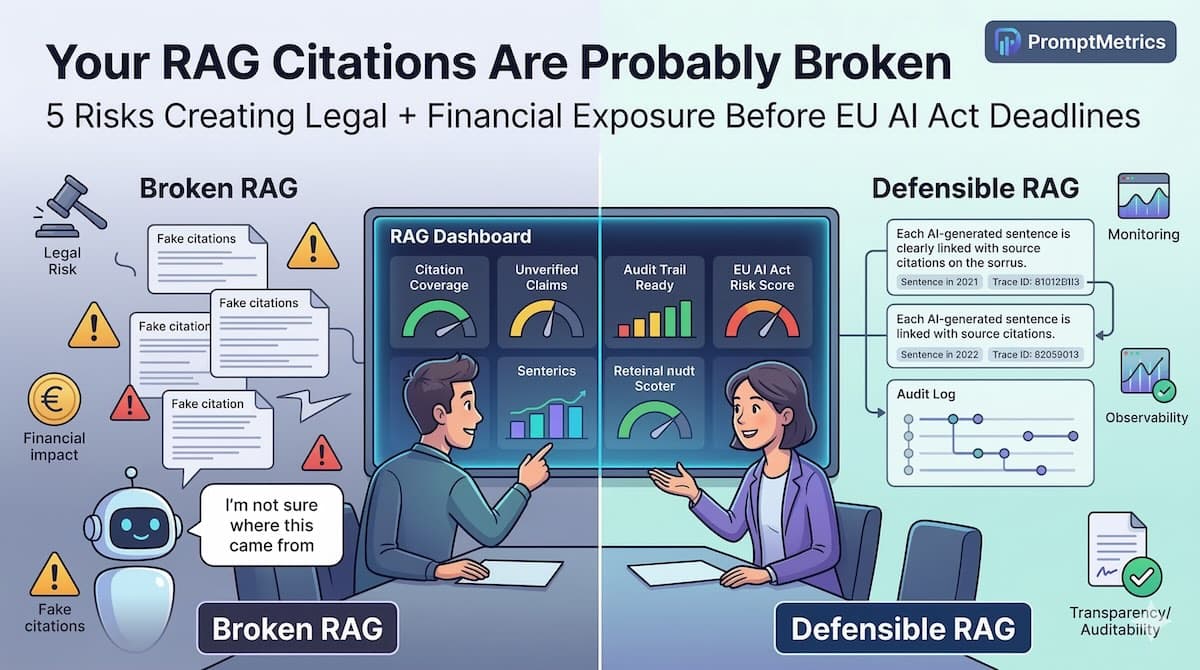
This isn't just a bug; it's a governance failure. With the EU AI Act compliance requirements regarding transparency ramping up through 2026, the need for oversight is no longer optional;it'ss the law. You need an audit trail that explains why the AI made a decision and how much it cost to make it.
Moving Beyond "Vibe Checks"
Most teams start by "vibe checking" their prompts in a playground. That works for a prototype. It fails at scale. To build observable AI systems, you need to treat prompts as versioned code and outputs as data.
Here is what the most robust teams are monitoring right now:
1. Track Cosine Similarity
Don't guess if the model is drifting. Measure it. Compare today's production outputs against a stored vector of known "good" responses using an embedding model (like OpenAI's text-embedding-3-small or Cohere's embed-v3).
If the similarity score drops below a set threshold, trigger an alert. Note regarding thresholds: A score of 0.85 is suitable for general customer support, but high-stakes domains such as medical coding may require 0.95+, while creative writing apps may tolerate 0.70.
2. Implement Model-Graded Evals
You can't have a human review every log. Use a "Judge Model" to score your production outputs.
The tip: Avoid bias by using a different model family for the judge (e.g., use Claude to grade GPT-4 outputs). Ask the judge simple binary questions: "Did the response return valid JSON?" or "Was the sentiment positive?"
3. Define Your "Golden Set."
You cannot detect regression if you don't know what "good" looks like. Build a dataset of 50–100 representative inputs with human-verified ideal outputs. Run this set through your pipeline whenever you push code or the provider updates its model.
4. Cost Guardrails
Set hard limits at the application layer. For a typical support workflow, a single session exceeding $2.00 usually indicates a runaway loop. Kill the chain before it kills your budget.
The Strategic Shift: Defensive Engineering
You might argue, "I pinned my model version to gpt-4-0613, so I'm safe."Providers like Anthropic and OpenAI have improved their versioning and deprecation notices. However, even pinned versions aren't immune. Providers frequently optimize the backend inference infrastructure to reduce compute usage. These optimizations can subtly alter output behavior without changing the version number.
Ultimately, you do not own the model; you rent intelligence from a provider who can change the weights without consulting you.
Successful AI teams are defensive. They build systems that assume the model is unreliable. They verify every output. They allow for hot-swapping providers when one degrades.
Don't Wait for the Next Update
The era of silent updates is here to stay. You can't control when model providers update their weights, but you can control how your system responds.
At PromptMetrics, we don't just show you that your API calls were successful. We tell you if quality has dropped, if costs have spiked, and whether your "Golden Prompts" are still performing.
Stop debugging in production. When the next silent update drops, get a Slack alert, not a support ticket avalanche.
See how PromptMetrics catches quality regressions before your users do with drift detection, cost guardrails, and Golden Set monitoring built in.