
You're spending €15,000 a month on OpenAI and Anthropic. Your 8-person engineering team is shipping AI features faster than your Series A investors thought possible. Everything's working beautifully until your lawyer mentions the EU AI Act.
Suddenly, your "quick and dirty" Langfuse setup no longer looks simple. You're facing Article 12 compliance requirements, GDPR audit trails, and data residency concerns that could derail your next funding round. The "free" open source observability tool is starting to look expensive.
As a founder who has built and operated LLM infrastructure for EU customers, I've seen this pattern play out repeatedly. Here is the core reality check: For EU companies, open source observability is often cheaper at the prototype stage, but becomes significantly more expensive by the time you reach real compliance and scale with paying customers.
Here's what you actually need to know before choosing between DIY and enterprise LLM observability.
[Image Suggestion: Split-screen composition contrasting a chaotic DIY developer workspace with 3 AM debugging vs. a clean, organized Enterprise dashboard in a European office]
The Real Cost of "Free" Observability in Europe
Open source LLM observability tools like Langfuse, Phoenix, and Traceloop are genuinely excellent. They handle the core technical requirements beautifully: tracing LLM calls, tracking token costs, versioning prompts, and building evaluation pipelines. For a startup prototyping in stealth mode, self-hosting Langfuse with Docker Compose makes perfect sense.
The problems start the moment you go live with European users.
Hidden Costs That Kill Your Runway
Let's be honest about what "free" actually costs when you're burning through cash with 18 months of runway left. Based on typical mid-sized SaaS models, here is where the money goes:
Engineering time you can't afford to lose. Maintaining production observability infrastructure requires dedicated attention to schema migrations, capacity planning, security patches, and 3 AM outages. Industry studies suggest engineers spend roughly a third of their week fighting fires and dealing with interruptions, rather than building new features. Even if you only dedicate half of one senior engineer's time, you've just consumed 3–4 months of runway maintaining infrastructure.
EU data residency compliance. GDPR isn't optional. Your observability data includes user interactions and may contain personal information. That means designing for EU-only storage, documenting sub-processors, and proving to customers where observability data actually lives. For a typical startup, this work can easily consume tens of thousands of euros in internal time and money that could fund additional product engineers.
Compliance consulting that bleeds cash. Public benchmarks for mid-sized companies place first-year GDPR costs between the low and mid-six figures, depending on complexity. Layer on EU AI Act requirements (Article 12 audit trails, algorithmic accountability documentation), and you are looking at significant additional consulting fees. That's runway spent on compliance work that doesn't directly improve your product.
The opportunity cost. While your lead engineer is troubleshooting deployment issues at 2 AM, your competitor is shipping the feature that wins your biggest prospect.
Where Open Source Shines (And Where It Breaks)
I'm not here to bash open source; it excels in technical execution. However, when viewed through an EU regulatory lens, the gaps become clear.
Capability | Open Source (Langfuse/Phoenix) | Enterprise Advantage |
LLM tracing & debugging | ✅ Excellent | Marginal OSS does this well |
Token cost tracking | ✅ Built-in | Marginal |
Prompt versioning | ✅ Well-supported | Marginal |
EU data residency | 🛠️ Requires manual setup | ✅ Critical built-in compliance |
Article 12 audit trails | 🛠️ Custom implementation | ✅ Traceability + tamper-proof logs |
Role-based access (RBAC) | ⚠️ Basic RBAC only | ✅ Granular permissions + audit |
Automated compliance reporting | ❌ Manual documentation | ✅ Investor/legal-ready reports |
Data retention automation | 🛠️ Manual deletion scripts | ✅ Policy-driven lifecycle mgmt |
SOC 2 / ISO 27001 hosting | ❌ Your responsibility | ✅ Certified infrastructure |
SLA guarantees | ❌ You are the SLA | ✅ 99.9%+ uptime commitment |
The pattern is clear: open source excels at technical observability. It's in compliance, governance, and operational resilience that you need to build your own platform. For EU startups, those "custom builds" aren't optional features; they are legal requirements.
EU AI Act: The Compliance Reality Check
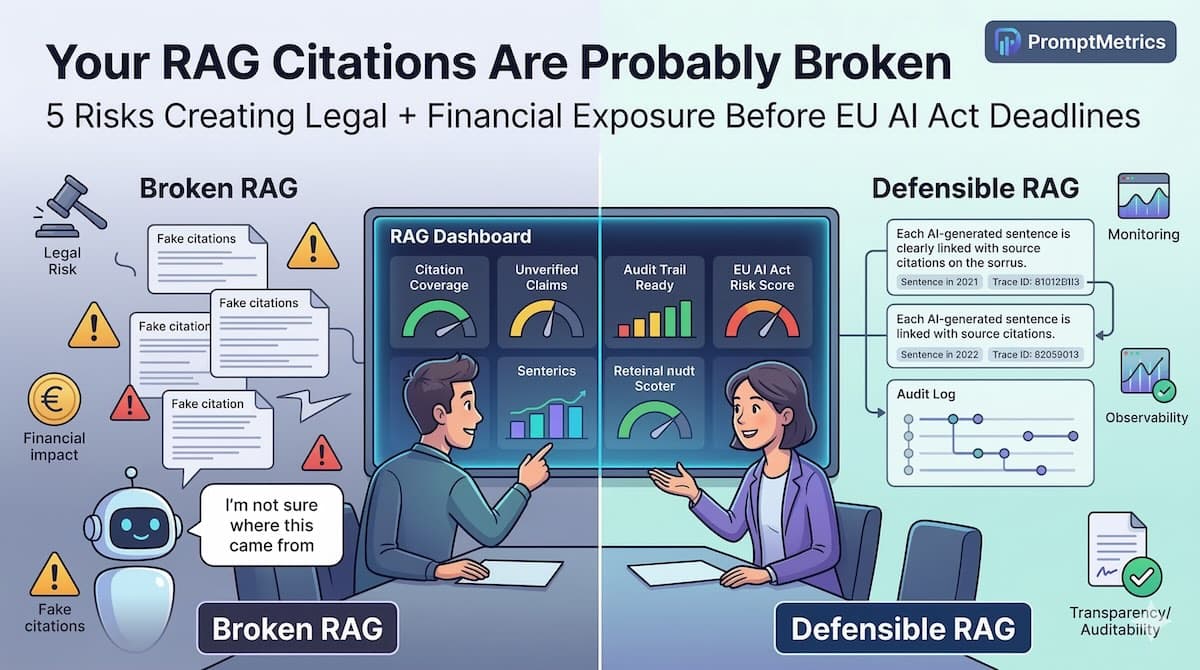
Article 12 of the EU AI Act requires automatic logging for high-risk AI systems. These practical requirements flow from Article 1212'socus on traceability and post-market monitoring:
Traceability: Every AI interaction must be linked to an authorized user and an authentication method.
Input/output capturing: Exact prompts, model responses, and post-processing must be recorded.
Data lineage: You must be able to trace which model version and fine-tuning data were used for each inference.
Integrity: Logs must be protected against undetected tampering to serve as a valid audit trail.
The enforcement is serious. The EU AI Act imposes substantial penalties: fines can reach up to €35 million or 7% of global turnover for prohibited AI practices, and there are significant penalties for other compliance failures, including logging requirements.
Now consider your current setup: Can your self-hosted instance provide an immutable audit log that satisfies an external auditor? These aren't criticisms of the tool;s Langfuse is outstanding at what it was built for. It wasn't designed with EU regulatory compliance as its primary constraint.
A Simple TCO Model for EU Observability
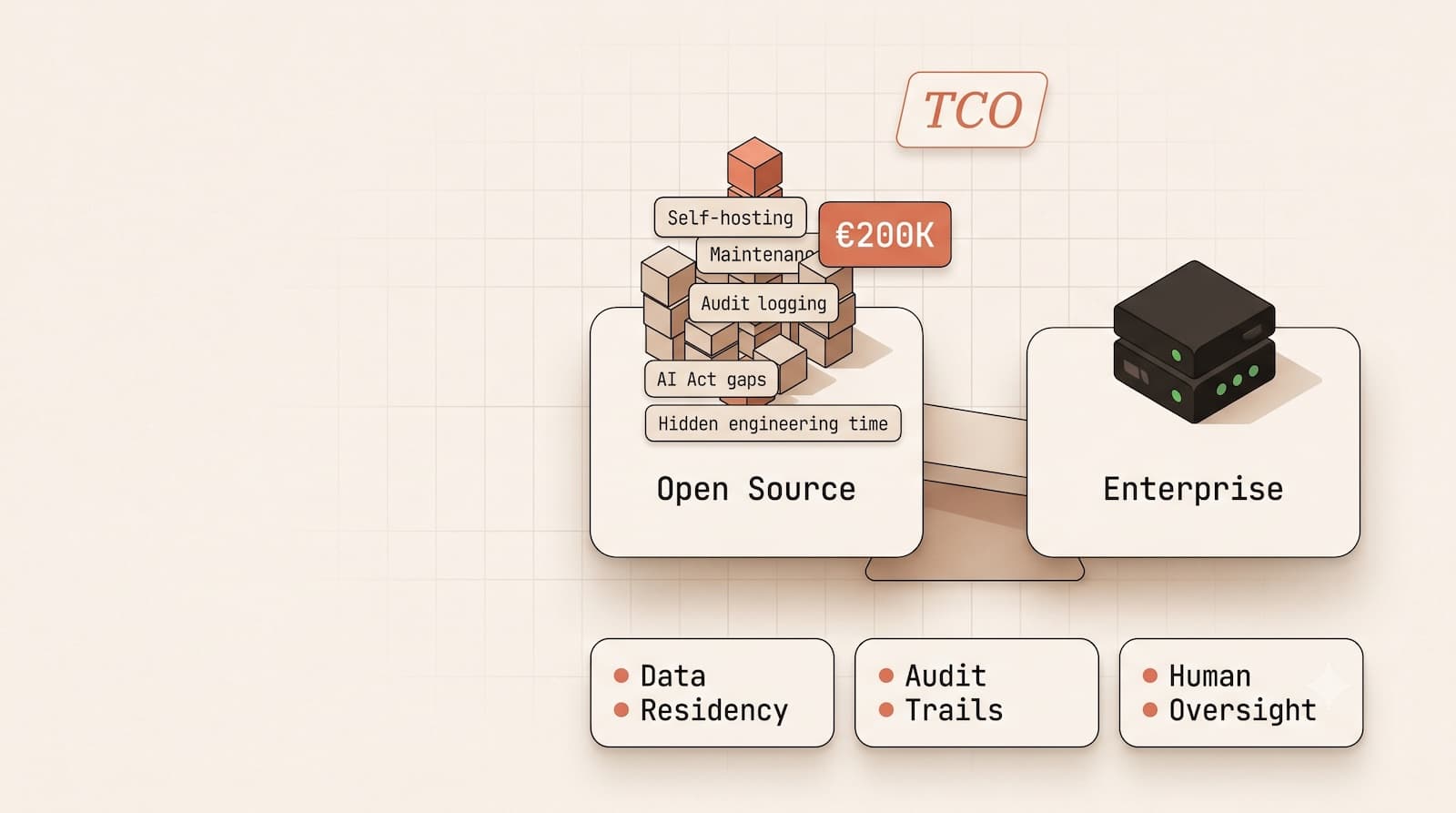
Here is an estimated model of what observability costs over 18 months for a typical Series A startup processing EU data.
DIY/Open Source Path (Estimated)
Infrastructure: EU hosting, storage, networking, backups: ~€30–50K
Engineering: 0.5 FTE for maintenance, ops, compliance work: ~€55–70K
Compliance Overhead: Documentation, audit prep, consulting: ~€60–100K
Risk: Unquantified exposure to fines or due diligence failure.
Total 18-month estimated cost: €145–220K
Enterprise Path (Estimated)
Platform subscription: ~€24–60K (varies by usage)
Implementation time: 1–2 weeks (vs. months of ongoing maintenance)
Compliance documentation: Included
Total 18-month estimated cost: €30–80K
Note: These ranges are directional, but they're consistent with public estimates for GDPR/AI Act compliance and DevOps staffing costs.
The crossover point: For most EU startups with >€10K monthly LLM spend, enterprise solutions often become cost-neutral within roughly 6–8 months once you factor in engineering time and compliance overhead.
Three Buyer Scenarios
Which path should you take?
Scenario 1: Pre-product startup (3-8 engineers, <€8K/mo LLM spend)
Go open source. You're still iterating rapidly, and your legal team hasn't mentioned the AI Act yet. Preserving cash is critical. Use Langfuse or Phoenix, but plan to migrate when you reach product-market fit.
Scenario 2: Growth-stage startup The Danger Zone (8-15 engineers, €15-25K/mo LLM spend)
You have EU customers, and your lawyers are starting to ask questions. You need compliance, butcan'tt afford an engineering distraction. Consider an enterprise if you are handling EU personal data or planning Series B fundraising within 12 months. The compliance documentation alone will save months of due diligence delays.
Scenario 3: Scale-up with enterprise customers (15+ engineers, €25K+ LLM spend)
Go Enterprise. It is likely cheaper when you factor in opportunity costs. Large customers will ask about your AI governance, data residency, and compliance posture. Having proper answers accelerates sales cycles.
In all three scenarios, the key is picking a solution that can grow with you, start simple, scale to compliance-ready, without forcing a rip-and-replace migration.
Why Europe Needs European-First Observability
The Valley-centric observability discourse focuses on technical features,s SDK ease, latency metrics, and dashboard aesthetics. These matters, but they miss the point for European companies.
Most monitoring products still use traces and dashboards. EU buyers need those, but they also need exportable evidence packages they can show to auditors, customers, and investors without spinning up a new project every quarter. The "free" option often becomes the most expensive option because it lacks this context.
What EU CTOs need is observability built European-first: data residency in EU regions by default, Article 12 compliance out of the box, transparent pricing without vendor lock-in, and support teams that understand European regulatory requirements.
This is what we set out to solve with PromptMetrics, a European-first observability platform designed around these constraints:
EU-First Architecture: We store all logs in EU data centers by default.
Compliance Ready: We provide exportable, cryptographically signed audit trails you can hand directly to auditors.
No Lock-In: We use OpenTelemetry-native integration, so you own your data. You can adopt it as a SaaS platform while keeping it open-source.
Your LLM observability shouldn't be your biggest compliance liability; it should be your strongest compliance asset.
The Bottom Line
Open-source LLM observability tools are technically excellent and well-suited for prototyping. But for EU startups handling customer data, the total cost of ownership often exceeds enterprise pricing within the first year of production.
So the real question is not "open source vs enterprise," but "where do you want your scarce engineering hours and compliance budget to go?"
Ready to see European-first LLM observability in action? Explore PromptMetrics, built for European companies that need enterprise reliability without vendor lock-in.