
The 5 problems with aggressive LLM cost optimization:
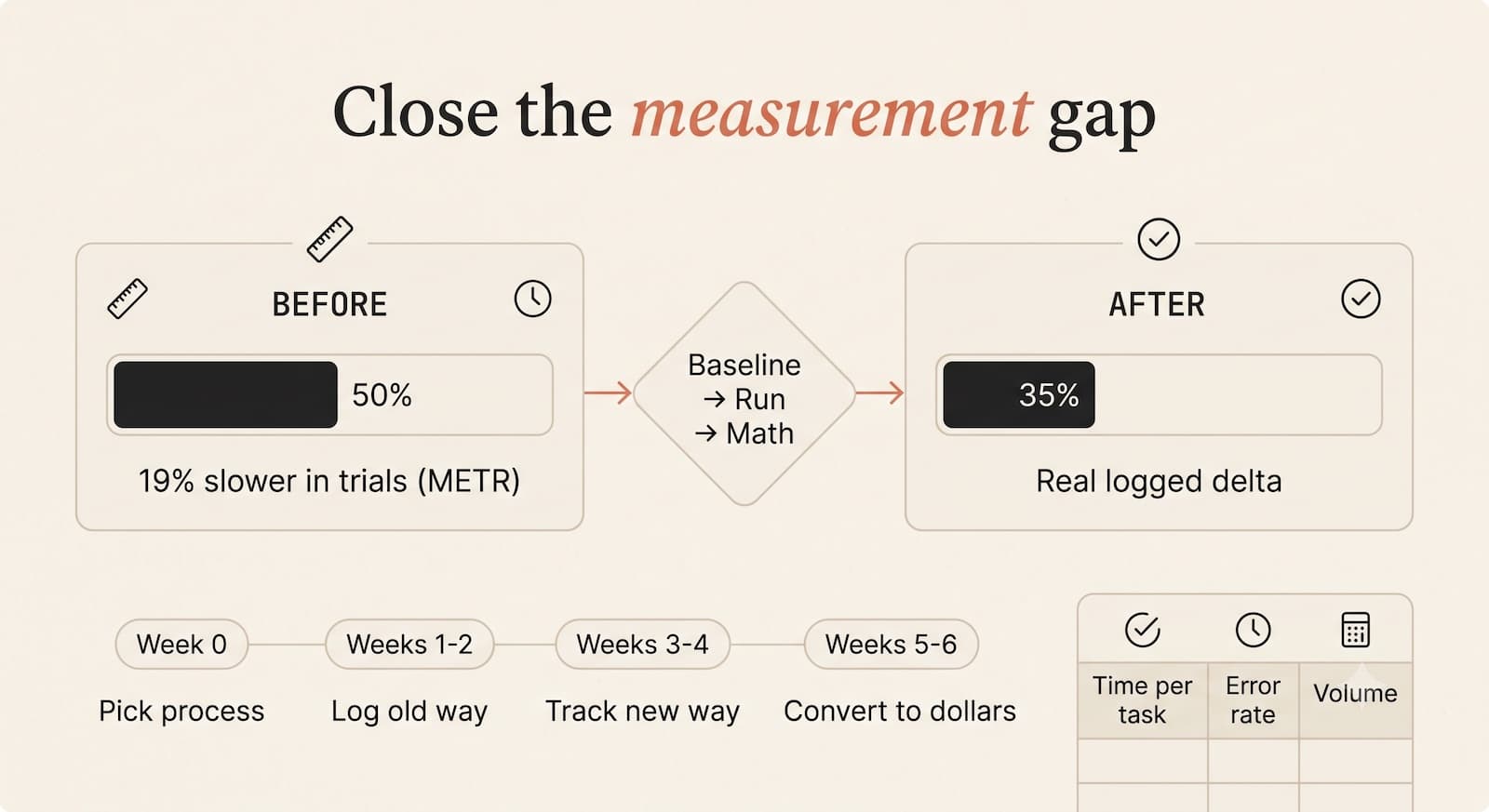
You can't measure what you've lost without quality baselines
Silent degradation goes undetected for weeks
The "shitty baseline" inflates your savings story
Prompt-model coupling breaks when you swap models
The monitoring gap means most teams are flying blind
You've seen the headline. Maybe you've bookmarked it. "How I Reduced Our LLM Costs by 88%."
The formula looks simple: record your GPT-4 calls, fine-tune a smaller model on the outputs, swap it in, and watch your bill evaporate from $10 to $1.20 per million input tokens. Output costs fall from $30 to $1.60. Ship it.
Here's the part they don't tell you: that 85% savings can silently destroy your product quality, and without the right infrastructure, you won't know until customers start leaving or worse, until your support team surfaces a pattern of complaints that's been building for weeks.
We're not here to talk you out of optimizing. The cost reduction opportunity is real. But after working with engineering teams navigating this exact transition, we've seen the same five problems recur. Problems that turn a smart cost play into a quality crisis.
Let's walk through them so you can avoid the expensive surprises.
1. You Can't Measure What You've Lost Without Quality Baselines
Here's the most common mistake: teams switch to a cheaper model without ever measuring what the more expensive model produced.
Think about that for a second. If GPT-4 scores 92% on your quality rubric across 1,000 representative inputs, that number is your benchmark. Without it, you have no idea whether your fine-tuned Mistral is matching performance or quietly degrading.
Quality baselines require three things most teams skip:
Defining "good" for each prompt. For summarization, that's factual accuracy, coverage of key points, and appropriate length. For classification, the metrics are precision and recall. For generations, tone consistency and hallucination rate have been studied. These definitions need to be explicit and measurable, not vibes.
Scoring a statistically significant sample. Automated evaluation, whether that's LLM-as-judge scoring, semantic similarity metrics, or structured human review, creates the ground truth that makes model comparison possible.
Establishing acceptable degradation thresholds. Parameter-efficient fine-tuning methods like LoRA can achieve 80–90% cost reduction with less than 1% quality degradation. But "less than 1%" has to be validated against your specific use case. A 1% accuracy drop for a customer service chatbot means something very different than a 1% drop for a medical information system.
The key insight: you cannot build these baselines retroactively. If you switch to a cheaper model without first measuring the quality of the more expensive model, you've saved money but have no idea what you've lost.
2. Silent Degradation Goes Undetected for Weeks
This is the problem that keeps CTOs up at night, or rather, it should, because most don't even know it's happening.
Research shows that 75% of companies experience a decline in AI performance within months without monitoring, with error rates increasing by up to 35% within six months. The degradation is rarely sudden. It's a slow drift, outputs become slightly less precise, responses vary more for similar inputs, and hallucination rates creep up.
Unlike a service outage, a drop in answer quality doesn't trigger a PagerDuty alert. Your Datadog dashboard shows a healthy 200 OK response in 200ms, but that response could be completely hallucinated.
By the time someone files a bug report, the damage has been compounding for weeks. Research shows drift is often present for 3–6 weeks before detection. Your lower-cost model has been consistently producing mediocre results, and your traditional APM tools told you everything was fine because they measure infrastructure health, not semantic quality.
What this means in practice: Continuous quality scoring becomes non-negotiable. Not periodic spot checks, automated evaluation running on every response (or a statistically valid sample), with scores tracked over time. You need drift detection that flags shifting patterns before accuracy metrics collapse.
3. The "Shitty Baseline" Inflates Your Savings Story
Here's an uncomfortable truth about those eye-popping cost reduction numbers: the magnitude of the savings is often inversely proportional to the efficiency of the starting point.
As one Reddit commenter put it perfectly: "The shittier the baseline, the more impressive the optimization."
Many early LLM applications were built for speed-to-market, not token efficiency. Developers used GPT-4 for everything,g including tasks a BERT-sized model could handle with 95% accuracy. They stuffed context windows with redundant documents, used verbose system prompts, and ignored caching entirely.
In that scenario, an 85% cost reduction isn't a breakthrough in model distillation. It's the remediation of technical debt. It's the difference between "we invented a better optimization technique" and "we stopped using GPT-4 to classify support tickets into three categories."
Why this matters for your planning: If your team has already implemented prompt caching, context filtering, and basic model routing, the remaining optimization headroom may be 30–40% rather than 85%. That's still significant, but it requires more surgical precision and much better observability to execute safely.
The teams that achieve massive savings without quality regression aren't just swapping models. They're right-sizing every prompt to the appropriate model, aggressively caching, and removing redundant steps from their LLM chains. And every one of those optimizations requires data you can only get from call-level logging.
4. Prompt-Model Coupling Breaks When You Swap Models
Here's something the "I saved 85%" posts rarely mention: the same prompt behaves differently across models.
A prompt engineered for GPT-4's reasoning capabilities might produce inferior results on a fine-tuned 7-billion-parameter model like Mistral 7B, even if the fine-tuning data came from GPT-4 responses to that exact prompt. The instruction-following patterns, the implicit reasoning chains, and the way context is weighted all vary between architectures.
This means prompt management is inseparable from cost optimization. When teams discover this mid-migration, it cascades into a much larger project than they planned for:
Per-prompt evaluation becomes essential. Your summarization prompt might transfer well to a smaller model, while your classification prompt degrades significantly. Blanket model swaps don't work.
Prompt versioning gets complicated fast. You need to track which prompt-model combination produces which quality scores. The prompt that works with GPT-4 may need significant reworking for Mistral.
A/B testing multiplies. You're not just testing Model A vs. Model B, you're testing Prompt-v1 + Model A vs. Prompt-v2 + Model B, with quality gates at each combination.
The most cost-effective architecture isn't "replace everything with the cheapest model." It uses intelligent routing, deploying expensive models only where they're genuinely needed and cheaper models where they perform equivalently. But you can only build that routing logic if you have prompt-level quality and cost data.
5. The Monitoring Gap Means Most Teams Are Flying Blind
Here's the stat that should alarm every engineering leader: fewer than half of organizations just 48% monitor their production AI systems for accuracy, drift, and misuse. Among small companies, that number drops to 9%.
Read that again. Most teams running LLMs in production have no systematic way to detect quality degradation. If you're one of them, every model switch is a blind bet.
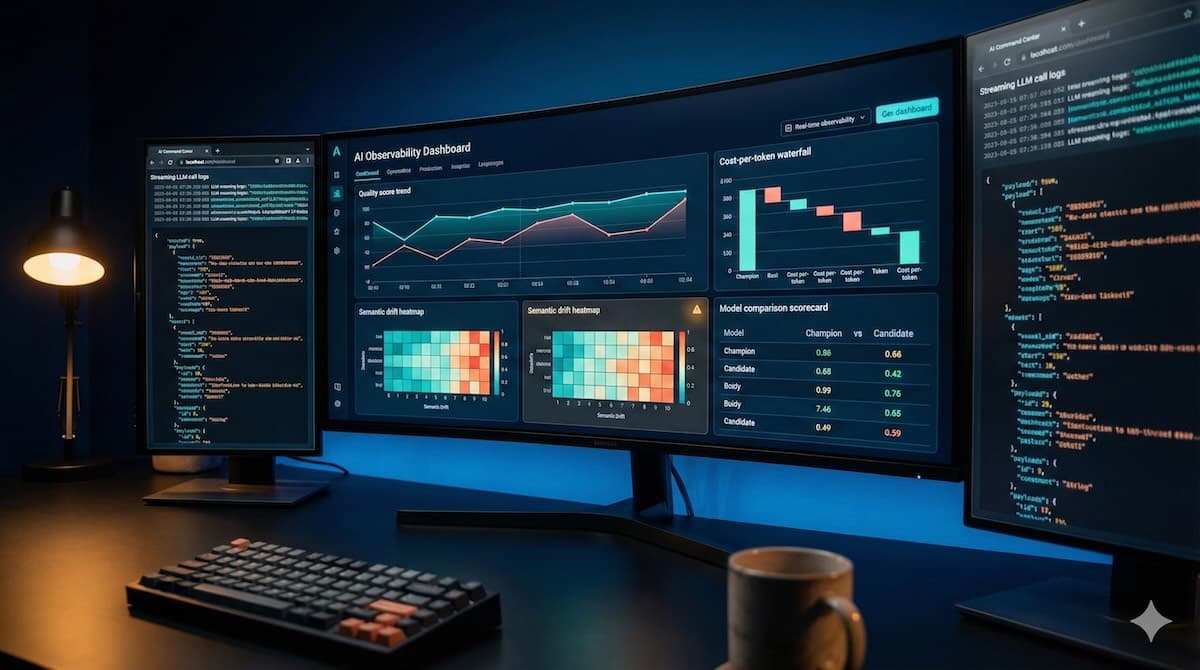
This is the monitoring gap: the space between "we switched to a cheaper model" and "we know the cheaper model is still performing well." It exists because traditional observability tools weren't designed for probabilistic systems. They tell you the API responded. They don't tell you what it said or whether the answer was any good.
Closing this gap requires a fundamentally different approach to monitoring:
Continuous quality scoring, not just uptime checks
Drift detection with semantic alerting flagging when response patterns shift, not just when servers go down
Regression testing on prompt updates, because a prompt tweak that improves one model might break another
Per-prompt cost tracking, because some prompts are perfect candidates for a cheaper model, while others need to stay on the expensive one
Without this layer, model switching is a leap of faith. You've optimized your bill, but you have no proof that quality was maintained.
When LLM Cost Optimization Isn't Right for You
Let's be direct. Aggressive cost optimization model switching, fine-tuning,and cascading might not be the right move if:
Your LLM spend is typically under €5K/month. In our experience, the engineering investment in safe model switching may not justify the savings at a small scale.
You don't have call-level logging yet. Without a dataset of your actual production prompts and responses, you're optimizing blind. Start with observability.
Your application hasn't stabilized. If you're still iterating rapidly on prompts and features, locking in a fine-tuned model creates rigidity at the worst time.
Quality is your differentiator. If your product wins on output quality and you can't afford any degradation, the risk-reward calculus changes significantly.
None of these is a permanent disqualifier. They're signals that you might need to build the foundation before chasing the headline number.
But if you have those foundations, logging, baselines, stable prompts, then the question shifts from "should we optimize?" to "how do we do it safely?"
The Playbook: Don't Flip. Fade.
The good news: every one of these problems is solvable. Teams that optimize successfully follow a consistent pattern; they don't flip a switch. They fade between models.
Shadow test first. Run the candidate model in parallel with production. Both receive identical inputs. Only the production model's output reaches users. Compare outputs systematically through automated scoring, not by eyeballing a handful of responses.
A/B test with quality gates. Route 5–10% of traffic to the new model while monitoring quality scores in real time. Set automatic rollback thresholds. If quality drops below your baseline, traffic shifts back automatically.
Roll out gradually. Increase traffic incrementally by 10%, 25%, 50%, and 100%, with a mandatory hold period at each stage. The entire rollout might take two to four weeks. That feels slow compared to a single deployment, but it's fast compared to recovering from a quality crisis that went undetected for a month.
This approach trades speed for confidence. And confidence, backed by data, is what separates a successful optimization from a quality crisis nobody saw coming.
Optimize With Confidence, Not Hope
The LLM cost optimization opportunity is real. Fine-tuning, model cascading, and intelligent routing can reduce inference costs by 80–98% for many use cases. But the prerequisite is visibility.
You can't optimize what you can't measure. You can't safely switch models without quality baselines. You can't maintain quality without continuous monitoring. And you can't route intelligently without prompt-level data.
The next time you see an "85% cost reduction" headline, ask the question that matters: how do they know the cheaper model is still performing?
If the answer isn't "continuous monitoring with quality baselines," the real cost hasn't been calculated yet.
Ready to optimize with confidence? PromptMetrics gives you call-level logging, automated quality scoring, and drift detection so you can optimize with data, not hope. Start monitoring for free → See what 85% savings actually costs.