
Most teams are asking the wrong question.
Not: "Which LLM observability tool is best?"
The real question: "Which stack helps us ship faster, catch failures earlier, and stay audit-ready in the EU?"
Based on the evidence set, here is the punchier, operator-first answer.
Full Transparency: This analysis of the observability landscape is based on external practitioner research (33+ Reddit threads, 300+ comments, and market data). PromptMetrics is included in this post as our recommended solution for the governance layer, distinct from the external research findings.
Executive Take: What Wins in Production
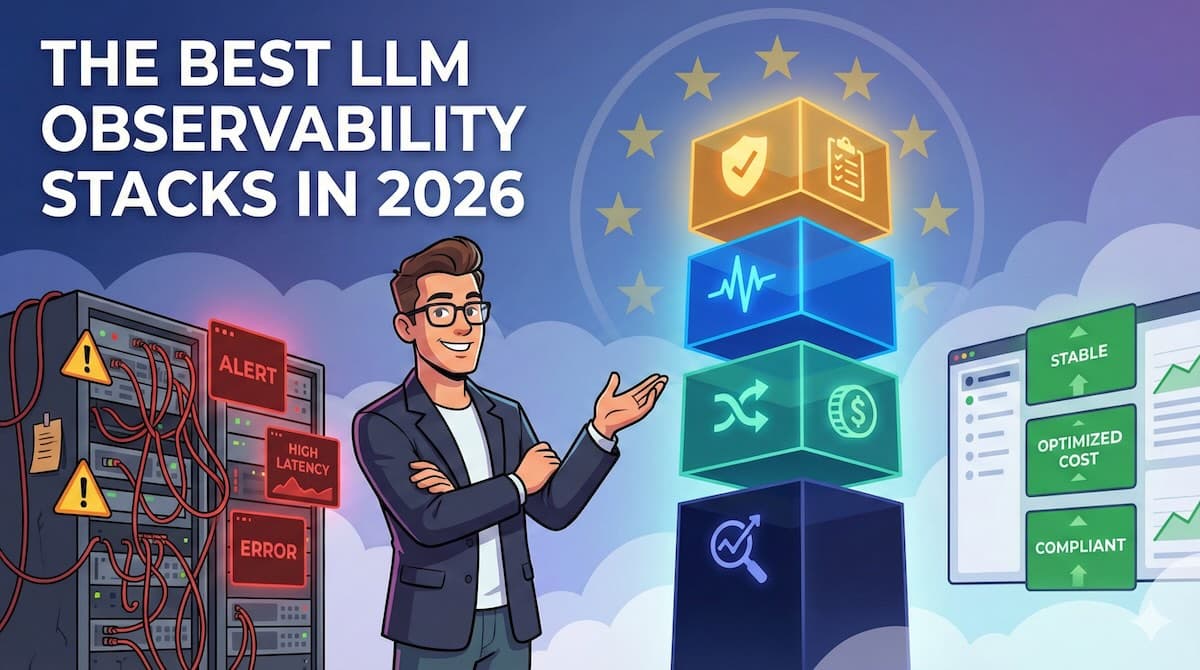
The practical winner is not one tool; it is a layered setup.
The pattern experienced teams are converging on covers three layers:
Tracing & Lifecycle: Langfuse (Open-source favorite)
Routing & Cost: LiteLLM (Abstraction) or Helicone (Logging)
Instrumentation: OpenTelemetry (Future-proofing)
The Missing Piece: While the research shows teams have made real progress on basic tracing and cost visibility, two gaps remain. Multi-agent debugging remains a hard engineering problem largely unsolved by current tooling. Production governance is the second gap.
That is where PromptMetrics fits in: moving from "did the model error?" to "is this prompt change compliant, tested, and approved for production?"
The Stack Layers
1. The Tracing Layer: Langfuse
Langfuse remains the strongest open-source default in the research set.
Why it keeps winning:
Strong self-hosting support (essential for data residency).
Deep integration of tracing with prompt management.
Broad SDK support.
Use it when:
Your team demands engineering control.
Data residency is a non-negotiable requirement.
You want to avoid closed-garden ecosystems.
Note: ClickHouse acquired Langfuse in January 2026. While the self-hosting option remains intact, teams with strict sovereignty requirements should monitor how the product roadmap evolves under new ownership.
2. The Proxy & Gateway Layer: LiteLLM or Helicone
A) LiteLLM: Best for Routing & Abstraction.
Use this if you need a unified API to swap between 100+ providers (OpenAI, Anthropic, Azure) without changing code. It allows fallback logic (if OpenAI is down, try Azure) to maintain high uptime.
B) Helicone: Best for Drop-in Logging.
Use this if you need immediate cost dashboards and caching with zero SDK overhead—change your base URL, and you are live.
Use a proxy when:
Monthly spend is scaling faster than user growth.
You need to route traffic dynamically based on cost or latency.
3. The Framework-Native Layer: LangSmith
If your stack is built entirely on LangChain or LangGraph, LangSmith offers the fastest time-to-value.
Use it when:
You need velocity right now within the LangChain ecosystem.
You accept tighter coupling in exchange for smoother debugging.
⚠️ Caveat:
Migrating away becomes difficult if youlater decide to drop LangChair.
Research threads note persistent UI changes that have prompted some teams to evaluate alternatives actively.
4. The Governance & Compliance Layer: PromptMetrics
While tools like Langfuse handle the traces (what happened?), PromptMetrics handles the controls (what is allowed to happen?).
For EU startups building High-Risk AI systems, observability alone is not enough. You need the documentation and approval workflows required by Article 12 (Record Keeping) and Article 9 (Risk Management). Even for non-high-risk systems, enterprise procurement is increasingly demanding this level of "compliance-grade" posture.
PromptMetrics delivers:
Prompt Lifecycle Management: Versioning, testing, and approval gates before deployment.
Cost & Business Context: Tying spend not just to a "trace," but to a specific feature or customer tier.
Audit-Readiness: Automated history of who changed a prompt, why, and when.
Use PromptMetrics when:
You are moving beyond PoC and need repeatable production controls.
Leadership demands reporting that connects AI behavior to business risk.
EU AI Act compliance is a roadmap requirement.
5. The Instrumentation Layer: OpenTelemetry
Treat LLM telemetry as part of your core observability system, not a side channel.
OTel-first helps you:
Reduce vendor lock-in.
Correlate model latency with database or API latency in a single view.
Keep your data portable as the tooling landscape shifts.
Use OTel when:
You are building your observability stack from scratch and want vendor-portable telemetry from day one.
You are already running Datadog, Grafana, or a similar APM stack.
Your team wants to avoid instrumenting AI and application infrastructure separately.
What the "Best" Teams Actually Do
Week 1: The Basics
Add tracing (Langfuse).
Add proxy-level cost visibility (Helicone/LiteLLM).
Install three hard alerts: Latency spikes, Error rate, and Daily spend limit.
Month 1: The Quality Loop
Create a "gold dataset" from real user traffic.
Run sampled evaluations (don't judge 100% of traffic).
Enforce prompt versioning.
Quarter 1: The Governance Layer (EU Readiness)
Implement PromptMetrics: Establish approval workflows for prompt changes.
Map to Regulation: Ensure your logging complies with Article 12 (automatic recording of events) if you fall into high-risk categories.
Documentation: Generate audit trails for model decisions.
Biggest Mistake to Avoid
Do not evaluate every request in production with expensive judge pipelines.
Research shows a common pattern in which the observability cost rivals the inference cost because teams run an LLM-as-a-judge on every transaction.
Winning teams use:
Sampled evaluation (e.g., 5% of traffic).
Risk-based slices (evaluate 100% of "high risk" topics).
Human review where business impact is highest.
EU CTO Bottom Line
By 2026, observability without governance is incomplete.
To survive board scrutiny and regulatory pressure (specifically the August 2026 deadline for high-risk systems), your stack needs four pillars:
Tracing & debugging speed (Langfuse)
Cost/Routing control (LiteLLM/Helicone)
Infrastructure portability (OpenTelemetry)
Policy & Audit discipline (PromptMetrics)
This isn't just about trending tools; it's about building a stack that keeps you fast, solvent, and legal.
Want to see where your stack stands on governance and audit-readiness?