
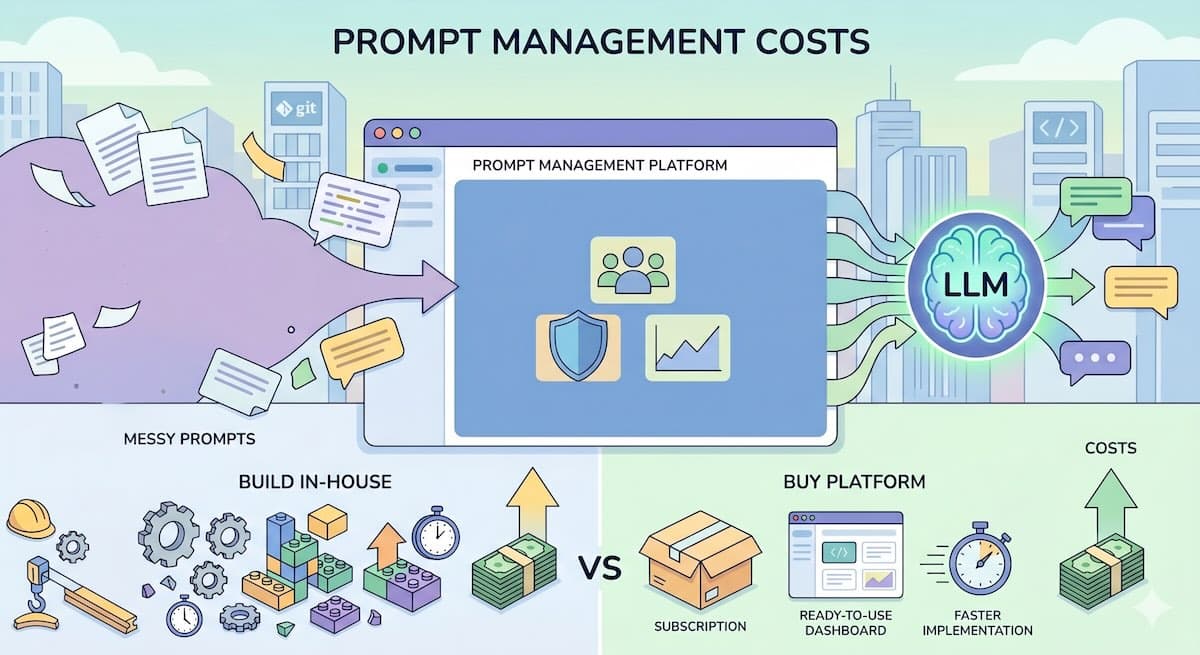
If you're scaling your company's use of large language models (LLMs), you've likely realized that managing prompts in spreadsheets and Git repos doesn't cut it for long. As you move from experimentation to production, you need a system that supports collaboration, versioning, testing, and governance.
That brings you to a critical question: How much will a dedicated prompt management platform cost?
The short answer: enterprise-grade prompt management software ranges from $500/month for a small team to over $25,000/month for a large-scale, compliant deployment. The market is estimated to reach $791 million in 2025 and is growing at a 32.5% CAGR (Technavio, 2025).
But that range doesn't tell the whole story. The final price depends on four core factors: your team size, usage scale, security and compliance needs, and deployment model. Let's break down the real cost of ownership.
Key Takeaways
Enterprise prompt management platforms cost $500–$25,000+/month depending on seats, usage, compliance, and deployment model (Technavio, 2025)
The average enterprise manages 1,200+ unique prompts across departments; poorly engineered prompts can inflate token usage by 40–65%
Building in-house costs $350K–$500K in year one alone, buying a platform typically breaks even within 6 months
Shadow AI adds $670K to breach costs on average, making governance features a risk mitigation investment, not a luxury (IBM, 2025)
What drives the cost? The 4 core levers
Understanding your needs is the first step to understanding the price. Vendors structure their pricing around four key variables.
Seats (your team size)
The most straightforward factor. How many prompt engineers, developers, product managers, and data scientists need access to create, review, and manage prompts? Most pricing models have a per-user component, typically $50–$150/user/month at the team tier, dropping at enterprise scale.
Usage (your operational scale)
This is about volume. It's not just how many prompts you have, but how you use them. According to industry benchmarks, the average enterprise deploying generative AI manages over 1,200 unique prompts across departments. Key metrics vendors track include: prompts under management, A/B test frequency, API calls routed through the platform, and the number of environments (dev, staging, prod) you support.
Compliance and security (your risk profile)
This is a significant cost driver for enterprises. If you operate in a regulated industry like finance or healthcare, you'll need SOC 2 Type II compliance, HIPAA attestation, Role-Based Access Control (RBAC), single sign-on (SSO), and user provisioning (SCIM). These aren't checkboxes; they represent substantial platform investment and are priced as premium, enterprise-tier features.
The stakes are real. IBM's 2025 Cost of a Data Breach Report found that shadow AI adds an average of $670,000 to breach costs, yet only 37% of organizations have governance policies to detect it (IBM, 2025). A platform with audit logs and access controls isn't overhead; it's risk mitigation.
Deployment model (cloud vs. self-hosted)
Do you want a simple SaaS solution, or do you need to host the platform in your own virtual private cloud for greater control over data and security? A self-hosted or VPC deployment provides maximum protection but comes with a higher license fee and the added responsibility of managing the underlying infrastructure. In our experience, self-hosted deployments typically add 20–35% to the license cost plus $50K–$100K/year in infrastructure and DevOps overhead.
What pricing models will you actually see?
Vendors in the AI tooling space generally use one of three models. Sometimes, they blend them.
Per-Seat Pricing: The simplest model. You pay a fixed monthly fee per user. This is common for entry-level plans, making costs highly predictable for small teams, for example, $75/user/month.
Usage-Based Pricing: You pay for what you use. This could be based on the number of managed prompts, API calls, or evaluation runs. This model aligns cost with value but makes forecasting trickier. For instance, platforms like LangSmith charge per trace, while others meter by request volume.
Platform Fee / Tiered Plans: The most common model. It bundles a certain number of seats and usage limits into tiers (Starter, Business, Enterprise). Each tier unlocks more capabilities, particularly around security and governance. This gives you predictable costs with room to scale.
Based on current market conditions, here's what you can realistically expect to budget.
Tier | Typical User Count | Key Features | Estimated Monthly Cost (SaaS) |
Starter / Team | 2-10 | Prompt versioning, basic collaboration, and integrations | $500 – $2,000 |
Business / Pro | 10-50 | A/B testing, analytics, basic RBAC, SSO | $2,000 – $8,000 |
Enterprise | 50+ | Full audit logs, SOC 2, SCIM, and VPC deployment option | $8,000 – $25,000+ |
Enterprise contracts are almost always billed annually, with typical contract values ranging from $100,000 to $300,000 per year, depending on the complexity, deployment model, and usage volume.
What do real-world deployments actually cost?
Let's make this tangible. Here are three common scenarios showing how the costs stack up.
Scenario 1: The startup (5 engineers)
This team is moving fast and needs a central place to collaborate on prompts for their new AI feature. They don't need enterprise compliance yet, just version control and team access.
Model: Cloud SaaS, Team Tier
Line Items:
Platform Fee (up to 10 seats): $1,500/month
Usage Overage (occasional testing spikes): $200/month
Total Estimated Monthly Cost: $1,700
Scenario 2: The mid-market company (25 users, multiple squads)
This company has several product teams building AI features and needs consistency and quality. The security team requires SSO. They're at the stage where moving from prototype to production becomes the critical challenge.
Model: Cloud SaaS, Business Tier
Line Items:
Platform Fee (up to 25 seats, includes SSO): $6,000/month
Advanced Analytics Add-on: $1,000/month
Total Estimated Monthly Cost: $7,000
Scenario 3: The enterprise (100+ users, regulated industry)
A financial services firm needs to deploy a prompt management system within its own cloud environment to meet data residency and compliance requirements. Their AI architecture decisions already include multi-model routing, making governance essential.
Model: Self-Hosted (VPC), Enterprise Tier
Line Items:
Annual Platform License (billed annually at $240,000): $20,000/month
Dedicated Support & Onboarding Package: $2,500/month
Indirect Cost: Internal Infrastructure & DevOps (see below): ~$5,000/month
Total Estimated Monthly Cost: $27,500
What hidden costs will surprise you?
The sticker price is just the beginning. The total cost of ownership (TCO) includes factors that first-time buyers consistently underestimate.
Implementation & Onboarding: Factor in time for your team to get set up and migrate existing prompts. For complex enterprise setups, expect a one-time professional services fee of $10,000 to $25,000.
Training & Adoption: A tool is useless if nobody uses it correctly. Budget time for your engineers and PMs to learn the new workflow. In our experience, teams need 2–4 weeks for the platform to become their default workflow rather than something they work around.
Integration Maintenance: Your prompt management tool connects to your CI/CD pipeline, model providers, and observability stack. These integrations require ongoing maintenance from your platform engineering team. Plan for 5–10 hours/month of engineering time.
Self-Hosting Overhead: If you choose self-hosted, you own the infrastructure costs (compute, storage) and the salaries of the DevOps engineers madeploymentloyment. This can easily add $50,000–$100,000 per year to TCO.
Why do these hidden costs matter? Because the platform fee is typically only 60–70% of true TCO. The rest comes from the operational wrappers around it.
How can you lower your total cost of ownership?
You can control your spending without sacrificing capabilities. Here's what we've seen work.
Sign an Annual Contract: Vendors almost always offer a 10–20% discount for an annual upfront commitment versus month-to-month. On a $100K contract, that's $10K–$20K saved.
Right-size Your Tier: Be honest about your needs. Don't pay for enterprise compliance features like SCIM if you have 15 users and no immediate plans to use them. Start lower and upgrade as you scale.
Bundle with Other Services: Some vendors offer suites of AI development tools. Purchasing multiple products from the same provider often leads to bundled discounts of 15–25%.
Focus on Prompt Optimization: an indirect but powerful lever. A good prompt management platform helps you design more efficient prompts. Reducing your average tokens per request by just 15% can translate into tens of thousands of dollars in API cost savings with providers like OpenAI and Anthropic. As we covered in our guide to cutting AI costs, prompt-level optimization is often the highest-ROI lever available.
OpenAI's deep dive on prompt caching, a technique that can cut input token costs by 50–90% when combined with structured prompt management.
Build vs. buy: what's the real math?
Your engineering team might say, "We can build this ourselves." It's tempting, but the numbers tell a different story.
Metric | Build (DIY) | Buy (SaaS Platform) |
Initial Cost (Year 1) | $350,000 - $500,000 | $100,000 - $300,000 |
Ongoing Cost (Year 2+) | $180,000+ | $100,000 - $300,000 |
Time to Value | 9-12 months | 2-4 weeks |
Key Risk | Diverts top engineering talent from core product work. | Vendor lock-in, reliance on the vendor roadmap. |
The verdict: For most organizations, building a homegrown solution is a costly distraction. The initial build cost is high, and the ongoing maintenance burden is consistently underestimated. Buying a dedicated platform gets you best-in-class features, compliance, and support immediately, letting your team focus on building your actual product rather than infrastructure.
But this isn't just about cost, it's about speed to value. A purchased platform delivers in weeks what a build team takes the better part of a year to build. In a market moving as fast as AI, that time gap is hard to overstate.
What do you actually need at the stage of maturity?
Don't overbuy. Match the tool to where your team is right now.
Experimentation Stage (1–5 people): You need version control and a way to share findings. Git and a well-organized Confluence/Notion page are often enough to get started. When prompt collaboration starts causing merge conflicts in your prompt files, that's your signal to upgrade.
stageng Stage (5–25 people): Collaboration is getting messy. You need a centralized prompt library, A/B testing, and analytics to see what's working. A Business/Pro tier plan is a perfect fit. This is the stage where context-engineering vs. flow-based agent-design decisions start to matter.
Enterprise Stage (25+ people): You're operating at scale, and risk is a significant concern. You need full audit logs, granular access controls (RBAC), and security compliance (SOC 2). This is where you invest in a true enterprise-grade platform. At this scale, evaluation datasets become as important as the prompts themselves.
What questions should you ask vendors before signing?
Before you commit, arm yourself with these questions to get beyond the sales pitch.
On pricing: "What exactly triggers overage costs on your usage-based plans? Can we set hard spending limits to prevent unexpected bills?"
On security: "Can you provide your full SOC 2 Type II report for our review? How do you segregate our data from other customer deployments? "For a VPC deployment, what are the specific infrastructure requirements? What's the typical setup time from contract to production?" latency: "What's the median and 99th percentile latency your platform adds to our end-to-end LLM calls?"
roadmap: "What are your top three product priorities for the next six months? How do you incorporate customer feedback into your roadmap?"
A practical walkthrough of prompt engineering techniques, including output length management and model selection, that directly impact your API costs.
When does a prompt management platform actually pay for itself?
The cost is only half the equation. A good platform pays for itself through three main channels.
Engineer Productivity: A centralized platform can save each engineer 5–10 hours per week by eliminating disorganized workflows and redundant work. For an AI engineer with a $180,000 salary, reclaiming just 5 hours a week translates to over $22,000 in productivity per engineer per year.
Reduced LLM API Spend: By systematically testing and optimizing prompts, teams can often reduce token consumption by 10–30%. If you spend $500,000 annually on LLM APIs, a 10% reduction saves you $50,000 per year, which alone can cover the cost of the platform.
Reduced Risk: The cost of a security breach or compliance failure from poorly governed AI can be catastrophic. According to IBM's 2025 Cost of a Data Breach Report, shadow AI adds an average of $670,000 to breach costs, and 97% of organizations breached via AI lacked basic access controls (IBM, 2025). A platform with audit logs and access controls is critical risk mitigation, not a nice-to-have.
When you factor in faster time-to-market for new AI features, the ROI becomes even clearer. The platform isn't a cost center. It's an accelerator.
Frequently asked questions
Can't we use Git for prompt management?
Git works well for code but falls short for prompts. It lacks A/B testing, analytics on prompt performance, and the collaboration workflows non-engineers need. At the experimentation stage, Git plus Notion is a reasonable starting point. Once you cross 5–10 team members or start deploying to production, the workflow breaks down. A dedicated platform adds the governance layer that Git alone can't provide.
How long does enterprise deployment typically take?
SaaS deployment: 1–2 weeks for basic setup, 2–4 weeks for full team adoption. Self-hosted/VPC deployment: 4–8 weeks, including infrastructure provisioning, security review, and integration with existing SSO/SCIM systems. Enterprise contracts often include a dedicated onboarding package ($15K–$25K) to accelerate this timeline.
What's the difference between prompt management and LLM observability?
They overlap but serve different primary functions. Prompt management focuses on the creation, versioning, testing, and governance of prompts themselves. LLM observability (tools like LangSmith, Helicone) focuses on monitoring production behavior, token usage, error rates, and output quality. Most enterprise deployments need both, and many platforms now offer integrated solutions.
Do we need prompt management if we're fine-tuning models?
Yes, and in some ways, even more so. Fine-tuned models still use system prompts and structured instructions. You still need version control, A/B testing, and governance. Plus, the 57% of organizations that don't fine-tune at all rely entirely on prompt engineering and RAG (LangChain State of Agent Engineering, 2025), making prompt management their primary quality lever.
Is open-source prompt management viable?
Yes, with caveats. Langfuse (MIT license) is the leading open-source option and can be self-hosted. It's strongest for observability, but it also includes prompt management features. The tradeoff: you manage the infrastructure and miss out on managed compliance certifications (SOC 2, HIPAA) unless you obtain them independently. For early-stage teams comfortable with DevOps overhead, open-source is worth evaluating before committing to a commercial platform.
Your next step
Ready to build your own budget? We've created a simple spreadsheet to help you estimate your Total Cost of Ownership. It includes all the line items discussed here, software fees, indirect costs, and potential ROI so that you can present a complete business case to your team.
Download the Free Prompt Management Pricing Worksheet
The bottom line
In 2025, a prompt management platform is no longer a luxury; it's a foundational infrastructure for any company serious about AI. The market reflects this: an estimated $791 million in 2025, growing past $2 billion by 2030 (Technavio, 2025).
The costs are real, but they should be weighed against the far higher cost of inefficiency, slow iteration, and compliance risk from not having one. Don't just ask, "How much does it cost?" Ask, "What's the cost of standing still?"
By choosing the right platform for the stage of maturity, you're not just buying a tool; you're investing in the speed, quality, and governance of your entire AI strategy.