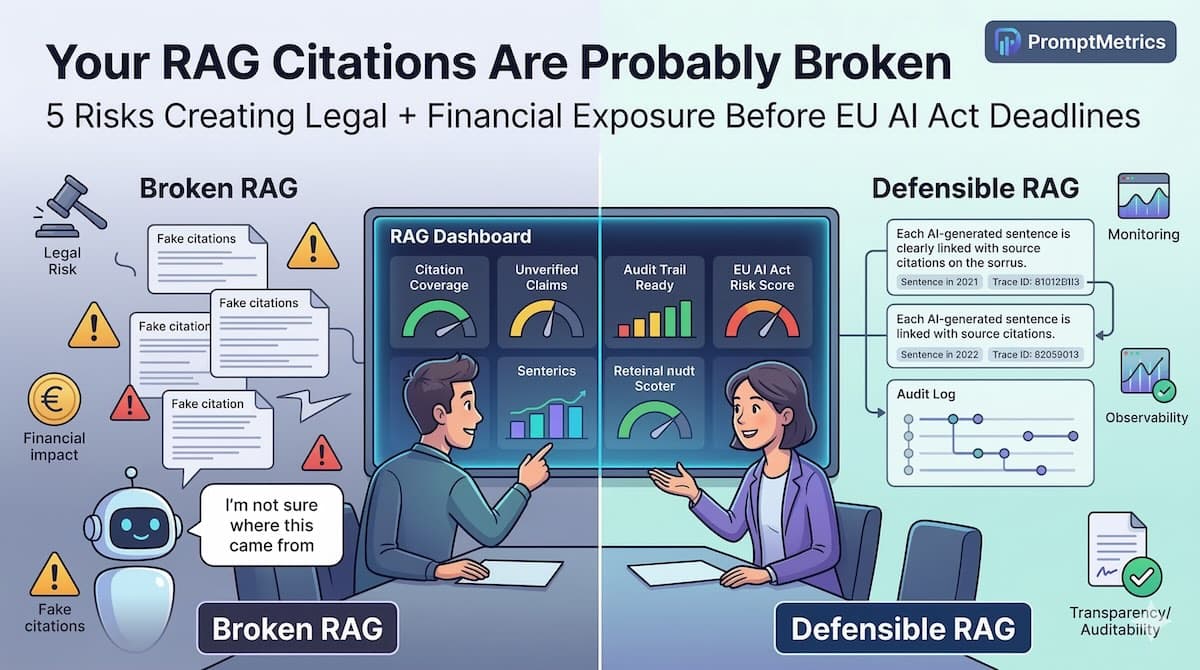


You might think it's counterintuitive for us, a company that sells prompt observability and management tools, to tell you that you cannot prompt-engineer your way out of a bad RAG system.
But here is the uncomfortable reality we see every day: typical enterprise RAG (Retrieval-Augmented Generation) architectures are currently failing at an alarming rate. And they aren't failing because GPT-5 is "dumb" or because your system prompt isn't clever enough.
They are failing because of retrieval.
If you are an AI CTO or Engineering Lead, you have likely faced this scenario: You deploy a "knowledge bot" to production. It works beautifully in staging. Then a user asks a complex question about a legacy product, and the bot confidently hallucinates a nonexistent feature, citing a document unrelated to the answer.
You blame the model. You tweak the temperature. You write a sterner system prompt: "You are a helpful assistant, do not lie."
It happens again.
The problem isn't the generation. It's the ingestion. Specifically, the "naive" chunking strategies that 90% of the industry still uses.
At PromptMetrics, we believe you deserve the unvarnished truth about why these systems break and precisely what it takes to fix them so you can stop debugging hallucinations at 2 AM and start shipping reliable agents.
The "Text-In, Text-Out" Trap
When most teams build their first RAG pilot, they use a standard ETL script: take a PDF, split it into 512-token chunks (with a 50-token overlap), embed it, and shove it into a vector database.
This is the "Text-In, Text-Out" trap. It treats your proprietary knowledge as a homogeneous stream of characters rather than a structured hierarchy of meaning.
The result? You are filling your context window with noise. And when an LLM is fed noise and asked for a signal, it is statistically coerced into fabrication.
Here are the three specific mechanical failures in your ingestion pipeline that are likely causing your hallucinations right now.
Problem 1: Semantic Fragmentation (The "Aspirin" Problem)
The most common cause of hallucination is Semantic Severance.
When you use fixed-size chunking (e.g., "split every 500 characters"), you are arbitrarily slicing through logic. You sever the condition from the consequence, or the warning from the instruction.
Real-World Impact
Imagine a medical document that says: "Aspirin is generally safe. However, it significantly increases bleeding risk when combined with alcohol."
A naive chunker might split this right in the middle.
Chunk A: "Aspirin is generally safe. However, it significantly increases bleeding risk..."
Chunk B: "...when combined with alcohol."
When a user asks, "Is Aspirin safe?", the retriever finds Chunk A (because it matches the keyword "Aspirin"). It misses Chunk B entirely because the semantic link was broken.
The LLM reads Chunk A and generates: "Yes, Aspirin is generally safe, though it may increase bleeding risk." It misses the crucial conditional context about alcohol. This isn't a "hallucination" in the creative sense; it is a logical failure induced by fragmented retrieval.

Problem 2: The "Middle Muddle" and Noise Pollution
We often assume that "more context is better." We populate the context window with the top 10 or 20 retrieved chunks.
The problem? Most of those chunks are pollution.
Naive retrieval often pulls in headers, footers, table-of-contents rows, and navigational breadcrumbs that happen to share keywords with the user's query. If a user asks about "Python configuration," your retriever might pull a chunk about "Java configuration" simply because both paragraphs contain the words "environment," "variable," and "setup."
Real-World Impact
This creates Contextual Dissonance. The LLM sees two contradictory instructions in its context window, one for Python, one for Java, but because the chunks were stripped of their metadata (like file names or section headers), the model can't tell which is which.
To resolve this conflict, the model often blends the two, creating a "Frankenstein" answer that looks syntactically correct but is technically impossible.
Problem 3: The "Needle in the Haystack" Failure
Dense vector embeddings are incredible at capturing "vibes" and general concepts, but they are notoriously bad at exact matches, things like specific error codes, SKUs, or version numbers.
Real-World Impact
If a user searches for "Error 0x884", a dense vector model might map that query to a generic "System Failure" cluster. It retrieves five general troubleshooting documents but misses the one specific document that mentions "0x884."
Why? Because in a 512-token chunk, the specific string "0x884" is mathematically "drowned out" by the hundreds of other words surrounding it. The vector embedding represents the average meaning of the chunk, not its specific details.
The result: The model cheerfully gives generic troubleshooting advice that doesn't solve the user's specific problem.
Is This Problem Right for You to Solve?
Before you tear down your entire ingestion pipeline, let's qualify this. You might NOT need to fix this if:
You are building a "Chat with PDF" toy: If the stakes are low and an occasional wrong answer is annoying but not fatal, naive chunking is fine.
Your corpus is small and homogeneous: If you only have 50 documents and they are all about the same topic, the LLM can usually figure it out.
You don't care about cost: You can technically brute-force some of this by using massive context windows (1M+ tokens) and stuffing everything in, though you'll pay a fortune in latency and token costs.
However, this IS a critical problem for you if:
You are deploying into enterprise environments (Fintech, Healthtech, B2B SaaS).
Your users expect 100% accuracy (e.g., support agents, compliance bots).
You are seeing hallucination rates above 10%.
Your "Head of Engineering" is spending more time debugging prompts than building features.
The Solution: A "Data-First" Architecture
The good news is that these problems are solvable. But the solution isn't in the prompt, it's in the pipeline.
To eliminate retrieval-induced hallucinations, you need to shift from "Naive Chunking" to Semantic Ingestion Controls.
1. Implement Semantic Chunking (And Accept the Trade-off)
Stop splitting by character count. Use Semantic Chunking algorithms that use an embedding model to detect "topic shifts" in the text. This ensures that every chunk you index is a complete, standalone unit of meaning.
The "No Free Lunch" Reality: We need to be honest, this is computationally heavier. It requires running an embedding model over your text during ingestion to find those breakpoints, making it 8–12x more expensive than simple splitting. But for enterprise reliability, paying that compute tax at ingestion is far cheaper than paying the "hallucination tax" in production.
2. Enforce Metadata Enrichment
Don't throw away data. When you ingest a document, extract structured metadata:
Document Hierarchy: Is this a parent section or a child section?
Temporal Scope: Is this from 2022 or 2025? (Crucial for avoiding "stale data" hallucinations).
Source Authority: Is this a verified technical spec or a draft wiki page?
By filtering on these fields before you search, you eliminate 90% of the noise that confuses the model.
3. Adopt Hybrid Search and Reranking
Don't rely on vectors alone. Dense vectors capture the "vibe," but they miss the details. To fix this, you need a two-step retrieval process:
Hybrid Search: Combine Vector Search (for concepts) with Keyword Search/BM25 (for exact matches like "Error 503").
Cross-Encoder Reranking: This is the highest-ROI "quick fix" for most CTOs. Once you retrieve the top 50 relevant chunks, use a Reranker to score them and pick the top 3.
Hybrid search ensures the right documents enter the candidate pool; Reranking ensures the correct answer appears in the context window.
How PromptMetrics Helps
We are not an ingestion engine. We don't build your vector database.
But we are the light in the dark room.
PromptMetrics gives you the observability to see precisely what your retriever is sending to your LLM.
See the whole context window: We show you the exact chunks retrieved for every query.
Spot the pollution: Quickly identify when your system is retrieving "Terms of Service" instead of "API Docs."
Trace the hallucination: Connect a bad answer directly back to the specific chunk that caused it.
You can't fix what you can't see.
Stop Flying Blind
Hallucinations are not a mystery. They are a mechanical failure of retrieval.
If you are ready to stop guessing and start engineering reliability into your AI stack, let's look at your data together.
Download our "CTO's Guide to RAG Observability" to see how high-performing teams are debugging their retrieval pipelines today.
Or, jump into PromptMetrics and see what your retriever is actually doing.