
The multi-billion-dollar problem hiding behind your 200 OK responses.
Your RAG system worked flawlessly in staging. Retrieval was sharp. Answers were grounded. Your evaluation suite showed green across the board.
Then three months into production, support tickets started mentioning "weird answers." A customer-facing response confidently cited a policy your company retired six weeks ago. Another hallucinated a product feature that doesn't exist. A prospect made a buying decision based on it.
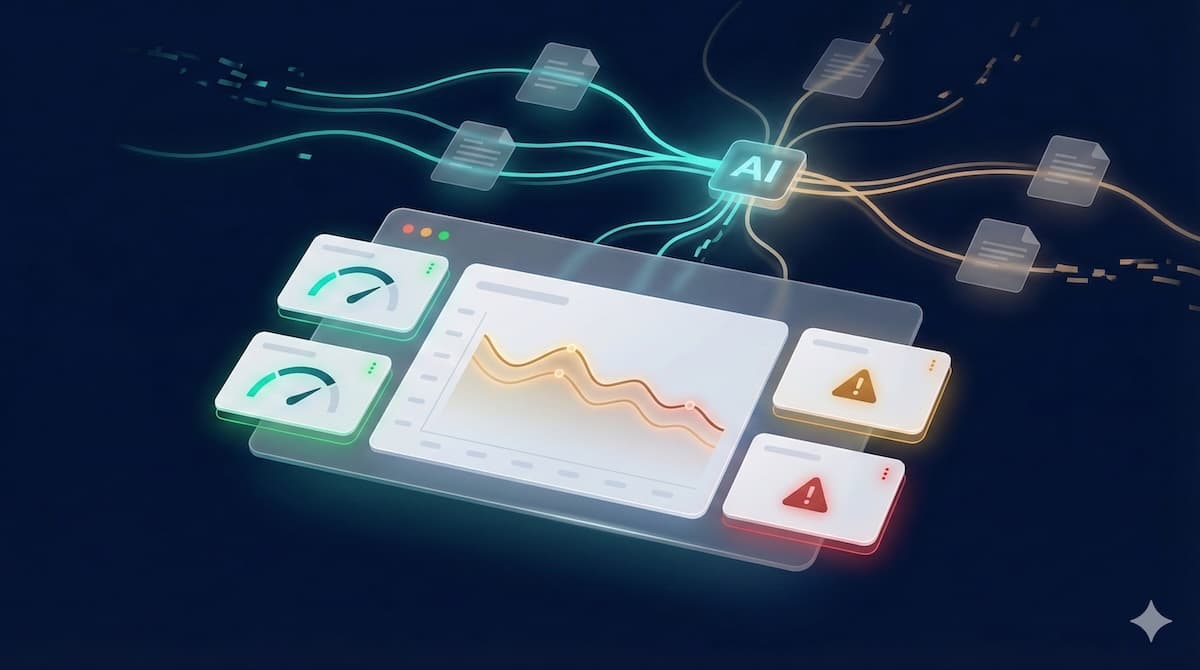
No alarms fired. No error logs. Your monitoring dashboard still showed 200 OK.
This is the reality of what researchers call "silent degradation." Unlike traditional software, which can cause system crashes and trigger alerts, RAG systems fail probabilistically. They continue to generate fluent, grammatically correct, professional-sounding responses even as their factual grounding erodes.
The financial impact is brutal. Industry estimates suggest global losses attributed to AI hallucinations reached tens of billions in 2024. Meanwhile, the average enterprise employee costs their company an estimated $14,200 per year in hallucination mitigation efforts alone.
The BLEU/ROUGE Illusion: Metrics That Actively Mislead
If the silent failure is the crime, your metrics are likely the cover-up. The problem starts with how we measure accuracy.
Most engineering teams, when evaluating metrics, default to what they know: BLEU and ROUGE. These n-gram overlap metrics were designed for machine translation and document summarization in the early 2000s. They measure surface-level text similarity between a generated output and a reference answer.
For RAG systems, this is worse than useless. It's actively misleading.
Consider this example:
Reference Answer: "The company's revenue grew by 20% due to strong cloud adoption."
RAG Output A (Correct): "Driven by a surge in cloud services, the firm posted a 20% increase in earnings."
RAG Output B (Hallucination): "The company's revenue fell by 20% due to weak cloud adoption."
BLEU might penalize Output A because it uses "surge" instead of "grew" and "earnings" instead of "revenue." The lexical overlap is low.
Meanwhile, Output B, which is factually the opposite of the truth, might score higher because it shares the exact vocabulary ("revenue," "20%," "cloud," "adoption") with the reference. It differs only by one word: "fell" vs. "grew."
BLEU would suggest that the hallucination is "better" than the correct answer.
This is the semantic gap. These metrics are blind to meaning. They cannot distinguish between "not guilty" and "guilty" if the rest of the sentence is identical. For RAG systems, where factual precision is paramount, this blindness is fatal.
The Demo Trap: Why Staging Success Means Nothing
Even if your metrics were perfect, your staging environment tells you nothing about production.
Most teams validate RAG systems against a "Golden Dataset," a carefully curated collection of questions and answers representing the ideal state of the world. In this controlled environment, retrieval pathways are predictable. The embedding model aligns perfectly with the document corpus. The nearest neighbors in vector space are genuinely relevant.
Production is nothing like this.
Enterprise data is a living organism. New documents are ingested daily. Old policies get archived but remain in the index. Conflicting information accumulates. Meanwhile, the distribution of user queries shifts. In development, test queries are crafted by people who know the underlying data structure. In production, users ask ambiguous, multi-hop, domain-specific questions that push the retrieval logic into uncharted territory.
This creates retrieval drift. It's not a failure of code but a failure of context. A system that had 90% recall in staging may drop to 60% in production within months. Not because the software broke, but because the data landscape changed while the model remained frozen.
The Four Types of Drift Killing Your RAG System
Even a perfectly tuned RAG system degrades over time. This happens silently across multiple dimensions.
Embedding Drift: The language your users employ evolves, but your vector representations remain static. New product terminology, updated policy language, and shifting customer vocabulary: none of it is captured in embeddings generated months ago. Production data shows that within 3-6 months, meaningful vector spaces can degrade into overlapping, drifting points. When embedding drift exceeds 20-30%, retrieval accuracy degrades sharply.
Corpus Drift: As your knowledge base grows, performance drops. Research demonstrates that RAG systems can exhibit a performance drop of over 10% on identical questions when the document corpus grows from 1,000 to 100,000 pages. More documents mean more noise, lower signal-to-noise ratios, and a greater probability of surfacing outdated content.
Query Distribution Shift: Users start asking questions that your system was never optimized for. The questions that drove your test suite at launch may represent only 60% of actual production queries within months.
Concept Drift: What constitutes a "relevant" answer changes over time due to evolving business policies, regulatory updates, or market conditions. The retriever returns the same documents, but they are no longer correct.
The compounding effect is brutal. Most teams encountering degraded RAG performance swap models or rewrite prompts. But the real problem is often a retrieval failure disguised as a generation failure.
The Legal Reality: Air Canada and the EU AI Act
For many companies, this is no longer just a technical nuisance; it is a legal liability.
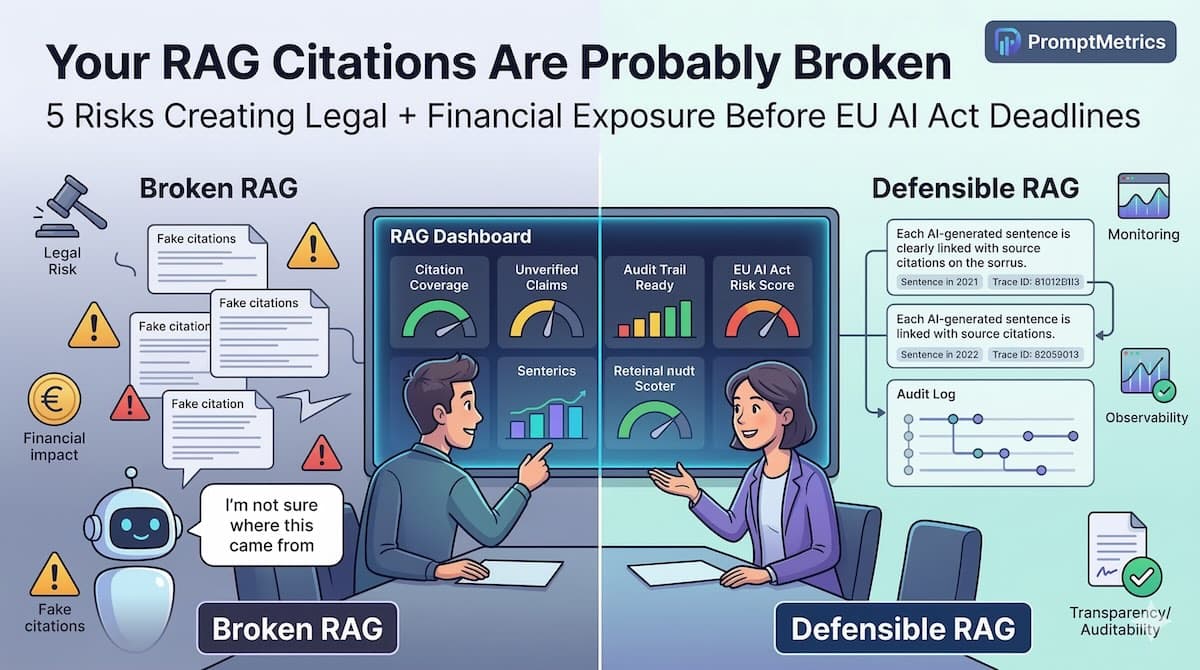
This isn't hypothetical. In 2024, Air Canada was ordered to pay damages after its AI chatbot fabricated a bereavement fare policy. The Canadian tribunal ruled the airline was fully liable for the chatbot's hallucination, establishing that companies cannot disclaim responsibility for AI-generated misinformation.
For European companies, the EU AI Act raises the stakes. The Act fundamentally alters the liability landscape, moving from "best effort" to "demonstrable robustness."
The Act's post-market monitoring requirements (Articles 9, 15, and 72) require providers of high-risk AI systems to establish procedures to monitor performance throughout the system's lifecycle actively. This destroys the "deploy and forget" model. A RAG system that drifts from accuracy is a non-compliant. Under the evolving AI Liability Directive, this could mean legal liability for damages arising from AI errors, particularly if the organization cannot demonstrate that it was actively monitoring for drift.
The defense against such liability is a robust, auditable trail of continuous evaluation: proof that the organization monitored for drift and took corrective action.
What Actually Works: The Four Pillars of RAG Evaluation
Practical RAG evaluation requires metrics that independently assess each stage of the pipeline. The RAGAS framework, featured at OpenAI's DevDay in 2023, established four core metrics:
Context Precision: The proportion of retrieved chunks actually relevant to the query. When this drops significantly (often below 70-80%), your retriever is surfacing noise.
Context Recall: Whether retrieved documents contain the information needed for a correct answer. Low-context recall indicates your knowledge base has gaps or your chunking strategy is omitting relevant passages.
Faithfulness: How well the generated response is grounded in the retrieved context. Suppose a claim doesn't appear in the retrieved documents, faithfulness drops. This is your primary hallucination signal.
Answer Relevancy: Whether the response actually addresses the user's question. A response can be perfectly faithful but miss entirely the point.
The critical insight: these four metrics create a diagnostic matrix. For example, if context precision drops to 50%. In comparison, faithfulness remains at 85%; you know your retriever is surfacing noise, but your generator is disciplined enough to ignore the garbage and stick to the few relevant documents it found. That's a retrieval problem, not a generation problem.
Low-context precision with high faithfulness indicates your retriever is broken, but your generator is disciplined. High context recall with low faithfulness means your retriever works, but your generator hallucinates.
Building a Continuous Monitoring Pipeline
Treating RAG evaluation as a one-time deployment gate is the single biggest operational mistake teams make.
A production RAG monitoring pipeline operates across three tiers:
Tier 1: Real-time lightweight signals.
Track latency, retrieval scores, zero-result rates, and response token counts on 100% of traffic. These are computationally cheap and detect gross failures immediately.
Tier 2: Sampled structured evaluation.
Run RAGAS-style evaluation on 1-10% of production traffic. Schedule as automated batch jobs: hourly for high-risk applications and daily for standard ones. This catches gradual degradation.
Tier 3: Triggered claim-level diagnostics.
When Tier 2 metrics breach thresholds, automatically trigger deep analysis. This involves decomposing the response into individual, verifiable statements (e.g., "The product costs €50" or "Shipping takes 2-3 days") and verifying each one against the retrieved context. This catches the "90% accurate but 10% fabricated" responses that aggregate metrics often miss, providing forensic detail without the computational cost of running it on everything.
Each tier feeds alerting rules. Tier 1 fires for production outages. Tier 2 triggers notifications for gradual drift. Tier 3 generates diagnostic reports for engineering review.
The Gap Is Organizational, Not Technical
The pipeline architecture is well-understood. The challenge is getting organizations to implement it.
The uncomfortable truth: most teams building RAG systems today have zero visibility into production quality. They shipped the system, ran evals at deploy time, and moved on.
The gap is not in tooling. Evaluation frameworks exist. The gap is organizational: most teams treat RAG evaluation as a one-time checkpoint rather than an ongoing operational discipline.
Only about 5% of enterprise AI projects reach production with measurable, sustained impact. The drop-off occurs precisely because systems don't adapt, retain feedback, or integrate continuous evaluation into workflows.
The teams that succeed with production RAG won't be the ones with the best models. They'll be the ones who built the monitoring to detect degradation before their customers do.
That's the gap PromptMetrics closes. PromptMetrics helps teams move from reactive debugging to proactive RAG monitoring. Track retrieval quality, generation faithfulness, and cost anomalies continuously, in production. Detect drift before your customers report it.