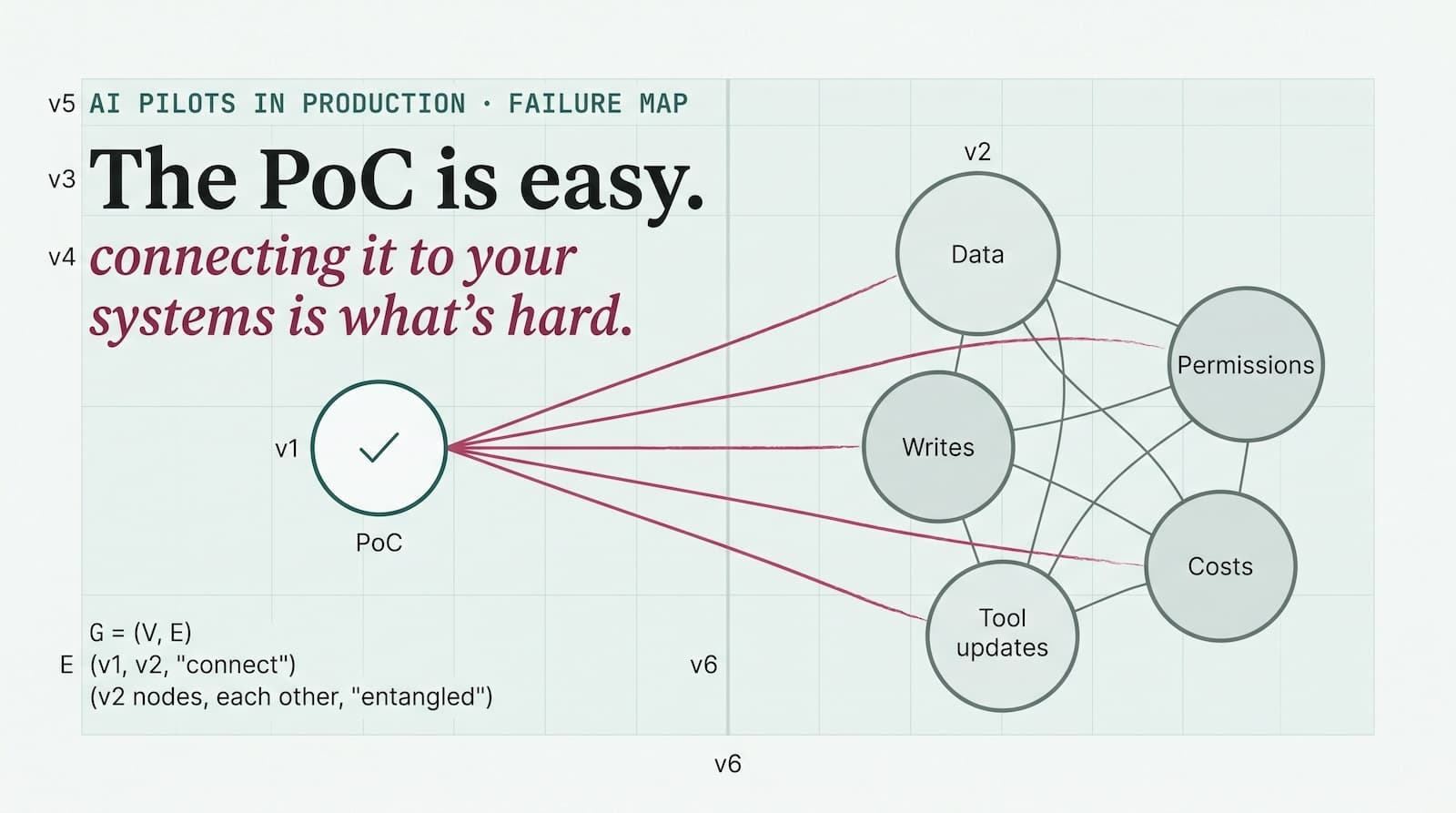


Your AI agent works in demos. It works on Tuesdays. It worked yesterday. But in production, with real users and real stakes, it fails somewhere between 20% and 40% of the time. You have no idea why, and your CFO is asking why the LLM bill jumped from €12K to €45K.
I keep coming back to a specific number from the AgentArch enterprise benchmark (2025): the best models achieve a 6.34% probability of executing a workflow correctly across all 8 trials. Not 60%. Not 30%. Six percent. That's not a reliability problem you can prompt-engineer your way out of.
The question every CTO building agentic systems needs to answer right now is not "which LLM should I use?" It's "how much of my pipeline should the LLM even touch?"
The two architectures, side by side
There are two fundamentally different ways to build an agentic system. Most teams default to the first one. The data says the second one wins.
ReAct loops let the LLM drive. The model reasons about what to do, calls a tool, observes the result, reasons again, and calls another tool. It's elegant. It's flexible. It's also stochastic, expensive, and unreliable at scale. According to a practitioner analysis by Grigory Sapunov on LinkedIn, production agents using this pattern operate at 70-80% reliability, with most 2025 pilots topping out at 85-90%.
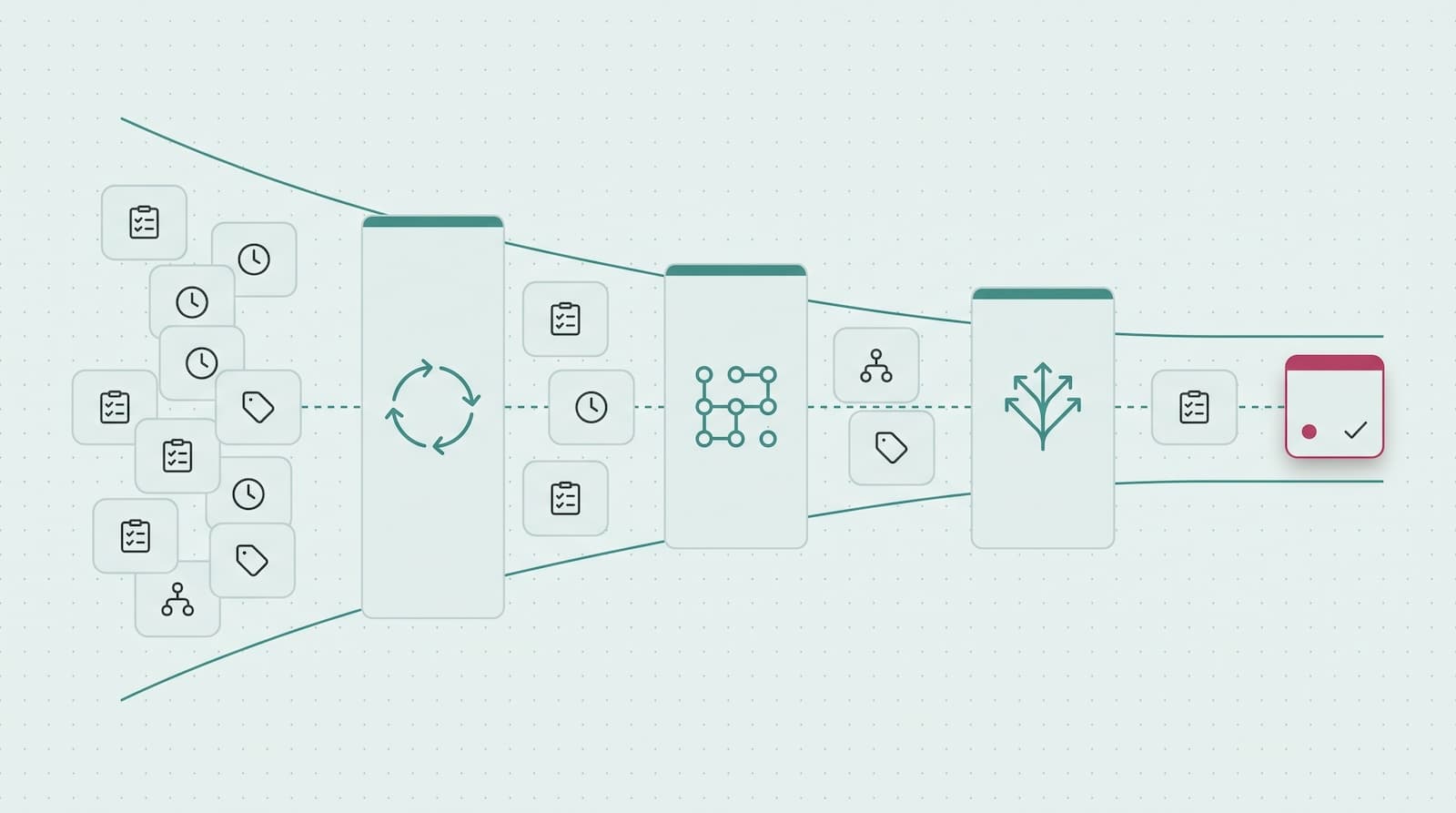
Deterministic orchestration flips the control plane. A non-LLM coordinator (Python code, state machines, workflow engines like Temporal) decides what happens next. The LLM gets called for specific, bounded tasks: parse this text, generate this response, classify this intent. Everything else is hard-coded. A controlled study of 348 trials by Drammeh (2025) found this pattern achieved 100% actionable recommendation rate with zero quality variance, compared to 1.7% for single-agent approaches.
That's not a marginal improvement. That's an 80x difference in specificity.
The comparison matrix
Here's what the data actually shows when you put these architectures head-to-head:
Factor | ReAct / Agentic Loops | Deterministic Orchestration | Hybrid (ML Router + Bounded LLM) |
|---|---|---|---|
Reliability (end-to-end) | 60-80% for 3-5 step workflows (AgentArch, 2025) | 99%+ for bounded tasks (Drammeh, 2025) | 95-99% depending on fallback design |
Latency per decision | 300ms-3s per LLM call (Rupesh Patel, LinkedIn) | <5ms for XGBoost/LightGBM routing | ~40ms for 80% of queries, 2-3s for LLM fallback |
Cost per 1K routing decisions | $10-$30 (API token costs) | <$0.01 (CPU inference) | ~$2-$6 (weighted average) |
Step compounding | 95% per step = 77% at 5 steps, 60% at 10 steps | No compounding (deterministic transitions) | Compounding only in LLM-handled steps |
EU AI Act compliance | Requires substantial documentation overhead | Full weight inspection, auditable decision boundaries | Natural compliance boundary at ML/LLM split |
Setup complexity | Low (prompt + tool definitions) | Medium (state machine design, orchestration code) | High (ML pipeline + LLM fallback + routing logic) |
Edge case handling | Strong on novel inputs | Limited to training distribution | Best of both: ML handles known, LLM handles unknown |
Sources: AgentArch benchmark (arXiv:2509.10769), Drammeh (2025, arXiv:2511.15755), Reddit r/learnmachinelearning intent classification comparison, LinkedIn practitioner reports.
Where ReAct loops actually win
I want to be specific about this because the answer isn't "always use deterministic orchestration." ReAct-style agents are still the right choice in three situations.
Unstructured data synthesis. When the input is a legal document, a customer email, or raw meeting notes and you need to extract structured data from it, an LLM is the only practical option. No amount of regex or classical ML handles the ambiguity of natural language at production quality.
Zero-shot prototyping. During early feature development, a prompt can simulate a classifier in minutes. One practitioner on Reddit reported using LLM routing during the first two weeks while collecting labeled data, then replacing it with a fine-tuned SetFit model that ran at negligible cost. The LLM was a scaffolding tool, not the final architecture.
Multi-step strategic planning. When a query requires reasoning across domains, an LLM needs to plan the execution steps. But the key architectural insight from the Princeton "Reliability-First AI" framework (Kapoor, 2025) is that even here, the LLM should plan and then hand back to a deterministic executor. The model reasons; the code acts.
Where deterministic orchestration wins
For everything that has a predictable shape, the numbers are overwhelming.
Intent classification and task routing. A Reddit developer tested both approaches head-to-head in production: a fine-tuned intent classifier handled 80% of routine queries, with an LLM fallback for the remaining 20%. The result was a 90% cost reduction and response times dropping from 2-3 seconds to 40 milliseconds. The specific libraries dominating this layer are scikit-learn (LogisticRegression, RandomForest), XGBoost, LightGBM, and CatBoost for latency-critical inference.
Rigid SLA environments. Any feature requiring guaranteed sub-200ms response times cannot depend on an LLM. UI autocomplete, fraud-detection triggers, and critical state-change approvals: these need the deterministic latency floor that classical ML provides.
Regulated decisions. Under the EU AI Act (entering full enforcement for high-risk systems by August 2026, with a backstop of December 2027 following the Digital Omnibus deferral), any AI system making decisions in employment, creditworthiness, or public services needs to be explainable. Classical ML models provide full weight inspection and auditable decision boundaries. LLMs are black boxes. For startups in the €2K-€50K monthly LLM spend range, building a hybrid architecture now means you won't have to rebuild when compliance deadlines hit.
The hybrid pattern that's actually working
The optimal 2026 production architecture is what practitioners are calling "uncertainty-based hybrid routing." It's not complicated conceptually, but it requires discipline to implement.
The classical ML classifier handles the 80% of traffic it's confident about. When confidence drops below a threshold, it routes to the LLM. One documented production system using heterogeneous model routing reduced average workflow cost by 63% (from £0.52 to £0.19 per workflow) while improving P50 latency by 18%, according to a technical analysis by Som Rout on LinkedIn.
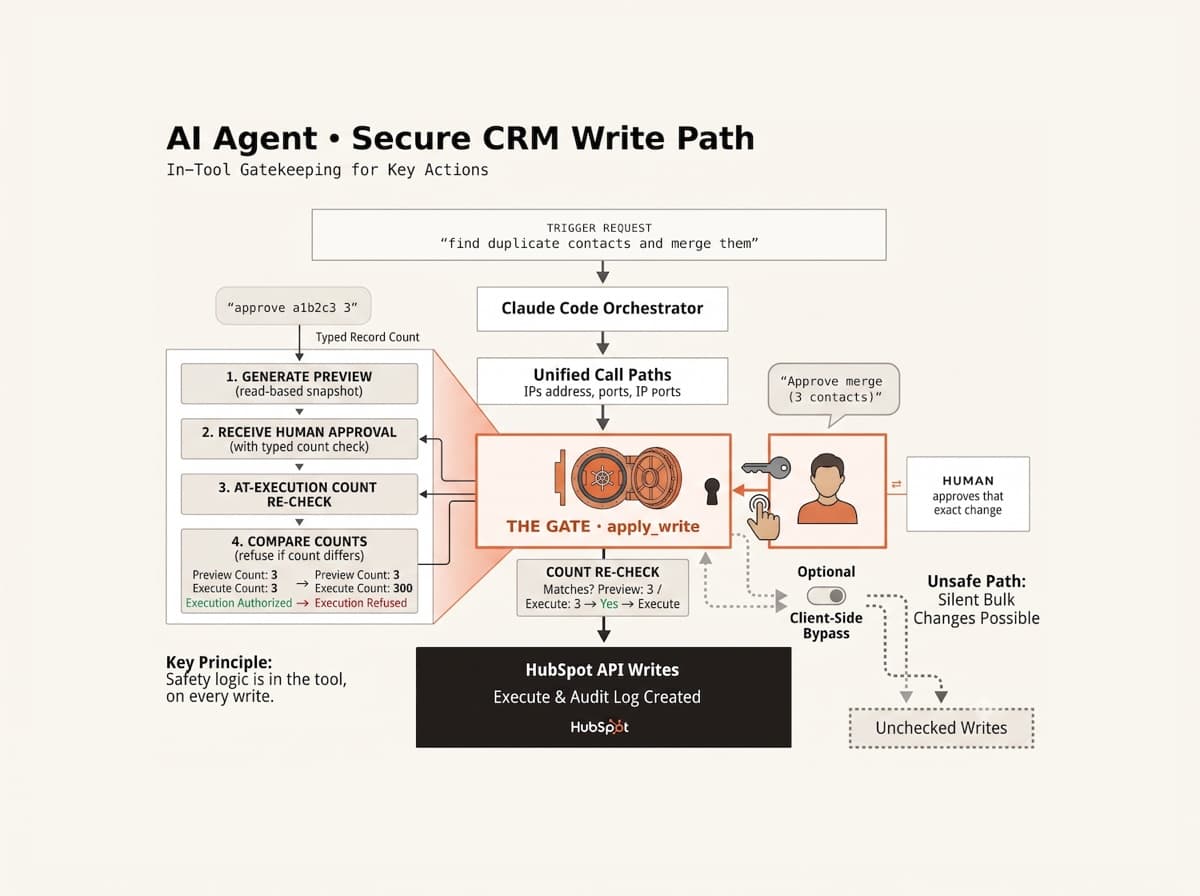
The architectural pattern emerging is what Praetorian calls "Thin Agent / Fat Platform": agents reduced to stateless, ephemeral workers under 150 lines of code, with knowledge loaded just-in-time and enforcement hooks operating outside the LLM context. The deterministic orchestration layer manages lifecycle, state, retries, and idempotency.
This maps directly to how PromptMetrics approaches the observability layer. When your routing decisions are split between classical ML and bounded LLM calls, you need per-prompt cost attribution to see which path is burning budget. You need staging environments to A/B test routing thresholds before production. And you need compliance-ready audit logs that trace every decision back to its source. That's the gap between "we have an agent" and "we have a production system."
Who should choose what
Choose pure deterministic orchestration if your workflows are predictable, your intents are well-defined, and you're in a regulated domain. You'll get 99%+ reliability, sub-50ms latency, and a compliance story that writes itself.
Choose ReAct-style agents if you're prototyping, handling genuinely unstructured input, or your use case changes too fast to build classifiers. Accept the 70-80% reliability ceiling and budget for the LLM costs.
Choose the hybrid pattern if you're past the prototyping stage and need production reliability without giving up flexibility. This is where most teams in the €2K-€50K spend bracket should be heading. The 90% cost reduction and 60x latency improvement on the routing layer alone make it worth the architectural investment.
What to do this week
Audit your agentic workflows for step count. If you have more than 5 LLM-dependent steps in series, your reliability ceiling is around 77%. That's math, not opinion.
Measure pass@k, not pass@1. The AgentArch benchmark found that top models on the pass@1 metric (single run success) showed only 6.34% pass@8 (all 8 runs succeed). If you're evaluating agents on single runs, you're hiding brittleness.
Deploy a classical ML classifier for your routing layer this month. The libraries are mature, the pattern is proven, and the cost/latency improvements are immediate. Start with scikit-learn's LogisticRegression for simplicity, or XGBoost for accuracy.
And start your EU AI Act compliance assessment now. The Digital Omnibus bought some time, but the realistic timeline for full conformity assessment is 32-56 weeks according to Modulos.ai. That means starting in Q1 2026, not Q3.
Sources
AgentArch enterprise benchmark, arXiv:2509.10769v1 (2025)
Drammeh, "Multi-Agent LLM Orchestration," arXiv:2511.15755 (2025)
tau-bench (pass@k decay analysis), arXiv:2511.14136 (2025)
Kapoor, "Reliability-First AI" framework, Princeton/Hive Research (2025)
LLM reliability as systems engineering, arXiv:2511.19933 (2025)
Grigory Sapunov, LinkedIn analysis of production agent reliability (2025)
Rupesh Patel, LinkedIn: AI agent latency/cost engineering data
Reddit r/learnmachinelearning: Intent classification vs LLM routing production comparison
Som Rout, LinkedIn: Heterogeneous model routing cost/latency analysis
UIUC LLMRouter: 16+ routing strategies (Towards AI, Jan 2026)
Praetorian: "Deterministic AI Orchestration: A Platform Architecture" (2025)
EU AI Act enforcement timeline: LegalNodes, Modulos.ai, Digital Omnibus (SGS, Jan 2026)
Baker Botts: "The EU Digital Omnibus Proposal: A Strategic Pivot" (2026)