
Every CRM vendor now claims to be "agentic." Salesforce has Agentforce. HubSpot has Breeze. Zoho has Zia Agents. Pipedrive promises a "network of intelligent, agentic AI digital teammates." The word is everywhere, and it's losing meaning fast.
Gartner's latest Hype Cycle for CRM Technologies calls out "agent washing" across sales, service, marketing, and commerce. Of the thousands of vendors now marketing "agentic AI," Gartner estimates only about 130 are delivering genuine agentic capability. The rest are rebranding chatbots, RPA workflows, and LLM wrappers (Gartner, 2025).
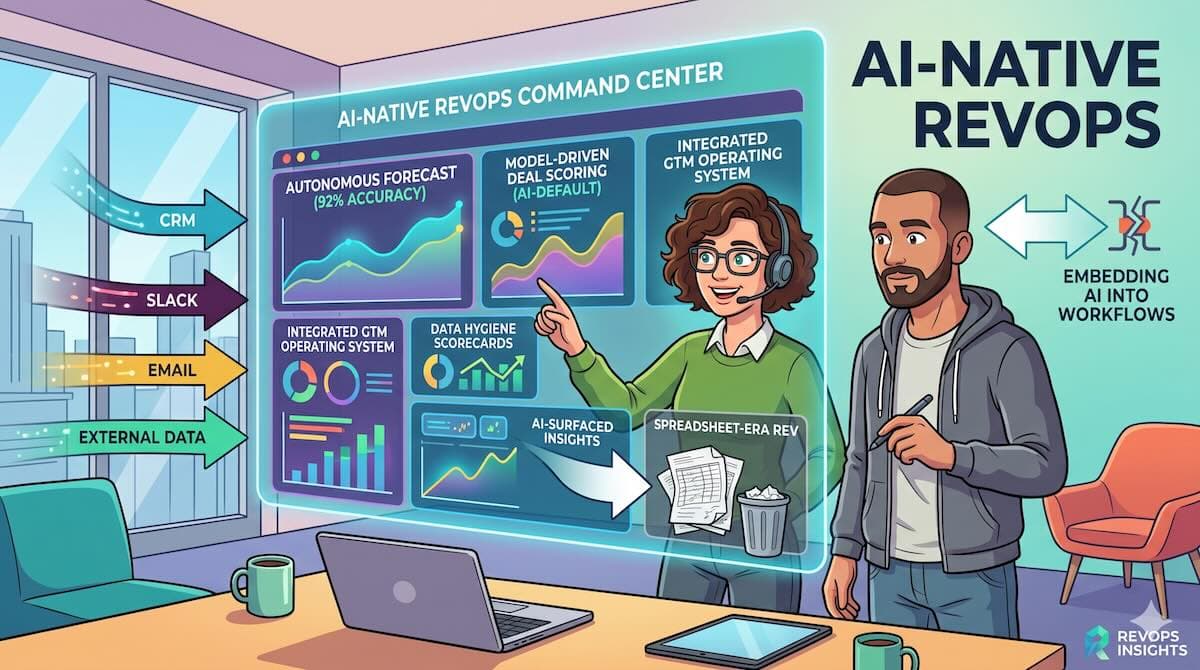
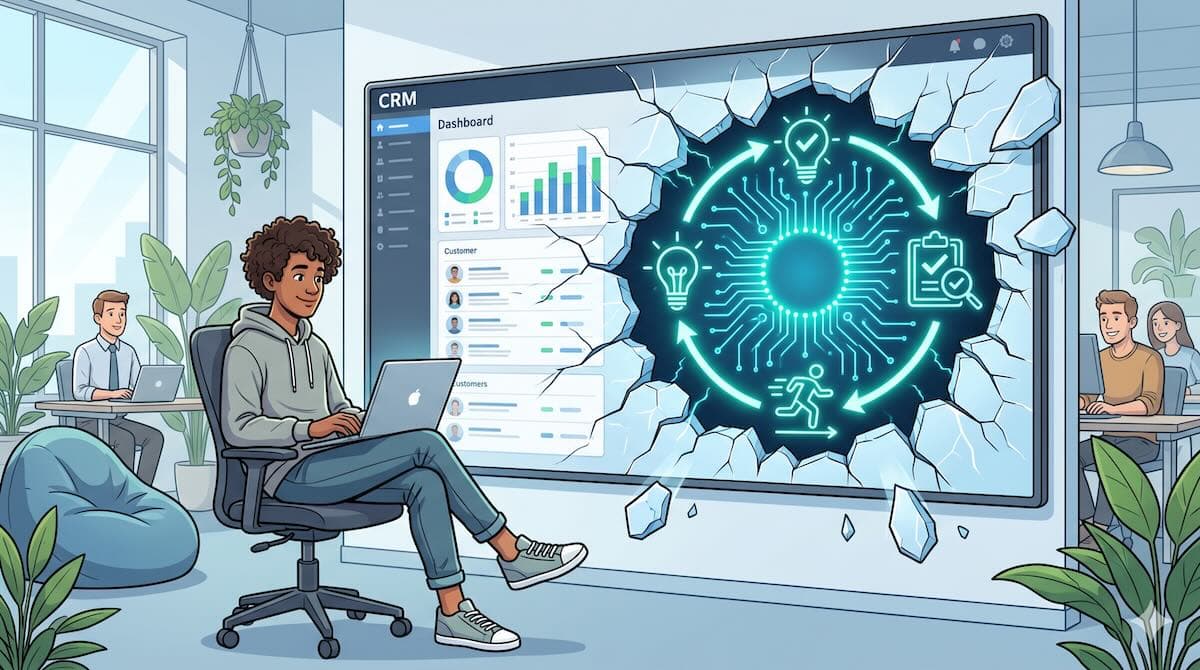
But here's the part nobody's talking about: the real agentic CRM won't be something you buy from a vendor. It'll be something revenue teams build themselves using the same coding agents that already demonstrate true autonomous loops. The agent isn't a feature inside the CRM. The agent is the CRM.
Key Takeaways
CRM vendors are "agent washing" only ~130 of thousands deliver genuine agentic AI (Gartner, 2025)
True agent loops (plan, act, review, repeat) are fundamentally different from the triggered workflows CRM vendors ship
35% of teams have already replaced at least one SaaS tool with a custom build; 78% plan to build more in 2026 (Retool, 2026)
Coding agents like Claude Code, Cursor, and Replit will become the operating system for revenue CRM data becomes just another input
What Does "Agentic CRM" Actually Mean Right Now?
Salesforce reported roughly 18,500 Agentforce customers as of early 2026, of whom about 9,500 were paying. That sounds like traction until you remember Salesforce has over 150,000 customers, meaning roughly 6% have adopted it in any form, and only about 3% pay for it. Fewer than 2% of those paying customers run 50 or more agent conversations per week (Salesforce Ben, March 2026).
The gap between the keynote demos and production reality is stark. Business Insider's investigation into Agentforce found that the showcase "Sophie" demo for Saks Fifth Avenue was never live in production. One Salesforce employee told them bluntly: "Anyone who took that training knows Agentforce isn't ready for primetime" (Business Insider, November 2025).
Salesforce's own researchers published a paper finding that LLM agents achieved only 58% success on single-function CRM tasks and just 35% on multi-step tasks, figures that directly contradict the company's marketing claims. The quiet pivot to AgentScript, a deterministic scripting layer added to supposedly autonomous agents, is an admission that pure LLM autonomy isn't reliable enough to ship without guardrails.
HubSpot Breeze follows the same pattern. MIT's AI Agent Index rated Breeze agents at L1-L3 autonomy out of 5. The evaluation noted: "No memory architecture was found." Default settings require human approval for every action. Third-party security testing found prompt injection still unsolved (MIT AI Agent Index, 2025).
Zoho's Zia Agents, Pipedrive's AI teammates, and Freshworks' Freddy all follow the same architecture: predefined templates, human approval gates, and tight ecosystem boundaries. They're copilots with ambition, not autonomous operators.
Agentforce Adoption Funnel Bar chart showing the steep drop-off in Agentforce adoption, 150,000 total Salesforce customers. 18,500 adopted Agentforce. 9,500 are paying customers. Fewer than 300 have 50 or more agent conversations per week. Source: Salesforce Ben, March 2026.

Figure 1: The Agentforce adoption cliff: fewer than 0.2% of Salesforce customers use agents at meaningful volume.
Why Aren't These Real Agent Loops?
Salesforce's own researchers found that LLM agents achieve only 58% success on single-function CRM tasks and just 35% on multi-step ones, numbers from the company building the most-hyped agentic CRM on the market (Business Insider, 2025). A true agent loop follows a specific pattern: plan what to do, execute that plan across whatever tools are needed, review what happened, and repeat with better context. The agent decides what to do next based on what it observes, recovers from errors without a human stepping in, retains memory across steps, and works across systems, not just within one vendor's garden.
What CRM vendors ship is different: a trigger fires, a template fills, text is generated, and a human approves. The sequence is predetermined. The "reasoning" is filling in text fields. There's no replanning when something goes wrong.
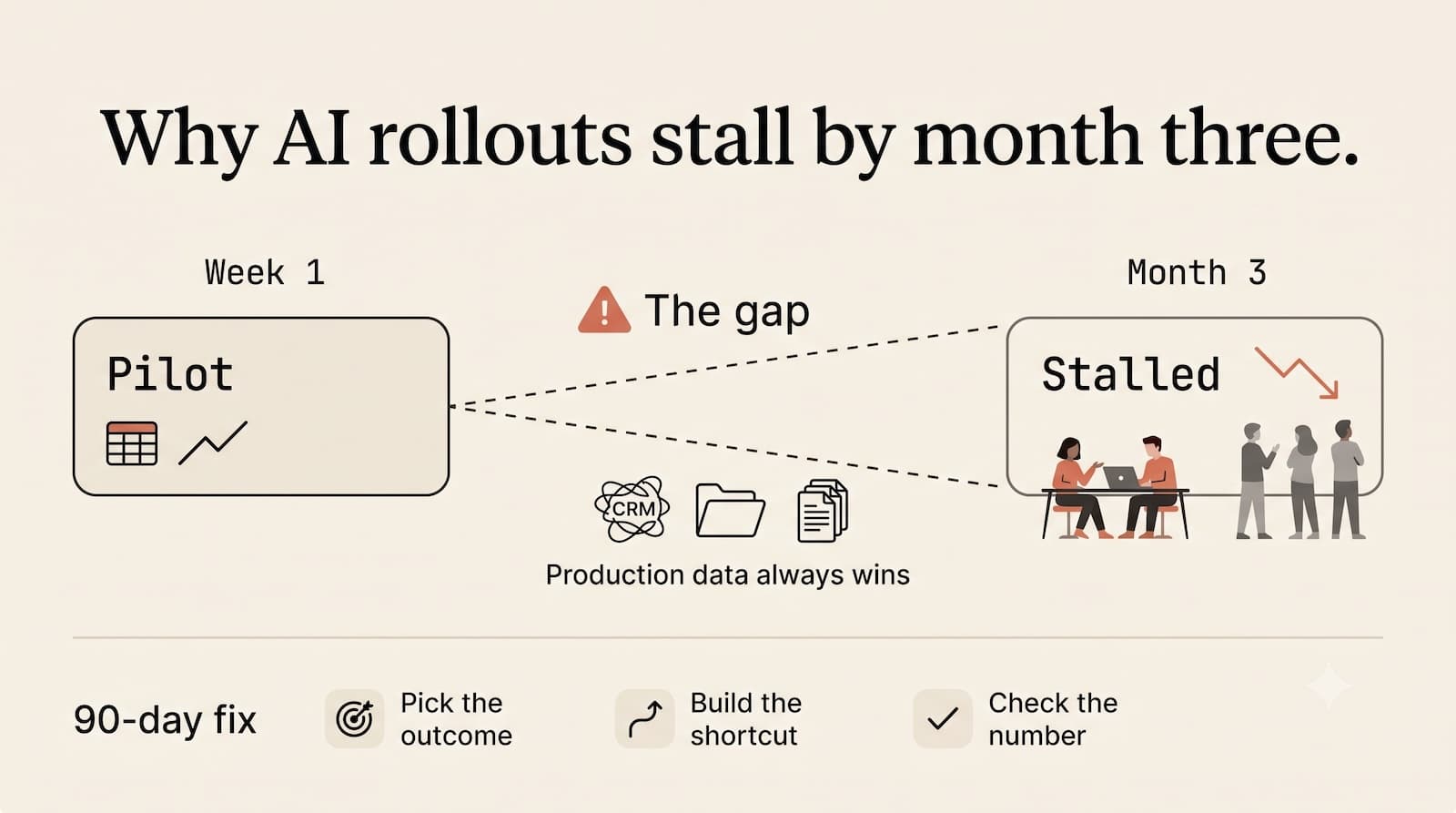
The compound reliability math is brutal. At 95% per-step accuracy, a generous assumption is that a 20-step agent workflow succeeds only 36% of the time. At 90% per-step accuracy, it drops to 12%. No CRM vendor publishes per-step reliability numbers, and the AgentScript pivot makes it clear why: they can't meet the reliability levels required to make fully autonomous agents safe to ship (EngineersOfAI, 2025).
This is the fundamental tension CRM vendors can't resolve. They sell predictability to enterprises managing customer relationships worth millions. You can't tell a VP of Sales, "the agent hallucinated a discount and sent it to a Fortune 500 prospect, but it was only 5% of the time." The Six Sigma standard for regulated industries is 99.999% reliability. Agentforce claims 93% four nines short of what serious operations demand.
So vendors add guardrails. Then more guardrails. Then, deterministic scripts are underneath the LLM layer. What ships is a supervised agent that's really a well-marketed macro. According to a 2026 Gartner study, enterprise buyers who consult AI assistants before contacting vendors are increasingly able to distinguish between genuine autonomy and agent washing (Gartner, 2025).
Compound Error Rate: Why Multi-Step Agent Autonomy Fails. Line chart showing three reliability curves. At 99% per-step accuracy, 20-step success is 82%. At 95%, it drops to 36%. At 90%, it plummets to 12%. Source: EngineersOfAI, 2025.

Figure 2: At 90% per-step accuracy, a 20-step agent workflow has only a 12% chance of completing without failure.
What Would a Real Agentic CRM Actually Do?
74% of enterprises are planning to switch or seriously evaluate switching CRM vendors between 2025 and 2028, according to the Futurum Group, and the quality of AI capabilities is the top criterion driving those evaluations (Futurum Group, 2025). Here are four things a genuine agentic CRM would deliver that no vendor currently provides.
Dynamic replanning. When a lead goes cold, the agent doesn't just send a pre-written follow-up. It analyzes why the prospect stopped opening emails. Did a competitor come up on a call? and changes strategy. It pulls new research, rewrites the angle, and adjusts timing based on engagement data. The plan evolves from results, not a flowchart.
Cross-system autonomy. A real agent doesn't care whether the contact record lives in HubSpot, email threads in Gmail, call transcripts in Gong, or the contract in Dropbox. It draws on everything, builds context, and acts wherever needed. Vendor CRM agents can't do this; their business models depend on keeping data within their walls.
Persistent, queryable memory. Not a session state that resets. Not a context window that overflows. Actual memory: what worked with this prospect last quarter, which objection patterns surfaced in the last 50 deals, and which pricing arguments converted in this segment. MIT's finding that HubSpot Breeze has no memory architecture isn't a bug; it's the whole category.
Governed, auditable execution. If you can't replay exactly what an agent did and why, you can't deploy it in a regulated setting. Git sets the standard here: every change is a commit, every commit has a message, every message traces to an author. Diego Oppenheimer, a VC who replaced his firm's CRM with a git repo and markdown files, put it simply: "The best interface between a human and an AI agent is a plain text file" (LinkedIn, 2026).
This four-part definition doesn't describe a CRM product. It describes Claude Code. Plan, code, review, repeat. Works across any file, any API, any system memory through files and conventions. Every action is traceable in Git. The agentic CRM isn't a product category waiting to be invented. The architecture already exists in the CRM industry, but it doesn't own it.
Revenue Teams Are Already Building It Themselves
The Retool 2026 Build vs. Buy Report surveyed 817 builders and found that 35% of teams have already replaced at least one SaaS tool with a custom build. 78% plan to build more in 2026. CRM and sales tools have a 25% higher replacement risk than project management or customer support tools (Retool, 2026).
This isn't theory. OpusClip, a 10-person B2B revenue team with zero production coding experience, used Claude Code to build call intelligence, renewal automation, and customer dashboards. Their sales call review coverage went from 5-10% manual to 100% automated. A self-built ROI calculator put together in 60 minutes unblocked five enterprise deals in its first month. The team surfaced over $200,000 in new pipeline from a single customer insight their manual processes had missed (Anthropic, 2025).
SyncGTM documented six workflow patterns revenue teams are running right now: lead sourcing at 50-200 qualified prospects in under 15 minutes versus 4-8 hours manually; CRM data cleanup at 10,000 contacts in under 5 minutes versus 2-3 days; outreach personalization at 50 unique emails in under 10 minutes (SyncGTM, 2026).
I keep seeing this shift firsthand. Revenue operators who couldn't write a line of SQL a year ago are spinning up working tools in an afternoon. Vibe coding isn't about teaching salespeople to code; it's about coding agents becoming fluent enough that you don't need to know how. You describe what the workflow should do, the agent builds it, and when it breaks, the agent fixes it. The skill isn't syntax. It's taste, product thinking, and knowing what your revenue process actually needs.
The numbers support this. 63% of Vibe coding users are non-developers, according to a 2026 analysis of data from Stack Overflow, JetBrains, and GitHub (Hostinger, 2026). Y Combinator CEO Garry Tan reported that 25% of YC's Winter 2025 batch have codebases that are 95%+ AI-generated. As he put it: "This isn't a fad. This isn't going away. This is the dominant way to code" (Y Combinator, March 2025).
Gartner projects that by 2028, 40% of new enterprise production software will be built through vibe coding, up from less than 5% in 2025. If that holds, the question isn't whether revenue teams will build their own tools. It's whether the CRM you're paying for will still be the center of gravity, or just one API endpoint among many.
SaaS Tool Replacement Rates by Category Horizontal bar chart. 35% of teams replaced workflow automation tools. 33% replaced internal admin tools. 29% replaced BI tools. 25% replaced CRM and form builders. 23% replaced project management tools. 21% replaced customer support tools. Source: Retool 2026 Build vs. Buy Report, n=817 builders.

Figure 3: CRM tools face a 25% replacement rate, more than project management or customer support.
The Coding Agent Is the Real CRM
The agentic AI market reached $7.84 billion in 2025 and is projected to reach $52.62 billion by 2030, with the coding and software development segment growing fastest at a 52.4% CAGR, nearly 4x the growth rate of the CRM market (MarketsandMarkets, 2025). The same agent architecture that writes, reviews, and ships code maps directly onto revenue operations. A coding agent that plans a feature, implements it across files, runs tests, reviews the diff, and fixes failures that loop fits revenue workflows perfectly: plan an outreach sequence, execute across channels, measure response, review what worked, and adapt.
Tarun Thummala migrated his company's CRM, containing hundreds of thousands of records, from HubSpot to Attio in a single day using Claude Code. He calls this "the disappearing layer." SaaS has been a middleman between humans and data, a UI, a schema, and permissions wrapped around a database. When coding, agents can interact with data directly through APIs, Markdown files, and Git; that UI layer becomes unnecessary (Medium, February 2026).
Diego Oppenheimer demonstrated the extreme version. His CRM is a directory of markdown files in Git. Each deal is a file. CONVENTIONS.md defines the schema. Ingestion takes 90 seconds, compared to 20-30 minutes in a traditional CRM. "Git provides transactions, audit trails, and access control for free," he writes. "Agents need files, rules, and version control, not GUIs" (LinkedIn, 2026).
The MCP (Model Context Protocol) layer speeds this up. When a CRM exposes an MCP server, as Attio became the first to do in February 2026, with OAuth, read auto-approval, write confirmation, and full audit trails, it becomes an agent-operable database. The governance layer becomes the product. The CRM that can't be safely operated by an agent becomes a UI wrapper around someone else's real operating system (Attio, 2026).
The unit economics lean hard in this direction. One AI agent replaces 3-4 SaaS subscriptions. API costs for agent-driven workflows run $20-50 a month versus $166 for the SaaS equivalent. Klarna's CEO, Sebastian Siemiatkowski, told 20VC he expects SaaS multiples to compress from 20-30x to 1-2x as companies move from buying seats to running agents. Klarna itself reduced its headcount from 7,000 to under 3,000 by using AI to build internal agents instead of buying software (20VC, 2025).
The agentic AI market hit $7.84 billion in 2025 and is projected to reach $52.62 billion by 2030, a 46.3% CAGR. The coding and software segment is growing at an even faster rate, with a 52.4% CAGR (MarketsandMarkets, 2025). Meanwhile, the CRM market grows at 8.5-15% CAGR. Those lines diverging tell you where the investment in real autonomy is actually heading.
Growth Trajectory: CRM Market vs Agentic AI Market (2025-2030) Dual line chart indexed to 100 in 2025. CRM market grows from 100 to 176 (12% CAGR, ~$100B to ~$176B). Agentic AI market grows from $ 100 B to $ 670 B (46.3% CAGR, $7.84B to $52.62B). Sources: Statista/IMARC for CRM; MarketsandMarkets for agentic AI.

Figure 4: The agentic AI market is projected to grow 6.7x by 2030, compared with 1.8x for CRM investment, as it moves toward real autonomy.
What Happens to Salesforce and HubSpot?
They don't go away. The CRM market is projected to grow from roughly $100 billion in 2025 to more than $300 billion by 2034. Markets getting wiped out don't triple.
But their role shifts. A CRM becomes a data source agents pull from, but it's no longer where the work happens. The real operating system for revenue is the coding agent orchestrating across CRM, email, call data, contracts, and billing. The CRM is a database with a legacy UI attached.
Gartner warns that 40% of agentic-AI-for-CRM projects will fail or stall by 2028 because customer data isn't consistent enough to trust with autonomous decisions. This is the cruel paradox for legacy CRM vendors: they hold the data, but it's a mess because their own tools make it easy to create records and hard to keep them clean. Revenue teams using coding agents to fix their CRM data are proving two things at once: that the data can be fixed, and that they don't need the CRM vendor to fix it (Gartner Hype Cycle for CRM Technologies, 2025, 2025).
The vendors that stay relevant will be the ones embracing agent-operable infrastructure rather than fighting to remain in the interface. Attio's MCP-first approach points the way. Salesforce and HubSpot will follow eventually; they have to, but they'll be playing catch-up against a developer ecosystem that already ships faster than any enterprise vendor can move.
Frequently Asked Questions
Isn't Salesforce too big to be disrupted by coding agents?
Scale matters, but this disruption is about gravity, not revenue displacement. Salesforce will keep printing money. The real question is whether a revenue team's most important tool is the CRM or the coding agent. When a Claude Code workflow pulls from Salesforce, enriches with external data, drafts personalized outreach, updates the opportunity, and logs everything to Slack, Salesforce becomes a data store inside a larger system. That's a different business than being the platform. The stock market has noticed: Salesforce dropped roughly 20% in 2025 w, while Oracle gained 55% (Business Insider, 2025).
Do revenue teams really have the skills to build their own CRM?
They don't need traditional programming skills. The OpusClip team had zero production coding experience and built working revenue tools. Replit documented multiple non-engineers building functional GTM tools in under two hours (Replit, 2026). The skill that matters now is product thinking, knowing what your revenue process actually needs and describing it clearly enough. Coding agents are becoming fluent enough in natural language that clear thinking beats knowledge of syntax.
What about compliance and security with self-built tools?
This is actually an argument for coding agents, not against them. Git provides better audit trails than most CRM activity logs. Commits are immutable, signed, and reviewable. A self-built workflow where every action is a commit with a diff is more auditable than a CRM where a rep clicked "mark closed-won," and the original deal amount was overwritten, leaving no history. The governed execution problem is real, but the tools to solve it, such as Git, code review, and access control, are more mature than anything CRM vendors offer for agent actions.
Will AI agents make CRMs obsolete or change them?
They'll change them the way APIs changed the web. CRMs don't die. They become endpoints. The interesting work, the logic, the decisions, and the adaptation happen in the agent layer above. Vendors that lean into this become infrastructure. Vendors that fight it become obstacles teams route around.
The Real Agentic CRM Isn't a Product
The agentic CRM that Salesforce, HubSpot, and Zoho are selling is a feature grafted onto old architecture. A chatbot here, an auto-complete there, an LLM dropped into a workflow trigger. It's incremental, safe enough for enterprise sales cycles, and hemmed in by the business model it serves.
The real agentic CRM is a capability, not a product. It's a revenue team with a coding agent that plans, executes, reviews, and adapts, pulling from whatever systems hold useful data, acting wherever action is needed, leaving clean audit trails the whole way.
That capability exists now. It isn't evenly distributed, and it takes a willingness to build rather than buy. But the teams that develop it now are the ones learning to describe their revenue process clearly enough for an agent to run it, and they will run circles around teams still waiting for their CRM vendor to ship the update that finally makes the agents work.
The CRM industry spent 20 years convincing you that its UI was where the work happened. Coding agents are about to prove the UI was never the point.