
The Top 5 Problems with "Offline" AI Evaluation
Static benchmarks ignore distribution shifts and "aggregation traps."
"Accuracy" hides the real cost of human intervention (and negative ROI)
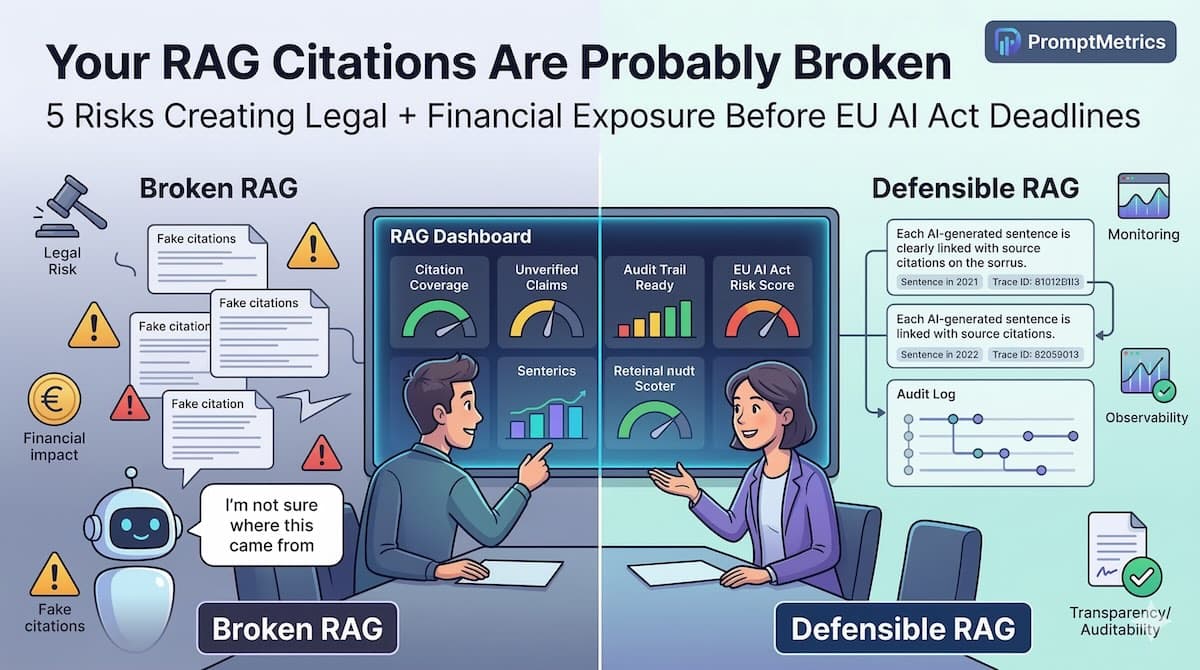
RAG systems fail silently without component-level definitions
Security protocols rely on "vibes" rather than adversarial testing
Compliance is treated as a feature, not an infrastructure requirement
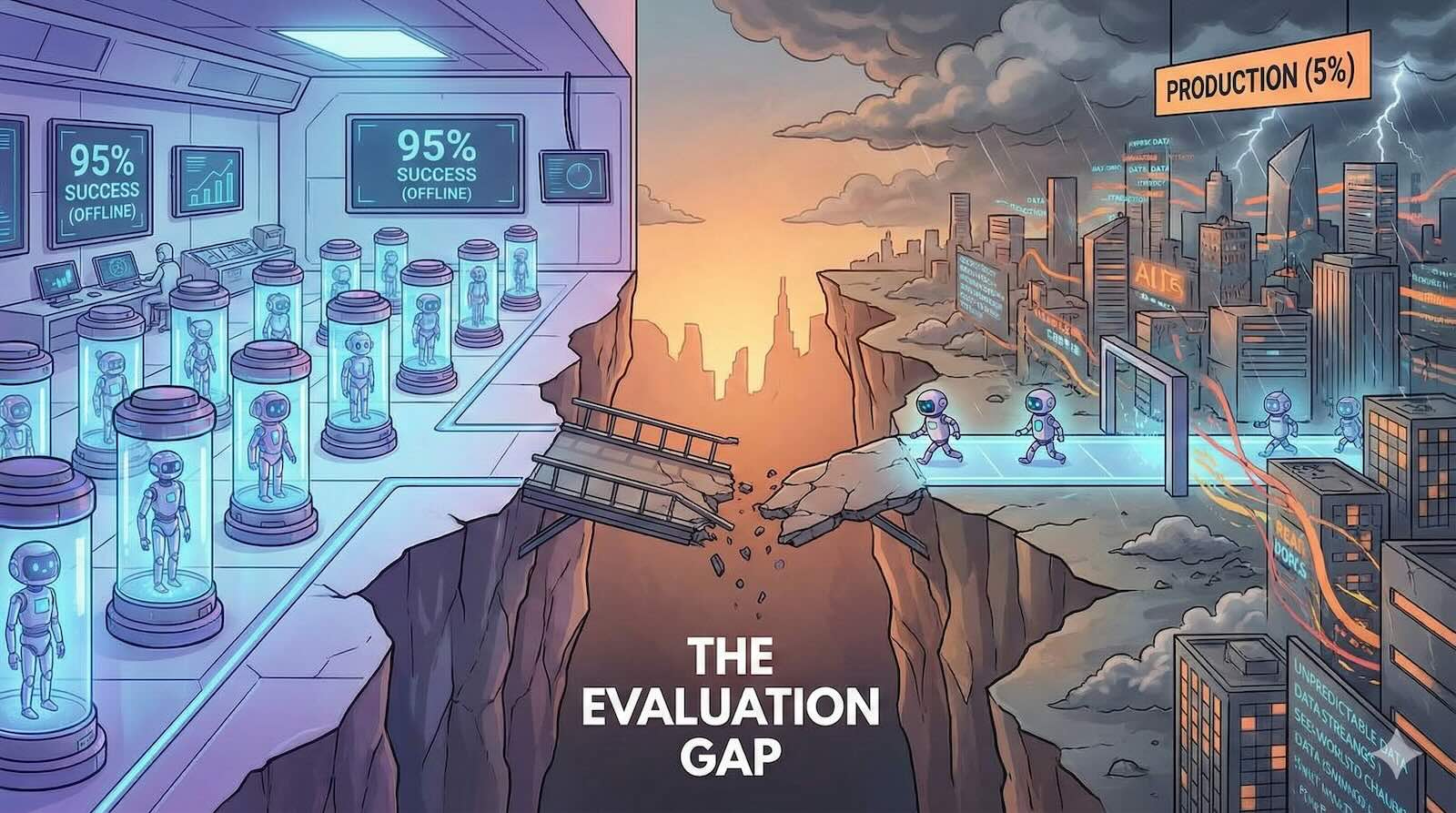
You just shipped your new AI agent. It scored a 95% on your internal "golden set" of test questions. The engineering team is celebrating.
However, according to recent industry analysis, only 5% of AI projects reach full-scale production. Approximately 42% are abandoned before reaching production, and the remainder stall in partial deployment or "pilot purgatory" (Source: LinkedIn analysis of LLM production challenges, 2025).
Why the disconnect?
It's called the Evaluation Gap. It occurs when teams use research-lab methods (static datasets) to test production systems (dynamic, personalized, messy user agents).
At PromptMetrics, we believe in radical transparency even when it hurts. We'd rather tell you now why your current testing strategy is broken, before you burn six months of budget debugging a system doomed by its own metrics.
Here are the five hidden problems with traditional AI evaluation, and exactly how to fix them to join the 5% that succeed.

1. Static Benchmarks & The "Aggregation Trap."
The Problem: Distribution Shift
Most teams test their LLMs using "offline" datasets, static lists of questions and answers. But in an offline test, every prompt is independent. Real users aren't. They have chat history, search context, and changing intent.
Research demonstrates thata distribution shift when live data deviates from your test set causes systematic performance degradation across real-world scenarios (Source: arXiv/NeurIPS Workshop on Distribution Shifts). When you test on a static CSV but deploy to dynamic users, you are effectively testing a different product than the one you shipped.
The Aggregation Trap: Why Averages Lie
Worse, relying on a global "92% Accuracy" score creates an Aggregation Trap.
Consider a typical RAG system. Research on production failures confirms a familiar pattern: systems often achieve high accuracy (e.g., 98%) on simple factual queries like "What are your business hours?", but drop significantly (e.g., 65%) on complex reasoning tasks like "What's the total cost for the Enterprise plan plus three add-ons for 50 users in Germany?"
A global score of "92%" hides this failure. You won't know your model is failing on your highest-value queries until your VIP customers start churning.

The Fix: Slice-Aware Evaluation
You must move beyond global averages. Stop looking at the aggregate.
Slice-Aware Evaluation requires tagging every query with metadata (e.g., user_tier: enterprise, topic: pricing, complexity: high). You then measure performance per segment. This allows you to catch regressions in critical user flows even when the overall average appears stable.
The Fix: Shadow Mode (Traffic Replay)
To test against real user behavior without risk, you must implement Shadow Mode. This involves silently routing live user requests to a candidate model. You compare its output to your production model before a user sees it.
Note on Complexity: We want to be honest, true Shadow Mode is operationally expensive. Building a production-grade implementation from scratch typically requires 2-4 weeks of senior engineering time. It involves:
Parallel inference infrastructure (running two models simultaneously).
Double the inference costs (temporarily).
Complex divergence logic (determining if a different answer is "better" or "worse").
Latency monitoring (ensuring the shadow call doesn't slow down the user).
However, it is the only way to test against actual user behavior without risk.
2. "Accuracy" Is a Vanity Metric (The Hidden ROI Killer)
The Problem
You might optimize your model to hit 97% accuracy. But what about the 3% failure rate? In traditional software, a bug is an error log. In AI, a bug is a "hallucination" that requires a human to fix.
Research shows that AI-generated errors require significantly more human intervention to resolve than standard support tickets, with agents spending additional time repairing customer relationships and untangling misinformation (Source: CMSWire/LTV Plus).
The Concrete Cost of Flying Blind
Let's look at the math for a standard support agent handling 10,000 queries/day.
Baseline: $0.03 per request × 10,000 requests = $300/day.
Without Observability: Imagine a provider outage or a prompt regression affects just 30% of your requests (3,000). If your system uses the standard retry logic (3 attempts per failure), you are generating 6,000 additional failed calls.
Calculation: 3,000 failed requests × 2 retries = 6,000 extra calls.
Total Volume: 16,000 calls.
New Cost: 16,000 × $0.03 = $480/day.
The Impact: A 60% daily cost spike that provides no value to the customer, and you likely won't notice it until the monthly bill arrives.
With Optimization: Semantic caching and intelligent routing can reduce volume by 40%.
The Difference: Between wasted retries and missed optimization, you could be burning tens of thousands of dollars per year on unnecessary compute, plus the cost of your support team cleaning up the mess.
The Fix: Business Proxies
Shift from measuring "token similarity" to measuring Business Proxies:
Acceptance Rate: Did the user copy the code snippet?
Conversation Length: Did the bot solve it in 2 turns or 10?
Sentiment Drift: Did the user start happy and end angry?
3. The "Black Box" of RAG Failures
The Problem
Retrieval-Augmented Generation (RAG) is the standard for enterprise AI, but it introduces a massive blind spot. When a RAG agent gives a bad answer, is it the Retriever's fault (bad search) or the Generator's fault (bad writing)?
If you treat RAG as a black box, you will waste weeks debugging the prompt when the problem was actually your database indexing.

The Fix: Component-Level Observability
You must measure three specific metrics separately:
Context Recall: Did the retrieval system find the document that contains the answer? (Measure: Ratio of relevant docs retrieved vs. total relevant docs available).
Context Relevance: Was the retrieved data actually useful, or just noise? (Measure: Reranking scores or embedding similarity).
Faithfulness: Did the generated answer stay grounded in the retrieved context, or did it hallucinate?
How to measure: Use Entailment Checking. This involves using a smaller model to verify that every claim in the generated answer can be traced back to a specific sentence in the retrieved source text.
4. The Hidden Risk of "Good Vibes" Security
The Problem
Many teams rely on manual "red teaming" or simple keyword filters. But attackers don't use plain text. They use Base64 encoding, jailbreak narratives, and foreign languages to bypass guardrails.
The risks are real and legally actionable:
Air Canada (Feb 2024): A tribunal ruled the airline was liable for a refund policy fabricated by its chatbot (Source: CBC News).
DPD (Jan 2024): The delivery firm's chatbot was tricked into swearing at a customer and criticizing the company, causing immediate viral brand damage (Source: The Guardian).
The Fix: Automated Adversarial Testing
You need Automated Adversarial Testing before deployment to catch vulnerabilities.
In production, use an LLM-as-a-Judge approach, a specialized model that scans outputs for policy violations in real-time.
Crucial Nuance: LLM-as-a-Judge is not a silver bullet. These evaluators can have their own biases (e.g., favoring verbose answers). The best practice is a Hybrid Approach: Use rule-based guardrails for known attacks, LLM-as-a-Judge for semantic nuances, and a "Human-in-the-Loop" review queue for borderline cases.
5. Compliance Is Being Treated as an Afterthought
The Problem
Most engineering teams build the system first and try to bolt on compliance logs later. This is dangerous. Under the EU AI Act, penalties vary by violation type:
Prohibited AI Practices: Fines up to €35M or 7% of global turnover.
High-Risk AI Obligations: (Where most enterprise RAG systems fall) Fines up to €15M or 3% of global turnover for failing to meet documentation, logging, and oversight requirements.
Why This Matters Now
The enforcement timeline is already active.
Feb 2025: Prohibitions on banned AI practices began.
Aug 2027: Full enforcement for High-Risk AI systems.
Organizations deploying AI in production today must demonstrate compliance readiness within 18 months. Regulators can audit systems retroactively. Building compliance into your architecture now is exponentially easier than retrofitting it after an audit.
The Fix
Make compliance a byproduct of Observability. By automatically tracing every step prompt, retrieval, tool call, and response, you generate the audit trail regulators require without extra work.
Why Teams Resist Production Evaluation
If this is so critical, why isn't everyone doing it?
Organizational Inertia: It is easier to report a simple "95% accuracy" metric to the Board than to explain a nuanced "98% reliability on pricing, 70% on support" dashboard.
False Sense of Control: Offline golden sets feel safe. Production evaluation reveals the messy reality of your product.
Investment: It requires operational discipline and infrastructure.
But the alternative, flying blind, is far more expensive.
Current Approach vs. Production-Grade
Current Approach | Production-Grade Approach |
❌ Static "Golden Set" CSVs | ✅ Shadow Mode + Slice-Aware Monitoring |
❌ Overall Accuracy % | ✅ Task Completion + Business KPIs |
❌ Black-box RAG | ✅ Component-Level Metrics (Recall, Faithfulness) |
❌ Batch Pre-Release Testing | ✅ Continuous Post-Deployment Monitoring |
❌ Manual Red-Teaming | ✅ Automated Adversarial Testing + Hybrid Guardrails |
❌ Compliance as a Bolt-on | ✅ Observability-Native Audit Trails |

Is PromptMetrics Right for You?
We are building PromptMetrics to solve these exact operational headaches. However, we believe in radical transparency. We want you to find the right fit, even if it's not us.
When to Graduate from Open Source
If you are pre-PMF or have <1,000 monthly users, open-source tools like LangFuse or basic logging are excellent, cost-effective starting points.
You should consider graduating to PromptMetrics when:
Your LLM spend exceeds €5,000/month, and you need optimization.
You are subject to GDPR, SOC 2, or EU AI Act audit requirements.
You have multiple LLM features and need unified Observability across teams.
You need to prove ROI to executives or investors.
What We're Still Building (Radical Transparency)
PromptMetrics is currently in private beta and specialized for production engineering.
✅ Available Now: Shadow mode infrastructure, slice-aware monitoring, and compliance audit trails.
🚧 In Development: Multi-region deployment management and advanced cost optimization algorithms.
❌ Not Our Focus: We are not a "No-Code" bot builder. If you need a drag-and-drop interface to build a chatbot without writing code, or model training/fine-tuning infrastructure, we recommend looking at other specialized platforms.
📊 Key Takeaways: Production-Grade Evaluation Checklist
✅ Stop relying on static benchmarks → Deploy shadow mode + slice-aware monitoring.
✅ Stop chasing accuracy % → Measure task completion + business KPIs.
✅ Stop treating RAG as a black box → Track recall, relevance, and faithfulness separately.
✅ Stop manual-only security testing → Automate adversarial testing + hybrid guardrails.
✅ Stop bolting on compliance → Build observability-native audit trails from Day 1.
Stop Flying Blind
The difference between a cool demo and a reliable product is control.
We mentioned earlier that Shadow Mode is operationally complex. While that is true for custom builds, PromptMetrics abstracts this complexity. Our SDK allows you to deploy shadow pipelines and start capturing production-grade observability data without rewriting your entire infrastructure.
We are currently onboarding a limited number of engineering teams who are ready to move beyond "vibes-based" evaluation.
Sign up for PromptMetrics today and the engineering teams building reliable, compliant AI in production.