Key Takeaways
61% of employees have hidden their AI use at work, and only about a third of companies have a written policy on it (KPMG / University of Melbourne, 2025).
People lose trust in an algorithm faster than in a human, even when both make the same mistake (Dietvorst, Simmons & Massey, Management Science, 2018).
The fix that actually rebuilt trust in that same research was not a smarter model. It was giving people a small amount of control over the output before it went out.
Real control only works when it comes with AI fluency, the skill to judge what a tool got right or wrong. A human first plan builds that fluency before it buys the license.
Until I was 40, I never really felt like I was from anywhere, having lived in six different cultures. Turns out that's useful training for the job I ended up doing. Twenty-five years of entrepreneurship, but I'll focus on the last 13.
Thirteen years helping companies through change: the region, the client type, the pricing model, the services, the operating model, the CRM switch, the team restructures, the cloud migration, the "we're going agentic now." What's common between all of them is that every one of these companies is a group of human beings about to go through a change.
Being from everywhere and nowhere means you never quite belong to the room you're in. That sounds lonely, and it's actually a professional advantage. You notice things the people inside the system stop seeing, the way you can't smell your own dog, but a guest can the second they walk in.
Here's what thirteen years of that taught me: it's never the tool or the process. Not the tech stack, not the org chart, not the sales process, not the AI model either. It's always the people, and the people keep getting treated as a row in a spreadsheet inside a plan that was already decided before they were ever part of it.
Why does the same fear show up in every rollout, 13 years apart?
The KPMG and University of Melbourne survey of workplace AI use found that 61% of employees have avoided admitting they used AI at work, and only about a third said their company even has a policy on it (KPMG / University of Melbourne, 2025). That number is not new behavior. It is the same fear I have watched for over a decade, just with a new tool attached to it.
Back in 2015, I sat with a woman named Delphine, who ran regional accounts for an insurance company. Her company was moving off spreadsheets onto HubSpot CRM, back when that was still an early move. She was not bad with computers. She was scared that once her twenty years of client relationships lived in a shared database, someone on her team could log in and do her job.
A few years later, in a different country, in a different industry, I sat with Isabel. She worked at one of the first ed tech SaaS companies in Chile selling into the US, the kind that got written up in magazines for being years ahead of every university it sold to. Isabel never said the fear directly. She circled it with different words: what happens to the years I put in, once the thing that made me valuable becomes something a system can show anyone. Being early to the technology doesn't make you early to the feeling.
Now it's Marco. Not his real name, this is a composite of about six Marcos I've actually worked with. Three weeks into a rollout, the leadership dashboard says adoption is "on track." What it doesn't show is that Marco spends ten minutes rewriting every AI-drafted post before he publishes it, not because it's wrong, but because if it sounds too good, too fast, his manager might start wondering what Marco actually does all day.
Same fear. Three different decades.
What happens once a person becomes a row in a tracker?
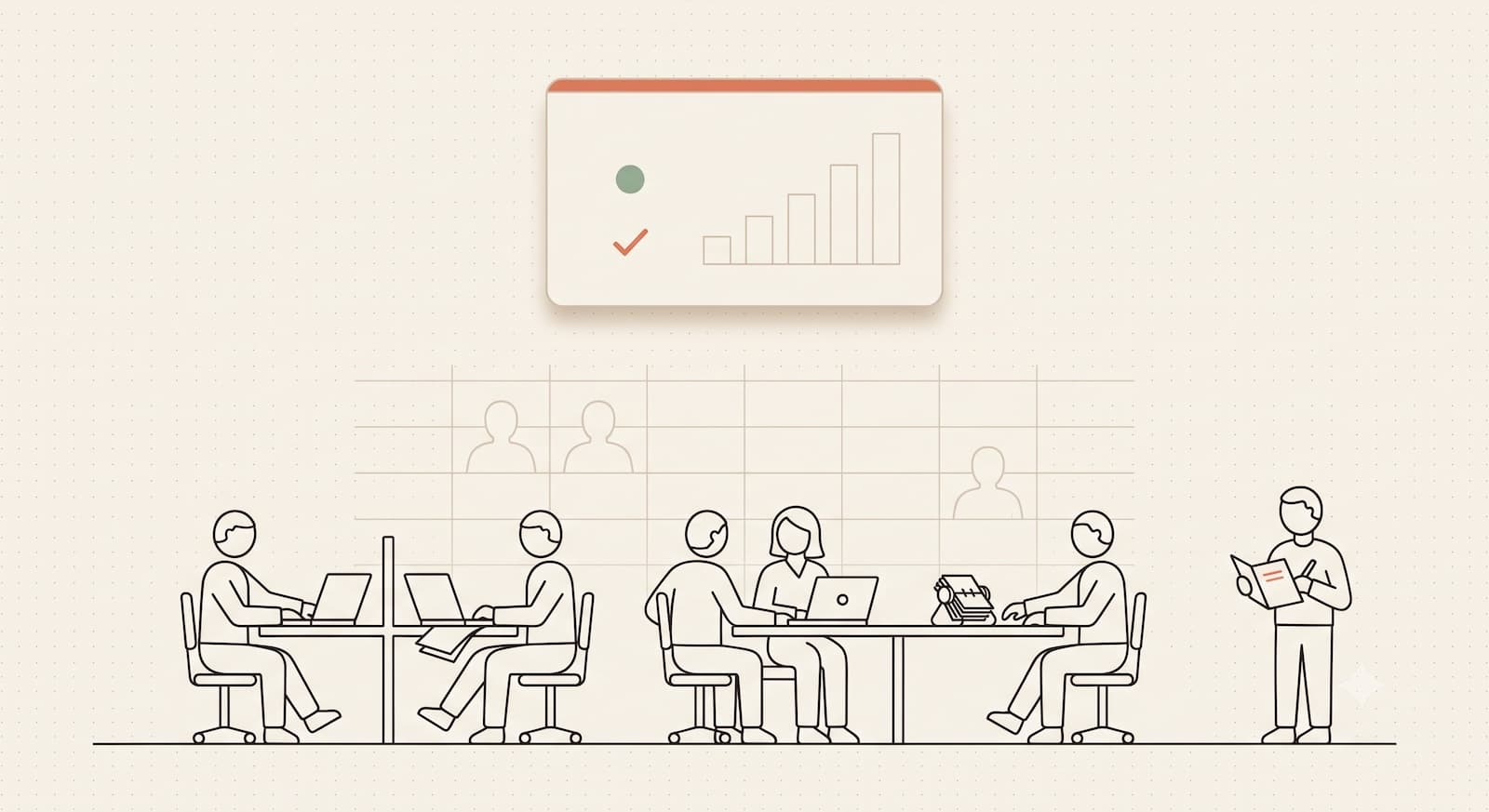
Somewhere in the planning phase, every employee stops being a person and becomes a seat count, a line in the adoption tracker that needs to turn green. I don't think this happens with any intent to harm. I think it's what a spreadsheet does to you if you stare at it long enough. It flattens you. Marco, the person who might be worried about his mortgage or embarrassed that he's slower on new software than the 24-year-old next to him, becomes Marco the row: adopted, or didn't.
Once someone is a row, nobody asks why they're scared anymore. You just measure whether they logged in, and that measurement stops meaning much. I've sat across from sales directors proudly showing me a dashboard of email sends going up and to the right, except a sequence can fire ten emails from one single click a rep made. What's actually being measured there is whether the automation fired, not whether anyone did anything differently.
This is a meaningful part of why so many digital transformation projects fail to deliver the change they promised, and why the research on it keeps landing on the same word: culture, not technology (McKinsey research on transformation and culture, discussed via industry analysis, retrieved 2026-08-03). In plain terms, the humans were never actually dealt with as humans. Worth flagging here that the specific "70%" figure attached to this claim circulates widely without a single traceable McKinsey report page. Treat it as directional, not gospel. The underlying pattern (culture beats tooling) is the part that holds up across the research.
You might be thinking, but there was a survey sent out for feedback, or a workshop that opened with a slide reading "co-created with employees." There was. And nine times out of ten, the decision was already made behind closed doors. The workshop existed to check a box, not because anyone planned to change course based on what came back.
People know the difference. You cannot fake being genuinely curious about someone's fear. They feel it the same way you can feel when someone asks "How are you?" while already walking away before you answer.
So the change lands top-down, wearing a bottom-up costume. That is arguably worse than an honest top-down rollout, because now people feel a little insulted on top of being scared. Research on ERP and system rollouts consistently traces resistance back to poor communication about why the change is happening and what it means for the people living through it, not to the system itself (industry analysis of ERP change resistance, retrieved 2026-08-03).
Why did workplace psychology get reduced to a wellness perk?
Somewhere along the way, "workplace psychology" got redefined as a wellness perk: a meditation app, a gym membership, a once-a-quarter "mental health day" email with a stock photo of someone stretching on a yoga mat. Nothing is wrong with the yoga mat. But it means psychology got filed under self-care, something you do to yourself on your own time, instead of what it actually is: the operating system underneath every decision a person makes at work. Whether they trust a tool. Whether they'll tell you the truth about using it. Whether they show up as their best self today or their triggered self from age seven.
You cannot bring change into a room full of scared people and expect the fear to stay contained. A person alone will quietly work around a new system. Thirty of those people in the same call will build an entire unofficial culture around working around it, with its own jokes and its own person who "unofficially" still does it the old way while everyone protects them for it. That behavior doesn't stay inside a wellness app. It leaks into how the whole team actually works.
Why is AI adoption a sharper version of the same resistance?
AI adoption will not be different, and research on algorithm aversion suggests it may be harder. Dietvorst, Simmons, and Massey found that people lose trust in an algorithm faster than they lose trust in a human, even when they watch both make the exact same mistake, and even when the algorithm is right more often overall (Dietvorst, Simmons & Massey, "Algorithm Aversion," Management Science, 2018).
A spreadsheet never claimed to think. It just stored what you typed. AI tools draft, suggest, and sometimes speak in a voice close enough to a person's own that it triggers a very specific insecurity. Not "will this be annoying to learn," the CRM era fear, but "does this make me replaceable," which hits closer to home.
Silence fills the vacuum leadership leaves behind. Employees who've hidden AI use at work: 61.% Companies with a written policy on AI use ~.33% Source: KPMG / University of Melbourne, "Trust, Attitudes and Use of AI," 2025. One slightly off AI-drafted output becomes the whole story someone tells from then on. A colleague sends an email with a typo, and we say,y "It's Friday." A tool does it once and gets shelved, quietly, forever. That reflex didn't exist with a spreadsheet. It exists with anything that sounds like it's trying to be you.
What actually rebuilt trust in Dietvorst's follow-up study wasn't a more accurate model. It was giving people a small amount of control, a way to tweak the output before it went out. Not because the tweak made the output better. Because control is what restores trust. Same thing Marco needed. Same thing Delphine needed, thirteen years earlier, in her own way. Not a smarter tool. A little bit of say.
Who is actually trained to read the fear in the room?
That's a long way into the problem, so here's where I think the fix starts: almost nobody assigned to a rollout is trained to read human behavior for a living. Every change project has a project manager, sometimes a change management lead, a vendor, an integrator, and a comms person writing the "exciting news!" email. Almost none of them have a social scientist on the team, someone whose actual job is understanding why a group of people, under fear, will quietly route around something rather than say no to it out loud.
That KPMG/Melbourne 61% figure traces back to exactly this gap. Most of that hiding isn't happening because of strict rules against it. It's happening in a vacuum, where nobody said what was okay, so people defaulted to the safest option: silence. Nobody was in the room reading that vacuum as it formed. That's the mistake.
What actually works instead of more training?
No more training. Marco already knows how to click the buttons. So did Delphine, and so did Isabel. What works is somebody, early, saying the fear out loud before anyone else does. Not "please use the new tool," but "I know this might feel like it's judging whether you're good at your job, and it's not; here's why I actually believe that," said by a real person, not a slide.
It also takes giving people real control, an actual edit button, not a take it or leave it output, and leadership using the new tool badly in public first, so the risk of looking incompetent belongs to them before it belongs to Marco. None of that shows up in a standard rollout plan. That's the real gap: not a training gap, a "nobody was hired to understand fear, and nobody thought they needed to be" gap.
What does a human's first plan actually look like?
It starts with leadership that is genuinely human-centered, not as a value on a slide next to the mission statement, but as an actual behavior. Someone senior says the fear out loud before anyone else does. A senior person uses the new tool badly in public, so the risk of looking a bit useless belongs to them and not to Marco. That sounds small. It is not. It is harder than picking the vendor or writing the rollout deck, because it asks the leader to be uncomfortable on purpose, in front of people, with no script.
Most of what gets called a rollout plan is really a system map with feelings bolted on at the end, a slide near the back labeled "change management" with a stock photo of people high-fiving. What you actually need is a human-first plan: an actual different document that starts with names, not tools. Marco, and what he's specifically afraid AI will expose about how he works. Delphine, and what she stands to lose the day her twenty years of relationships become searchable by anyone on her team. Isabel, and the decade she spent circling a fear instead of naming it. You cannot write that list from an offsite. You have to sit with the actual humans and ask.
A human first plan answers three questions before a single license is bought:
Who is scared, and of what, specifically? Not generically.
Who has the authority to go first and look a bit incompetent in public, on purpose?
What does real control look like day to day? An actual edit button, not a take it or leave it output.
Skip those three, and you get exactly what I keep walking into: a green dashboard sitting on top of a room full of people quietly working around the very system it swears is working.
Why does AI fluency matter more than the edit button itself?
There's a fourth thing hiding inside that third question, the one about real control. Control without the skill to use it isn't control; it's a nicer-looking cage. That's where AI fluency comes in, and it is not the prompt engineering course everyone is suddenly selling.
AI fluency is smaller and more human than that. It's knowing what a tool is actually good at and where it's just confidently guessing. It's being able to look at an AI-drafted email and know in ten seconds whether it's right, instead of rewriting the whole thing for thirty minutes because you don't yet trust your own judgment on it. It's knowing which answer to double-check and which one to just trust.
That matters more than the tool itself because Marco's fear was never really about the AI being wrong. It was about Marco not knowing if he'd catch it when it was wrong. Hand someone an edit button with no fluency behind it, and you haven't given them control; you've handed them a red pen and asked them to grade a subject nobody taught them. That's a faster way to feel behind, not an empowered one.
Fluency is also what turns a scary tool into a normal one, faster than any dashboard or town hall. Delphine was never going to trust HubSpot on faith. She needed to trust that she'd still know more than the system about her own client relationships, and that only holds if she understands what the system can see and what it can't. Fluency is what lets Marco stop hiding that he uses AI, because he finally has the judgment to stand behind his own edits instead of hoping nobody asks how the post got written.
Human-centered leadership, the real kind, means building that fluency into people before building the system into the company. Empower the humans before you empower the tool. Skip that order, and the fear doesn't go away; it just gets a faster interface.
Underneath all of it, none of this was ever really about the software. It was whether Marco felt safe enough to admit he rewrites every AI draft out of fear, not quality control. Whether Delphine felt seen enough to hand over twenty years of relationships instead of quietly guarding them. Whether Isabel felt heard enough to name the fear instead of circling it for a decade.
Safe. Seen. Heard. Three words that never show up on a rollout Gantt chart, and probably should. A human first plan is what it looks like when you finally put them there.
So the open question isn't whether companies should hire an anthropologist or write a human-first plan. It's why that hire, or that plan, only ever shows up after the damage, every single wave, when it would cost so much less to bring it in before.
FAQ
What is a "human-first plan" in change management? A human-first plan is a document built before any tool or license is purchased. It names the specific people affected by a rollout, what each of them fears losing, who has the authority to go first and risk looking incompetent in public, and what real day-to-day control looks like for the people using the new system.
What is AI fluency, and how is it different from prompt engineering? AI fluency is the practical judgment to tell when an AI output is right or wrong, and how much to trust it, rather than the technical skill of writing prompts. Prompt engineering is about getting better outputs. Fluency is about knowing what to do with the output once you have it.
Why do employees hide their AI use at work? A 2025 KPMG and University of Melbourne survey found that 61% of employees have avoided admitting they used AI at work, largely because only about a third of companies have a written policy on it (KPMG / University of Melbourne, 2025). Without a stated policy, people default to silence as the safest option.
Why do people trust AI mistakes less than human mistakes? Dietvorst, Simmons, and Massey (2018) found that people lose trust in an algorithm faster than in a human after watching both make the same mistake, even when the algorithm was right more often overall. Giving people a small amount of control to edit the output, rather than a more accurate model, was what rebuilt trust in their follow-up research.