
We know AI is changing how we work. You've read that sentence a hundred times this year, so let's skip past it.
What actually matters is this: the way we think about skill sets already changed. Not on some future roadmap. Already.
Key Takeaways
Jack of all trades used to be a soft insult. AI turned it into a job title: AI Orchestrator, someone who directs a stack of agents and catches what they get wrong.
PwC calls this shift "the rise of the generalist," and it shows up in support and customer success too, not only revenue teams (PwC, 2026).
Revenue has the cleanest numbers on it: SDR headcount is down 18% YoY in 2026, concentrated in junior roles (down 31%), while senior roles grew 14% (Bridge Group via Landbase, 2026).
The vague "AI Generalist" job title only pays around $91k. The role this piece actually means, AI Orchestrator, pulls $145k-$158k (ZipRecruiter, 2026).
What Actually Is a Generalist Now?
For years, "generalist" was a polite way of saying you weren't good enough at any one thing to specialize. Jack of all trades, master of none. Say it out loud at a networking event and watch people's eyes glaze over.
That definition doesn't hold anymore. A generalist is someone who can move across five domains and knows which one needs real depth right now, breadth without being shallow, focus without getting boxed into one lane. Generalist World, a community past 40,000 members since 2022, calls this the Generalist Value Pyramid. Their point lands clean: a generalist can absolutely have a specialty. The value was never breadth instead of depth, it's breadth that tells you where the depth belongs.
This is the generalist the rest of this piece is actually about, and it's a narrower idea than "dabbles in five departments." It's someone who runs the agent stack for an entire chain, decides how the pieces connect, decides what an agent can be trusted to do without a check, and steps in the moment one gets it wrong. There's already a job title for that. AI Orchestrator.
Why Is Being a Generalist Suddenly a Superpower?
One thing changed the value of that skill almost overnight: AI fluency.
Being a generalist used to mean spreading yourself thin across five domains and then specializing anyway, because nobody can actually be expert level in five things at once. AI fluency breaks that ceiling. You don't need to personally hold expert knowledge in five domains anymore, you need to understand each one well enough to direct an agent that does, and to trust your own judgment when something's off.
The superpower isn't knowing everything. It's knowing enough, in enough places, and having an agent that can go deep the second you point it somewhere. A generalist with real AI fluency stops being spread thin and starts operating like five specialists sharing one face, which happens to be the actual job description behind the title AI Orchestrator.
Is This Only Happening in Revenue Teams?
No, and PwC gave this exact shift a name in 2026: the rise of the generalist. Their read is that companies are flattening out of tall, narrow-role structures into something broader and outcome focused, with the person running it called an "M-shaped" supervisor, broad across domains, deep enough in AI to actually direct the agents doing the work (PwC, 2026). It's the T-shaped generalist Generalist World has been describing the whole time, just with a couple of extra peaks.
Support and customer success are going through the same shift with different vocabulary. Coverage of CSM teams in 2026 states plainly that the strong ones now function as orchestrators, leaning on AI copilots to cover more ground while spending their own time on what a copilot can't fake: empathy, negotiation, actually reading a client. Revenue simply has more research already published on it, which is the only reason it gets to be the example that follows.
What Does This Look Like in a Revenue Team?
Think about everything that has to happen between a stranger noticing you exist and that same person becoming a paying, renewing customer: someone finds the lead, someone qualifies it, someone closes it, someone onboards them, someone keeps them around, someone actually gets the invoice paid. Five or six specialists, minimum, because no one person could hold demand generation, outbound, negotiation, customer success, and billing in their head at once. That constraint doesn't exist anymore.
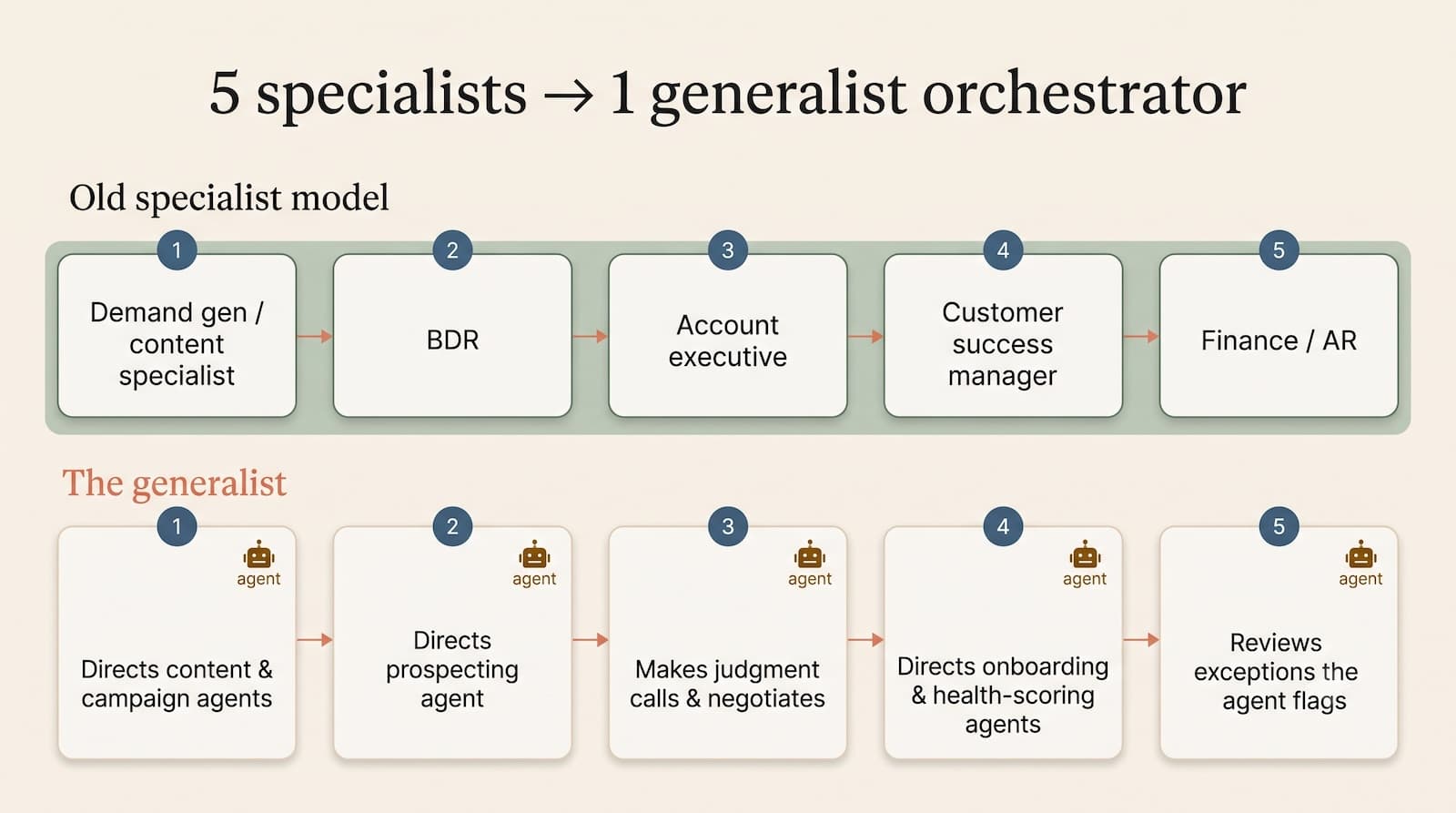
One generalist, the same one from the last section, now runs this entire chain instead of five separate hires. What that looks like, stage by stage:
Stage | Old specialist model | The generalist, stage by stage |
|---|---|---|
First touch | Demand gen / content specialist | Owns the pipeline number, directs the content and campaign agents |
Qualify | BDR doing outbound and qualification | Same person, now directing the agent doing prospecting and first-pass qualification |
Close | Account executive | Same person, stepping in only for the judgment calls and the actual negotiation |
Retain | Customer success manager | Same person, directing the onboarding and health-scoring agents |
Final invoice | Finance / AR chasing invoices | Same person, reviewing whatever exceptions the agent flags before it reaches collections |
Read that right column top to bottom. That's one person's Tuesday, not five job postings.
The stage everyone already has an opinion on backs this up with real numbers. SDR headcount in US B2B SaaS dropped 18% year over year in 2026, and almost none of that came out of senior roles: junior SDRs took the hit, down 31%, while senior SDR and "reply specialist" roles actually grew 14% (Bridge Group data via Landbase, 2026). Getting one qualified opportunity into the pipeline used to cost around $487 with a human-only pod. Pair that same person with an agent instead and it runs about $224, roughly half, for the identical result (Landbase, 2026).
Overall SDR headcount fell 18% year over year. Junior SDR roles fell 31% while senior SDR and reply specialist roles rose 14%. Overall -18% Junior SDR -31% Senior SDR +14% Source: Bridge Group data via Landbase, 2026 It scales too. Five people running this chain or five hundred, the ratio of generalists to revenue is what's actually shrinking either way. The number moves. The shape underneath it doesn't.
Is the Generalist the Human, or Is It the Agent?
This is the part I can't fully resolve, and I don't think anyone else has either. Is the generalist the human directing the agent stack across this whole chain, or has the generalist function actually moved into the agents themselves, with the human getting narrower instead of broader?
Both readings hold up. In the first, the human's edge is judgment, knowing which agent output to trust before it reaches a customer or a forecast. In the second, the human doesn't get broader at all, they get narrower, down to whatever an agent genuinely can't fake: reading a room that's gone tense mid negotiation, rebuilding trust with someone who got burned by a vendor before, sensing that a deal which pencils out perfectly on paper still feels wrong and walking away from it anyway. Either way, what survives is the same thing wearing two different jobs: someone who sees enough of the whole picture to catch what a specialist would have missed, and who's still sharp enough in the one spot that matters to know the agent got it wrong.
Is Anyone Actually Getting Paid to Be a Generalist?
Yes, once you're precise about which generalist you mean.
There's a version of "generalist" the market still punishes: vague, unanchored, a little of everything with no real job attached to it. The literal title "AI Generalist" only averages $91,461 a year, and specialists are out-earning generalists by 17 to 28% overall (ZipRecruiter, industry reporting, 2026). Fair enough, honestly. That isn't the generalist this piece is arguing for.
The generalist this piece is actually pointing at, the person running the agent stack and catching it when things go sideways, already has a name and a real paycheck attached. It's called AI Orchestrator, and it's pulling $145,000 to $158,000 as of mid-2026 (ZipRecruiter, 2026). Eightfold describes the role plainly: the orchestrator acts as "the human in the loop for critical decisions." PwC named the idea before the market priced it properly. The word took a while to catch up. The job itself was never really in question.
Human in the loop isn't just flavor text either, it's a real term out of AI safety and governance for someone whose job is catching a mistake before it reaches a real decision, and it's older than any of this. For years it mostly meant checking a model's output for accuracy inside content moderation and data labeling, unglamorous, low paid work. That's changing fast. The EU is making human oversight mandatory for high-risk AI systems, similar rules are moving through the US, and that market alone is on track to grow from $4.1 billion in 2025 to $12.5 billion by 2027 (The Interview Guys, 2026), pushing well past annotation into healthcare compliance, legal review, and tax work, judgment anchored to one domain, not generic babysitting.
Put next to everything above, the generalist and the orchestrator turn out to be the highest paid version of the exact same job: someone with the range to sit across a whole chain, and the depth in any one link of it to catch the agent when it's wrong. Strip the compliance-checklist tone off "human in the loop" and that's really all it ever meant.
Is anyone getting paid to be a generalist, then? Yes, just don't search for the word "generalist" on the job board. Search for orchestrator, or human in the loop. Different label, same job, and it's already a well paid one.
How Should Leaders Prepare Their Teams for This?
Three things matter here, and none of them require a consultant to explain:
Hire for the whole chain, not one link in it. Whatever chain your team runs, next time you're about to post a job for a single stage, ask yourself honestly whether that's a job, or a task an agent could pick up with one generalist keeping an eye on it.
Don't let the way people used to learn this business quietly disappear. Junior roles were where a lot of good people cut their teeth on the fundamentals. Lose that rung without replacing it and you'll notice in about three years, when there's no one ready to promote. Build something in its place, a rotation, a short apprenticeship watching over the agents, anything.
Pay people for the job they're actually doing. Someone directing agents across three stages of a chain isn't doing the job your comp bands were built for. Keep paying for the old job and you'll watch whoever figured that out first hire your best people away from you.
Frequently Asked Questions
What does it mean to be a generalist in the AI era?
Someone who runs the agent stack across an entire chain, revenue, support, or product, rather than owning one narrow piece of it: deciding how the agents work together, where their judgment ends, and catching it when they're wrong. Some companies already have a title for this: AI Orchestrator.
Is being a generalist actually valuable, or is it still "jack of all trades, master of none"?
The old framing assumed a generalist spread themselves thin across every domain. Paired with AI fluency, a generalist directs expert level output in each domain instead, closer to five specialists sharing one person than a diluted amateur. Increasingly, that's just the job called AI Orchestrator.
Is this only happening in sales and revenue teams?
No. PwC calls the wider shift "the rise of the generalist," and it's showing up in support and customer success too, where CSMs are already being called orchestrators outright. Revenue just happens to have the most research published on it, which is why it anchors the example here.
Will AI replace revenue roles outright?
Not outright. Junior, narrow, single-stage roles are shrinking, SDR headcount is down 31% at the junior level, while senior, judgment-heavy roles are growing, up 14%. Most teams are reshaping this chain, not erasing it.
Are companies actually hiring and paying for generalists right now?
Yes, once you stop searching for the literal word "generalist." That title only averages $91,461, and specialists out-earn generalists by 17-28% overall (ZipRecruiter, industry reporting, 2026). The actual function behind the word, directing agents and catching their mistakes, already has a name and a real premium: AI Orchestrator, averaging $145k-$158k and described outright as the human in the loop.
Conclusion
Generalist used to be a soft insult. Paired with real AI fluency, and increasingly a real job title, AI Orchestrator, it's about as close to a superpower as anyone directing a team gets right now, not because this generalist knows more than everyone else, but because they can point expert-level depth at any lane the moment it's actually needed.
Revenue just happened to be the easiest place to show this with real numbers attached. The same shift is already on the record in support and customer success, and PwC isn't calling it "the rise of the generalist" for nothing. None of this argues for hiring fewer people forever. It argues for changing what the people you do hire are actually responsible for: a whole outcome, not one task buried inside it, whatever team that chain happens to belong to.
If you're trying to figure out where to start building this, or you've already got agents running and they're not pulling their weight yet, that's the actual conversation worth having. Book a call with PromptMetrics and we'll walk through what your team's chain actually looks like right now.
Sources: Landbase, The Death of the BDR Role, 2026, retrieved 2026-07-23 · Generalist World, retrieved 2026-07-23 · The Generalist Value Pyramid, retrieved 2026-07-23 · ZipRecruiter, AI Generalist Salary, retrieved 2026-07-23 · ZipRecruiter, AI Orchestration Jobs, retrieved 2026-07-23 · Eightfold, The Most Important Job of 2026, retrieved 2026-07-23 · PwC, No More Pyramids, retrieved 2026-07-23 · The Interview Guys, Top 10 Human-in-the-Loop Jobs, retrieved 2026-07-23