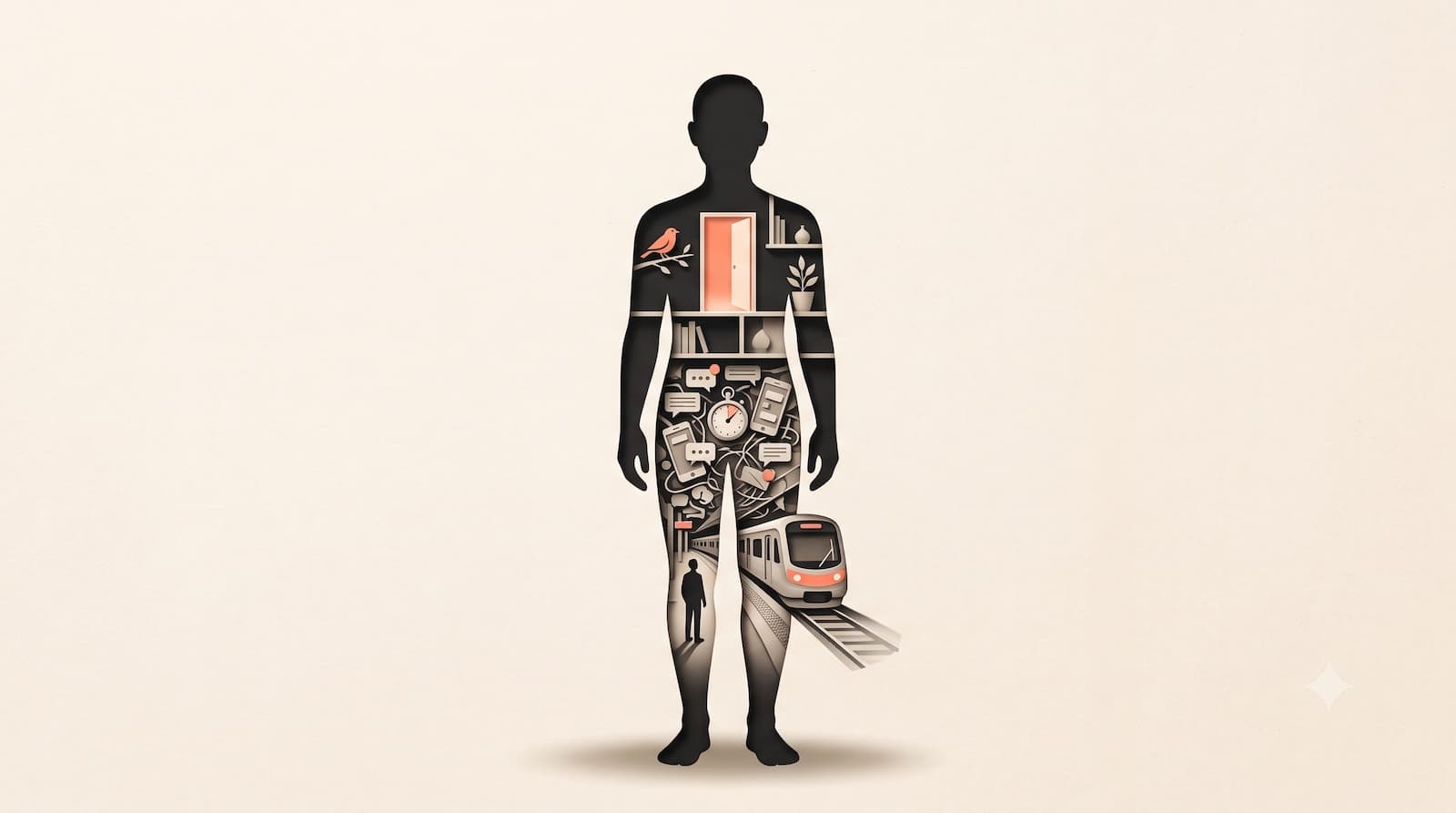
Let me tell you about Daisy. She's not a real person, by the way. She is a combination of many people I have worked with over the years.
Daisy's Tuesday started normally. Coffee, inbox, Slack. Then her feed did the thing everyone's feed does now. A founder she vaguely follows posted "we're AI-first now, are you?" Her manager forwarded an article titled something like "The Great AI Divide." Someone in a client call casually said "obviously we automated that with AI" like it was as unremarkable as using email. By 11 am, Daisy had that specific feeling of a train leaving without her and nobody even bothering to ring a bell.
Here's the part that would've made her laugh if she'd had the distance to see it: she'd been using AI for months. Constantly, actually. Asking it to help translate a form for her mother-in-law. Getting it to explain a weird rash before her doctor's appointment. Having it read over a text to an ex so she didn't sound unhinged. None of that felt like falling behind. It just felt like Tuesday. So why did the same technology feel like a test she'd already failed the second it showed up at the office?
Why does saying "I'm anxious about this" feel like a confession?
Hiding AI use at work is common, not rare. Fifty-seven percent of employees admit to it, presenting AI-assisted work as entirely their own, per KPMG and the University of Melbourne's 2025 global study of over 48,000 people across 47 countries. Thomas Hübl, who's spent decades studying how trauma moves through people and organizations, has a name for what usually sits underneath that kind of hiding: "high functioning dissociation." Not focus. Not resilience. A pretty sophisticated way of not feeling something, dressed up as competence.
That's exactly what Daisy did. She never actually sat with the anxiety, so it never got processed; it just got buried under output. She said yes to every AI request that landed on her desk, kept producing, and quietly stopped mentioning which parts were actually hers. Not because she's dishonest. Because saying "I used AI for this and I'm honestly not sure it's right" felt like handing someone a reason to doubt her, right when she needed to look like she'd already caught up.
Here's an uncomfortable one: when was the last time you told a coworker, out loud, that you weren't totally sure whether a piece of work was yours or the robot's?
That's the same shadow Hübl talks about; it just shows up at work instead of at home. It doesn't disappear once it's underground. It just keeps running things without you noticing.
What is staying this anxious actually costing you?
Staying anxious about AI has a real, measurable cost. Trust in company-provided generative AI dropped 31 percent in three months, according to Deloitte's TrustID Index (2025), even among the same corporate workers who were leaning on it more than ever. More use, less trust, at the same time. That gap is expensive, whether or not anyone's naming it.
A few weeks into her AI sprint, Daisy hit a wall. Not a dramatic one. Just a quiet Tuesday where she looked at a report she'd shipped and genuinely couldn't remember if she'd checked the numbers or just trusted the output, because checking felt like admitting she wasn't sure. She'd been using AI more and feeling less steady about it with every week that passed.
Hübl also talks about a kind of return on integration, roughly this: energy available for the present, divided by effort required to get the same result. When you're operating from unprocessed "I'm behind" panic, effort goes way up, and energy for the actual work goes way down, because a chunk of you is always busy managing the feeling instead of doing the task. Daisy wasn't bad at her job. Most of her fuel went to not looking anxious. Whatever was left over went to the work.
That same KPMG and Melbourne study found 56 percent of employees have made a mistake in their work because of AI, and two in three use AI outputs without evaluating them at all. Not because the tool is bad. Evaluating something properly means slowing down long enough to actually look at it, and slowing down was the one thing Daisy's nervous system wouldn't let her do while it thought it was in a race.
What would it actually cost you to admit, this week, exactly how much of your last big deliverable you didn't check?
Could you build this from presence instead of panic?
The AI Fluency Framework gives you a structured way to work with AI without operating from panic. What moved Daisy forward wasn't a better prompt. It was one obvious question she'd skipped entirely: what am I actually trying to accomplish here, in my own words, before I even open a chat window?. That's called Problem Awareness, and it sounds too simple to matter until you notice how rarely anyone does it under pressure.
Here's the shape of it, stripped down. Four competencies:
Delegation – deciding what's genuinely yours to do and what's AI's job
Description – telling AI what you actually want, clearly enough that it can deliver it
Discernment – judging whether what came back is good, and how it got there
Diligence – owning it afterward, honest about what you checked and what you didn't

And three modes of actually working with it:
Automation – one instruction, one output, taken at face value, like a vending machine
Augmentation – going back and forth with AI like an actual thinking partner, pushing on the first draft instead of accepting it.
Agency – letting AI run with your judgment built in, while you stay accountable for what it produces
Discernment was the muscle Daisy had let go slack. She'd been living entirely in Automation and calling it speed.
Hübl's own framing for this, applied outside anything to do with AI, is building from a place of wholeness rather than a scar. I don't think that changes much once you point it at a chat window. The things that actually happen between two attentive humans, real attunement, real co-regulation, aren't things AI replicates. That part stays ours entirely. What changes is that once you're not white-knuckling the anxiety, you actually have bandwidth left over to use the tool well.
Are you building your relationship with AI from a place of clarity, or from a place of panic you haven't looked at yet?
One question before you go
Daisy's fine now, for what it's worth. Not because she got faster. Because she stopped hiding the parts she wasn't sure about, and started asking better questions before she started at all.
So here's the only question that actually matters: are you going to keep performing like you've got this handled, or are you going to sit down and actually learn it? Let me know in the comments.
Quick answers, if you're skimming
Is it normal to feel anxious about AI at work?
Yes. It's common, not personal. Trust in workplace generative AI dropped 31 percent in three months even as usage increased (Deloitte TrustID Index, 2025), which points to widespread unease rather than an individual skills problem.
Why do so many people hide their AI use?
57 percent of employees hide their AI use and present the work as entirely their own (KPMG & University of Melbourne, 2025). Admitting uncertainty about AI-assisted work feels risky, especially under pressure to look like you've already caught up.
What is the AI Fluency Framework?
A model for human-AI collaboration built around four competencies: Delegation, Description, Discernment, and Diligence. It helps you decide what to hand to AI, how to communicate with it, how to judge its output, and how to stay accountable for the result.
What are Automation, Augmentation, and Agency?
The three modes of working with AI. Automation is one instruction, one output, accepted as is. Augmentation is treating AI as an active thinking partner. Agency is configuring AI to act on your judgment while you stay accountable for what it produces.
Where do I actually start with AI?
Start with Problem Awareness: define, in your own words, exactly what you're trying to accomplish before you open a chat window. A vague goal gets you a generic result, every time, regardless of the tool.
Sources: KPMG & University of Melbourne, "Trust, attitudes and use of Artificial Intelligence: A global study 2025," retrieved 2026-07-22, mbs.edu/faculty-and-research/trust-and-ai. Deloitte, TrustID Index, "Trust: The missing link in scaling AI," 2025, retrieved 2026-07-22. Thomas Hübl, on collective trauma and integration; see also Attuned & Healing Collective Trauma.