

Every quarter, sales leaders walk into budget meetings with the same problem. They know AI tools could transform their team's performance. They have vendor case studies. They have competitor pressure. And every quarter, their business case comes back with the same note: "Let's revisit next quarter."
Meanwhile, top-quartile firms now spend 4.2% of OpEx on GTM AI tooling, compared to 1.5% at bottom-quartile companies (Golden Door Asset, 2026). The gap isn't about conviction. It's about how the case gets built.
Most business cases for AI tools fail for the same reason most sales pitches fail: they lead with the product instead of the problem. This guide walks through the framework that actually gets CFOs to say yes.
Watch: Welcome to Agentic GTM — The AI Revolution in SalesKey Takeaways
- 31% of AI sales pilots never reach rollout; the #1 cause is buying point tools instead of workflow solutions (Gartner, 2024)
- Median B2B orgs spend $9,300/rep/year on AI tools, while top-quartile performers invest nearly double the median (Pavilion Benchmarks, 2025)
- Build your case around one measurable workflow, not "AI" as a category. Organizations that win funding show conservative, auditable ROI models with 3-6 month payback periods
- Fund AI by cutting redundant tools first: 85% of sales leaders plan to consolidate their tech stacks, and replacing 2-3 point solutions with one platform often covers the cost
Why Most AI Business Cases Get Rejected
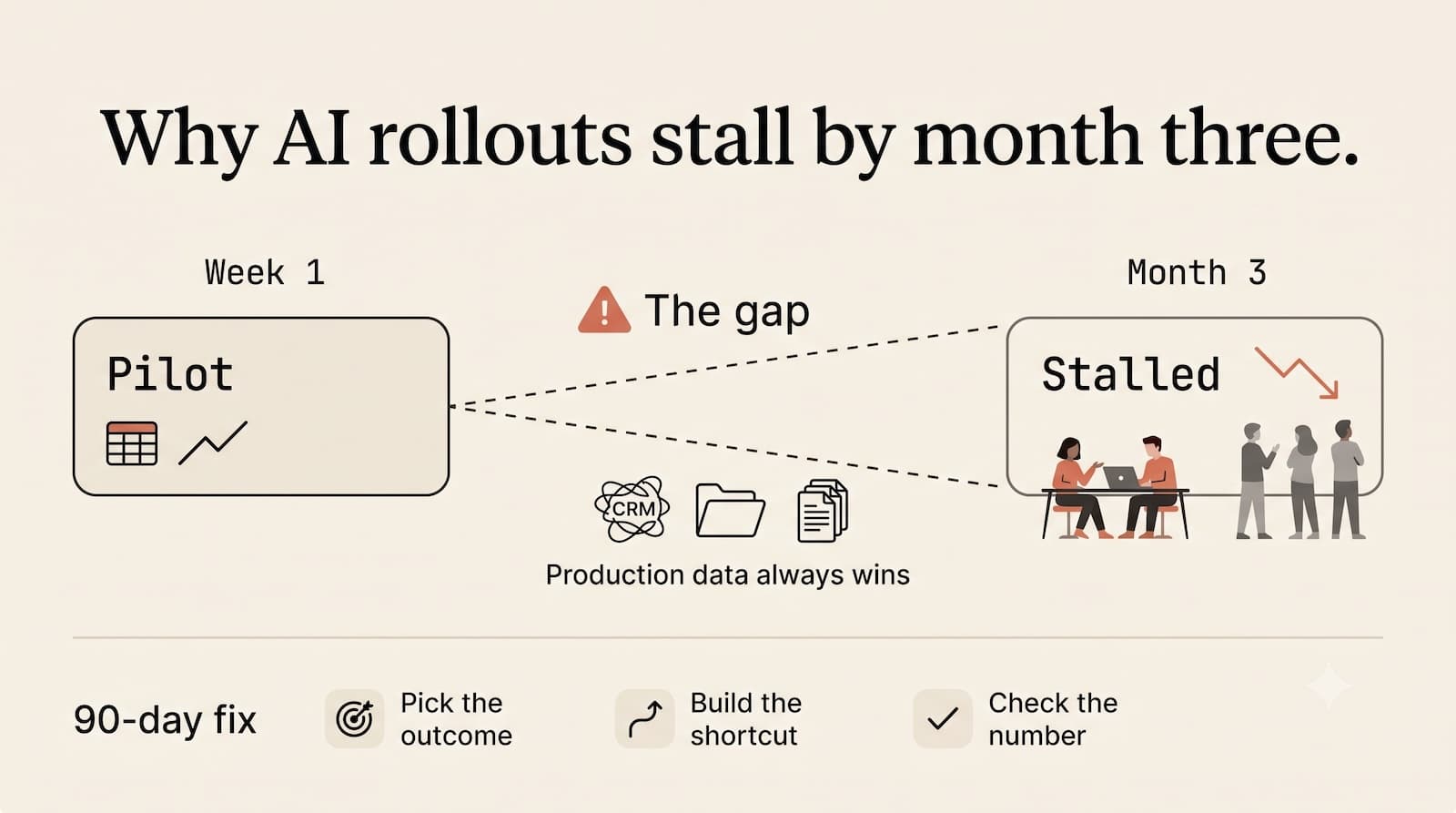
A 2024 Gartner CSO survey found that 31% of AI sales pilots never make it to rollout, and fewer than 10% of AI pilots reach scale (Gartner, 2024). The primary reason isn't that the technology doesn't work. It's that the business case was built around a tool rather than a specific operational problem the CFO can price.
The failure modes are remarkably consistent across organizations. Buying a point tool instead of a workflow solution tops the list, followed by auto-writing to CRM without rep review, skipping voice training on outreach, measuring vanity KPIs like "emails sent" instead of outcomes like reply rates, and failing security reviews late in the process. Each of these traces back to the same root cause: the budget request started with a vendor demo rather than a time study.
[INTERNAL-LINK: sales tech stack audit guide → step-by-step tool rationalization framework]
Here's how this typically collapses. A VP of Sales sees an AI conversation intelligence demo with auto-generated call summaries and a stat claiming "37% higher win rates." The VP builds a budget request around those features and that vendor-supplied number. The CFO asks three questions: What's our current win rate? What behavior change creates that 37%? And what's your confidence our reps will adopt this? The VP doesn't have answers anchored in internal data. Case rejected.
The fix isn't finding better vendor statistics. It's starting with a spreadsheet that shows what the current broken workflow actually costs.
Start With the Problem, Not the Tool
Only 33% of a sales rep's time goes toward actively selling (Salesforce State of Sales, 2026). The rest disappears into CRM data entry, internal research, call summarization, list building, and manual pipeline updates. That's your budget case, not "we need AI," but "we're burning $X per month on non-selling activity we can automate."
Before naming a single vendor, run a two-week time study on the workflow you want to fix. Pick one high-volume, measurable activity: post-call CRM notes, lead research, proposal drafting, forecast compilation. Have reps log every instance, the minutes it takes, and the loaded hourly rate of the person doing it.
The math gets uncomfortable fast. A rep at $120K fully loaded spending 90 minutes a day on CRM admin costs the company roughly $27,000 a year in non-revenue activity per rep. A 50-person sales team burns over $1.3 million annually on tasks AI handles in seconds.
[INTERNAL-LINK: maximizing rep selling time → actionable strategies to reclaim capacity]
This baseline number becomes the denominator for your entire ROI model. Without it, you're asking for trust. With it, you're asking for math.

When I've built these cases for teams, the time study step alone often reshapes the conversation. One RevOps leader I worked with discovered her team spent 14 hours a week manually compiling forecast data from five different systems. That single finding produced a business case approved in one meeting, because the problem had a price tag and the fix had a clear payback.
The 4-Layer ROI Framework That CFOs Trust
According to a 2026 analysis of AI business cases by StackBuilt, organizations that get funding approved use a multi-layer ROI model rather than a single headline number (StackBuilt, 2026). The ones that get rejected typically lead with a vendor-supplied "10x ROI" claim that crumbles the moment someone asks to see the math.
Build your case across four layers:
Layer 1: Direct Time Savings. Multiply monthly hours saved by the fully-loaded hourly rate of the people doing the work. If a tool saves reps 6 hours a week on CRM admin at a $60/hour loaded rate, that's $1,440/month/rep in recoverable capacity. This is your most defensible number because it draws from your time study, not vendor projections.
Layer 2: Quality and Output Multiplier. Calculate the delta between current and projected output. If reps currently run 12 discovery calls a week and reclaiming admin time enables 15, that 25% capacity gain translates directly to pipeline volume. Only count time you can realistically redirect, not every saved minute.
Layer 3: Revenue Attribution. Most teams skip this layer because direct attribution is genuinely hard. That instinct is right. If you include revenue projections, apply confidence weighting: high-confidence benefits at 100% credit, medium at 60%, low at 25%. Hard benefits alone must cover the investment.
Layer 4: Total Cost of Ownership. License fees are roughly 20% of real cost. Add setup, training, pipeline maintenance, governance overhead, and switching costs. Realistic year-one TCO typically runs 1.5-2.5x the sticker price. A $30K annual license often means $55-75K in year-one cost.
The formula that resonates: (L1 + L2 + L3 - L4) / L4 = ROI multiple. Present three scenarios: conservative (50% adoption), base (70%), and optimistic (90% with full workflow change). Running the scenarios signals you've thought through failure modes, which is exactly what your CFO is already doing.
A practical benchmark: 90% of AI users save roughly 3.5 hours a week (Iternal, 2026). At a $74/hour fully-loaded rate across 10,000 employees, that's $135 million in annual productivity. Scale it down to your team size and rate. The math scales cleanly.

Benchmarks That Pass the Smell Test
High-growth B2B SaaS companies now allocate 4-6% of ARR to AI tooling, with AI commanding 8-12% of the total GTM operating budget (Golden Door Asset, 2026). Here's how real spend breaks down by company stage:
| ARR Range | AI Spend Median (% ARR) | AI Spend Top Quartile |
|---|---|---|
| $10M-$25M | 0.85% | 1.60% |
| $25M-$50M | 0.72% | 1.35% |
| $50M-$100M | 0.65% | 1.20% |
Per-rep figures tell the same story with different resolution. The median B2B organization spends $9,300 per rep per year on AI sales tools. Enterprise firms reach $14,000 to $28,000 per rep (Pavilion Benchmarks, 2025).
What do these numbers actually mean for your proposal?
First, percentages decline as companies scale because AI spend doesn't grow linearly with headcount. A 200-rep org doesn't spend 10x what a 20-rep org spends on the same tool. Reference per-rep efficiency, not just the total line item.
Second, the median-to-top-quartile spread is roughly 2x at every size band. Top performers aren't buying more tools, they're integrating and adopting fewer tools better. Consolidated stacks cost less per rep than fragmented ones.
Third, build vs. buy only favors in-house development above roughly 250 reps. Platform licenses at $99-$299/rep/month beat the $200K-$500K annual cost of maintaining homegrown AI infrastructure at any smaller scale.
[INTERNAL-LINK: build vs buy sales technology → decision framework for in-house vs vendor AI]
Use benchmarks as guardrails, not targets. Proposed spend at 3x your size band's median needs specific evidence. Spend at median can be framed as "keeping pace."
The Budget Reallocation Play: Fund AI by Cutting Elsewhere
What are you already paying for that you should stop paying for?
85% of sales leaders plan to consolidate their tech stacks within two years (Gartner, 2025). The average B2B company runs 87 software tools, yet only 23% directly impact revenue generation (ProspectX, 2025).
Pull the last 12 months of software spend. Tag every tool by usage: daily, weekly, monthly, or "who subscribed to this?" Tools in the last category aren't just waste, they're your AI budget, pre-funded.
Modern AI platforms absorb multiple point solutions. A conversation intelligence tool replaces your call recording software, manual QA sampling, and chunks of your forecasting spreadsheet. One $100/rep/month subscription eliminates two or three at $30-50 each.
I've watched a 60-person sales team fund their entire AI rollout, conversation intelligence, signal-based prospecting, and automated call summaries, by cutting four tools nobody could remember buying. The net budget change was slightly negative. The CFO approved it in under 48 hours because there was no net-new ask.
The consolidation trend by company stage confirms this pattern:
| ARR Range | Platform Spend | Point Solution Spend |
|---|---|---|
| $10M-$25M | 30% | 70% |
| $50M-$100M | 65% | 35% |
Companies naturally consolidate as they grow. Accelerating that curve is a legitimate strategy. Frame the conversation as: "I want to reduce our tool count by three and reallocate the savings to one integrated platform." CFOs lean in for that conversation.
[INTERNAL-LINK: sales tech stack consolidation guide → which tools to cut and which to keep]
The 6-Slide Pitch Deck That Gets a Yes
What does a CFO actually need to see? Not a vision deck. Six slides.
Slide 1: The Problem With a Price Tag. Current workflow cost from your time study. One number in large font: "Our 50 reps spend $1.3M/year on CRM admin."
Slide 2: The Fix. One specific tool described by what it replaces, not its AI features. "This handles post-call CRM entry, next-step logging, and pipeline stage updates automatically, with rep review before commit."
Slide 3: Conservative ROI Model. Three scenarios with confidence-weighted inputs. Hard benefits must alone cover the cost. Soft benefits are upside. Show the payback period for each scenario.
Slide 4: Industry Validation. Two or three benchmarks from comparable deployments, not vendor case studies. "Median peers at our size spend $9,300/rep/year and report 8 admin hours saved per week (HubSpot, 2025)."
Slide 5: Pilot Proposal. 4-6 week test, 10-15 reps, under $5K total cost. Explicit go/no-go criteria: "If we don't see 4+ admin hours saved per rep per week by week 4, we don't expand."
Slide 6: Risk Honesty. Name the three things most likely to fail, typically adoption, data quality, and integration complexity, and what you'll do about each. Acknowledging risk isn't weakness. It's the fastest way to build trust with a finance audience.
The pilot slide carries the deck. Asking for $200K to roll out AI across 100 reps triggers every organizational immune response. Asking for $4,800 to test one tool with eight reps for five weeks with a pass/fail bar? That's an experiment budget. Most CFOs approve those at their level without escalation.
Frequently Asked Questions
How long should the payback period be for an AI sales tool?
Target 3-6 months for workflow automation tools. The median rep saves 8 admin hours per week with AI assistance (HubSpot, 2025), which at typical loaded rates means per-seat license costs are covered within 1-2 months. Longer payback is reasonable for tools requiring behavioral change, like forecasting or coaching platforms.
Buy an AI platform or build in-house?
Buy unless you have more than roughly 250 reps. Platform licenses at $99-$299/rep/month run well below the $200K-$500K annual cost of maintaining an in-house engineering team. The exception is when your workflow is genuinely unique to your business, but most sales processes are more alike than different.
What's the single biggest mistake in AI budget proposals?
Leading with AI capabilities instead of current-state operational costs. The organizations that win funding don't ask for an AI budget. They ask to solve a specific workflow problem that happens to be best solved with AI, and they bring their own baseline data.
How do I handle the "what if adoption fails" objection?
Build the pilot proposal before the full rollout ask. A 4-6 week bounded test with a small rep group and explicit go/no-go criteria answers the adoption question with evidence. If the pilot fails, you're out a few thousand dollars. If it works, those reps become your internal champions.
Conclusion
81% of sales teams are already investing in AI, and 92% of businesses plan to increase that investment (Salesforce, 2026). The question isn't whether AI tools belong in your budget. It's whether you build the case the way your CFO evaluates every other decision: with a clear problem, conservative math, realistic adoption assumptions, and a bounded pilot with hard exit criteria.
- Start with a two-week time study on one measurable workflow to price the problem
- Build a 4-layer ROI model with confidence-weighted inputs and three scenarios
- Fund tools by eliminating redundant subscriptions, consolidation often covers the check
- Present a 6-slide deck that leads with your problem cost, not vendor capabilities
- Run a small pilot with go/no-go criteria before asking for the full rollout budget
The teams that get their AI budgets approved aren't the ones with the most compelling vision. They're the ones who show up with a spreadsheet that makes the CFO lean forward and say, "Show me the pilot plan."
[INTERNAL-LINK: ROI tracking framework for sales tools → how to measure what you justified]