I've been reflecting over the weekend and I feel that AI is not just making work faster. It changed what our work actually is.
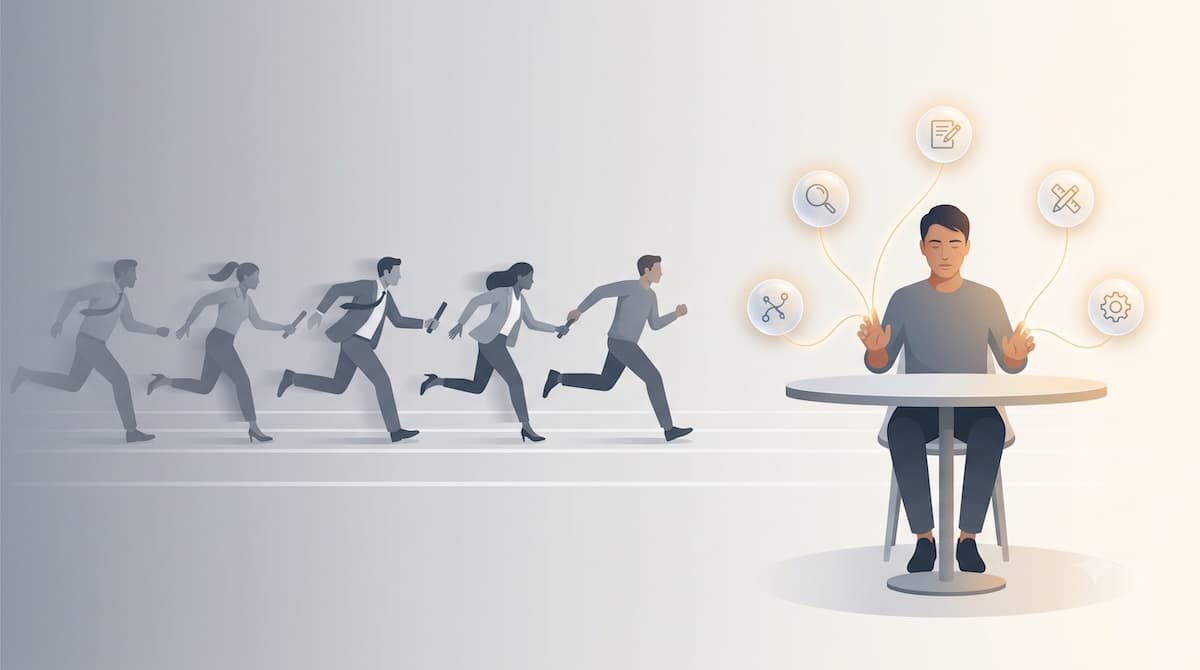
For years, building something meant a relay race. Someone researches. They hand off to whoever sets the strategy. Strategy hands off to whoever writes the copy. Copy hands off to design. Design hands off to engineering. And as many of you know, with every handoff some of the context is missed and slows down the momentum, and there's a small chance the thing drifts from what was actually meant, because the person doing the next step wasn't in the room for the last one.
We just launched PromptMetrics from scratch. We built ICP, value proposition, jobs to be done, our own "why," the full website copy, every page designed, the services we're offering, the Skool community, the content and funnel to go with it, in a week. From start to finish. Not because we worked faster than usual. Because there was no relay. We were able to brainstorm, design, build, test with multiple agents working with us and handing off to each other.
Here's the part that matters if you run a company: the org chart built for that relay race doesn't make sense anymore. A strategy team, then a copy team, then a design team, then an engineering team, with tickets and reviews at every boundary. I believe that structure was viable because execution used to be slow and each stage needed a specialist to do it well. If today teams can work with agents that have many skills to give us the specialist input when needed and can execute each of those specialist stages autonomously and fast, the boundaries you built to manage slowness are now the slowest part of the whole system. You're not behind because you lack tools. You're behind because your team is organized and structured for a relay that isn't happening anymore.
I felt this one directly. AI let us write PRDs faster than ever, with a level of detail we'd never have had the time or resources for before. Which sounds like a pure win, until the PRDs started queuing up waiting for our PM to actually review them. The speed didn't disappear. It just moved. It stopped being an execution or a build problem and became a review problem, and nobody had resized the review step to match. And the solution isn't to skip reviews. The human staying in the loop isn't the part that's broken. In my opinion the review step has to change shape too, the same as everything upstream of it, and I don't have a clean answer for what that looks like yet, and chances are I won't have a clear answer soon, because the AI ecosystem is changing so fast.
It's not just about efficiency. It's actually how we work has changed. It's not just faster, it's different.
And it doesn't stop at the org chart, it comes all the way down to what makes one person valuable. A few years ago, being an expert in one thing was the whole career, the path to being the best copywriter, or the best engineer. The advice was to stay in your lane, get better at it. Now the scarce skill isn't depth in one lane, on the contrary, it's being able to hold the whole picture and orchestrate work between agents across specialties you were never trained in, in the same afternoon. Staying narrow isn't safe anymore. It's what leaves you standing at a handoff that no longer exists, waiting for a relay that already ended.
I watched this happen again tonight, while I was writing about it. A conversation about building a newsletter pipeline turned into an actual, working, committed plugin about twenty minutes after we agreed on the idea. I wasn't in a planning phase and then a building phase. There wasn't a ratio between the two worth measuring. It was one conversation that happened to end with working software in it.
If your business is still organized like a relay, and if you're still measuring your own value or your team's value by how deep they are in one lane instead of how much of the whole picture you can hold, then that's the thing worth looking at this week. Not the tools. The shape.