
n8n went from $70M to $100M in annual recurring revenue in four months. In May 2026, SAP invested at a $5.2B valuation (Sacra, n8n company profile). Meanwhile, half your feed says Claude Code just made it obsolete. Both stories read as true. Both miss the point.
Here's the actual problem: operators pick a tool first, then force every task through it. If you live in n8n, you end up rebuilding judgment work as a 40-node canvas nobody wants to maintain. If you live in Claude Code, you end up paying per token on every run for a fixed job, whereas a €20 n8n plan runs at a flat rate. Same mistake, opposite directions.
We built orchestration layers on both patterns after 12 years inside the HubSpot ecosystem, watching automations break. This guide gives you a per-task decision test, honest category winners, and real monthly numbers. It pairs with our take on choosing automation or augmentation per task.
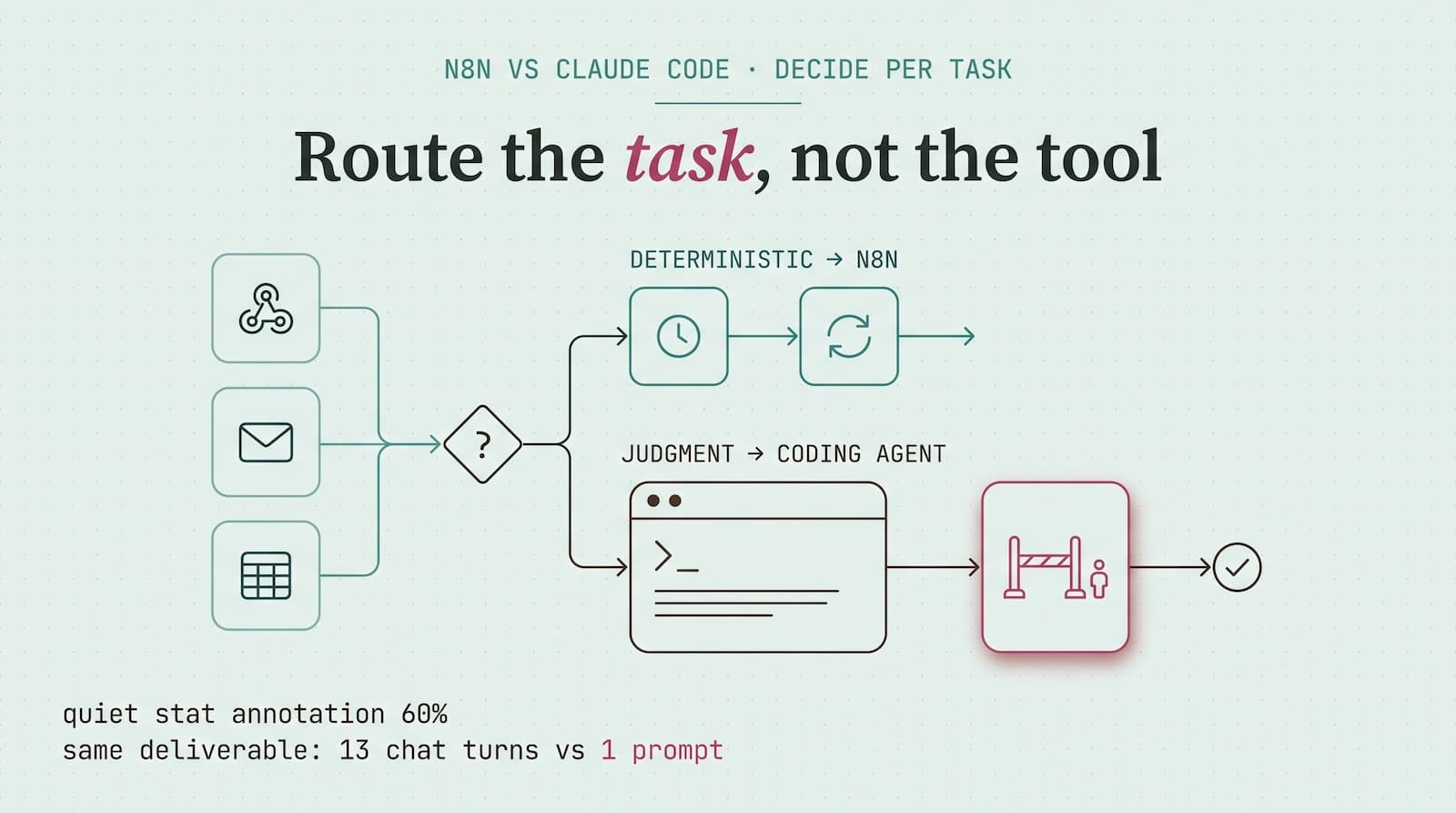
The short version: Use n8n when the task is deterministic: same trigger, same steps, high volume. Use Claude Code when the task needs judgment: reading context, deciding, drafting. By late 2025, more than 80% of workflows on n8n involved AI agents (Sacra), so most operators already run both patterns. Decide per task, not per tool.
n8n vs Claude Code at a Glance
Neither tool "wins." They solve different task shapes, and the table shows where each one earns its keep.
Category | n8n | Claude Code |
|---|---|---|
Best for | Deterministic, high-volume workflows | Judgment work: triage, reconciling, drafting |
Interface | Visual canvas, nodes, JSON | Plain language in a terminal or Cowork |
Trigger model | Webhooks, cron, retries built in | Prompts, plus scheduled tasks with extra wiring |
Determinism | Same input, same output, every run | Judgment with variance, a human approves changes |
Debugging | Visual: click the failed node | Transcripts and logs, agent helps investigate |
Handoff | Requires n8n literacy | Plain-language skills plus a README |
Pricing shape | Per execution, flat and predictable | Per seat plus tokens, variable |
Governance | Execution logs | Nothing writes until you approve it |
As of September 2026, n8n's pricing page lists the Starter plan at €20/mo for 2,500 executions and Pro at €50/mo for 10,000, billed annually, one plan for your whole team (n8n pricing). Claude is priced per person: Pro at $20/mo, Max from $100/mo, or a Team plan at $25 per seat monthly, and for Max usage it's $100 to $125 per seat per month depending on whether you pay annually or monthly. (Anthropic pricing).
What Does Each Tool Actually Do?
n8n is a workflow engine: nodes on a canvas, fired by triggers, executing the same steps on every run. Claude Code is a coding agent: you describe the outcome in plain language, and it reads, decides, writes, and executes under your review. In late 2025, n8n's free Community Edition counted 1.7 million monthly active builders (Sacra). These are not niche tools anymore.
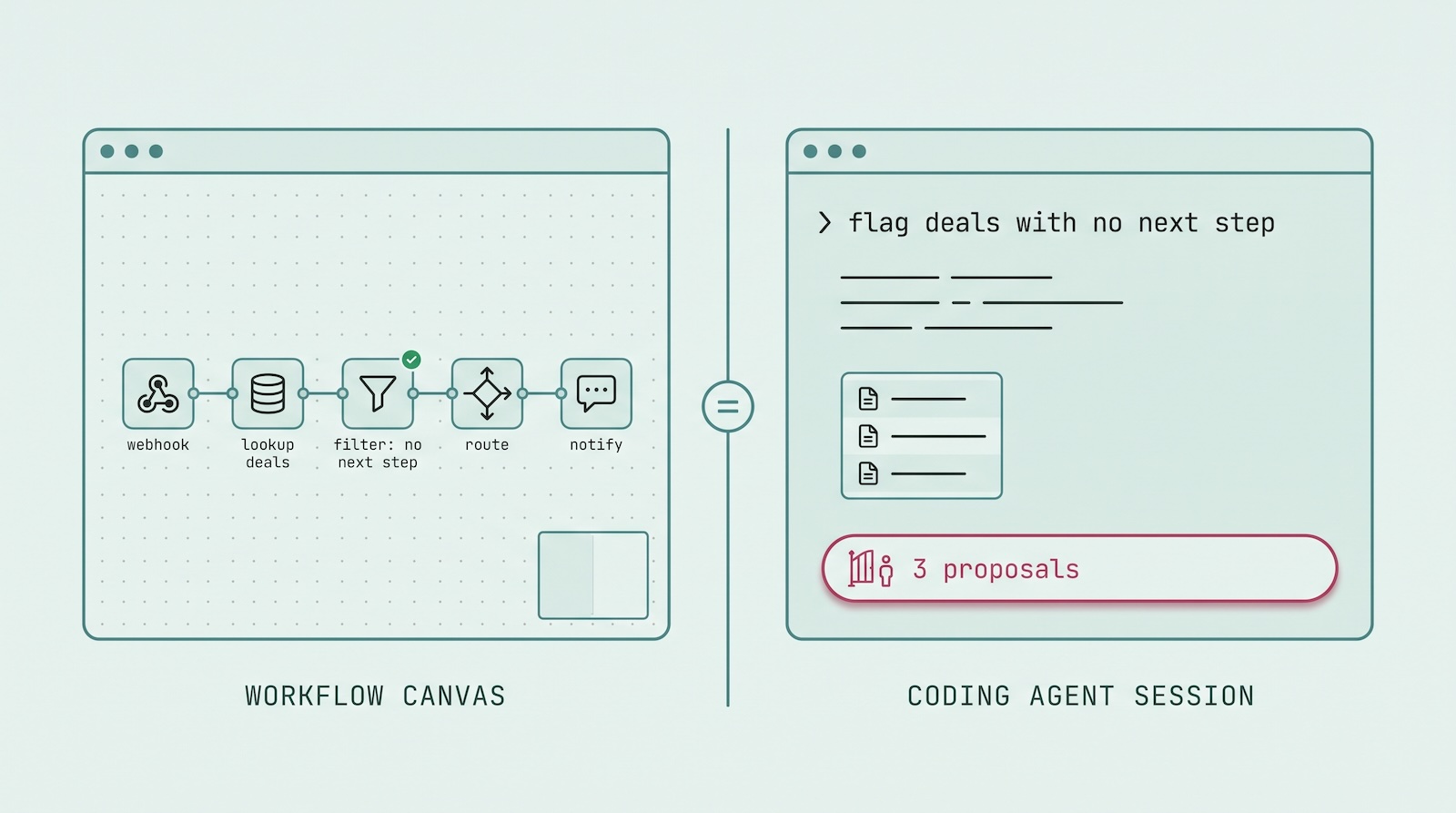
n8n, the workflow engine
You drag nodes onto a canvas: a webhook trigger, a HubSpot lookup, a filter, a Slack message. Every run walks the same path. The open-source repo sits above 203,000 GitHub stars as of September 2026 (n8n on GitHub), and its pricing counts executions, not steps. One run of a 50-step workflow is one execution.
One catch the pricing page won't shout about: the flat rate covers the workflow, not the AI inside it. Drop an AI node into your flow, and that node calls a model provider with your own API key. You pay the provider per token, every time the node runs. Retries included.
Claude Code, the coding agent
You type what you want: "flag every deal with no next step and draft a nudge for each owner." The agent writes the code, calls the APIs, and shows you the result before anything changes. Kill the misconception here: this stopped being a developers-only tool. The operator running a governed CRM cleanup is the growth user, not the programmer.
Which Handles Repetitive, High-Volume Workflows Better?
n8n wins, and it's not close. A task that fires 2,000 times a month on the same webhook with the same steps belongs on a workflow engine. As of September 2026, an n8n execution is a single run of your entire workflow regardless of step count (n8n pricing), so 2,500 of those cost €20 flat.
That flat rate is the whole argument. Webhooks, cron schedules, retries, and a visual execution log come built in. When something fails at 3 a.m., you click the red node and see the exact input that broke it. No archaeology.
Could Claude Code do this? Sure. Scheduled tasks exist. But running a deterministic 50-step pipe through a probabilistic agent means paying token prices for work a €20 plan does at fixed cost, and accepting variance where you wanted none. Every workflow starts as an event, and events belong on an event layer. More on that pattern in every workflow starts as an event.
Verdict: n8n for deterministic volume. Full stop.
Which Handles Judgment Work Better?
Claude Code wins when the task needs reading, weighing, and deciding. Here's the clearest number I've seen on it. In June 2026, Anthropic measured how much back-and-forth the same deliverable takes: writing a blog post took people a median of 13 messages in chat, and a single prompt in Claude Code (Anthropic Economic Index, Cadences). Same output, one instruction instead of thirteen. The difference is that the agent goes and finds the context itself instead of asking you for it, piece by piece.

Can't an AI node inside n8n do the judgment? It can make one call. You wire in the inputs, the model returns an answer, and the next node runs with it. That works when the question is small, and the context already sits in the payload. It falls over on a question like "is this account worth a human call?", because answering that well means pulling the deal history, the last three emails, and the company's website first. In n8n, you'd have to wire every one of those lookups in advance. The agent does the digging itself, case by case, and shows you its answer before anything happens.
Operators already know this. In an October 2025 survey of 525 US C-suite leaders by Zapier and Centiment, operations ranked second among departments deploying AI agents at 47%, just behind customer support at 49% (Zapier, State of agentic AI adoption).
Now the uncomfortable part of n8n's own headline number. By late 2025, more than 80% of workflows on the platform involved AI agents (Sacra). Read that again: most n8n workflows now have a model making a decision somewhere in the middle of a fixed pipe. Nobody checks that decision. The next node just runs with whatever came back. One small AI step in a flow is fine. When the AI decision is the whole point of the workflow, and no human sees it before it acts, that's where the silent breakage lives.
Verdict: coding agent for judgment. Workflow engine for the pipe around it.
Which Can a Non-Coding Operator Actually Run?
The honest answer: n8n is easier to start, Claude Code is easier to hand over. The canvas makes it easy to build almost anything in your first week. But as the workflow grows, and you add more nodes and more branches, it gets hard to maintain, hard to hand to a teammate, and hard to build on. A Claude Code skill is the opposite shape: a folder of plain-language instructions with a README. Anyone on the team can read it and change it.
One thing matters more than which tool you pick: who approves the change before it happens? Both tools can do it. n8n can pause a workflow and wait for a yes. Claude Code can propose a change and hold it until you accept. The point is that you build the approval step in, whichever tool you use, on anything that writes to a system you care about. Most companies already work this way: in the October 2025 Zapier survey, a human approving the agent's work was the most common setup at 38%, and only 20% let systems act with minimal oversight (Zapier).

This is how we run our own HubSpot portal. The agent has write access, and it can't change a single property until I approve the proposed write. The gate lives inside the tool, and the audit log shows both the proposal and the approval. I wrote up the architecture in the gate belongs inside the tool. If governance is landing on your desk, that's because governance is the operator's actual new job.
What Do They Cost at a Lean Team's Scale?
Compare like with like, because the sticker prices hide a seat difference. One n8n Cloud plan covers your whole team: unlimited users, €20 to €50 a month depending on execution volume. Claude is priced per person: $20/mo Pro or from $100/mo Max for individuals, and $25 per seat monthly on the Team plan, so a three-person team runs $75/mo before anyone touches a heavy tier (both vendors' pricing pages, September 2026). The shapes differ too. n8n bills per execution, flat and predictable. Claude bills per seat with usage limits, and heavy sessions vary. And n8n's AI nodes need a separate LLM API key on top, which is the cost most comparisons forget.
An execution is fixed-price. A token count is variable. That's not a methodology wrinkle to apologise for. It's the argument: n8n sells you predictable cost; the coding agent sells you judgment at variable cost.
One more path deserves honest treatment: n8n's Community Edition is free to self-host, and 1.7 million builders do. Free comes with three catches. You rent the server it runs on. You become the person who patches, backs up, and restarts it. And the free edition is built for a single operator: sharing workflows and credentials across a team, projects, and SSO all sit behind paid licenses (n8n docs, Compare editions). Free software, not free operation, and not a free team plan.
We built the same task both ways to put numbers on it: a HubSpot deal-hygiene check that flags every deal with no next step, run against a sandbox portal with roughly 100 Acme Corp test deals. The n8n version took ⟨X hours⟩ to build; the Claude Code skill took ⟨Y minutes⟩. Per run, n8n's plan math is fixed: €0.008 on Starter, €0.005 on Pro. The Claude Code version used a median of ⟨N tokens⟩ per run across 10 runs (min ⟨A⟩, max ⟨B⟩), which prices at ⟨€Z⟩ per run at current API rates, and at zero marginal cost inside a subscription until you hit usage limits.
[CHART-3: line chart, monthly cost vs run volume with crossover marked. BUILD AFTER BENCHMARK: n8n as a flat line stepping at 2.5K and 10K runs; Claude Code as median-tokens-per-run x API rate x runs. Mark the crossover run count.]
The crossover is the number that matters: below roughly ⟨N runs⟩ per month, the agent is cheaper per task. Above it, flat executions win. Run the same math on your own task before you commit either way.
Run Both Together
Most serious setups do exactly this, and the division of labour is simple: n8n does the plumbing, the agent does the thinking. Here's the Acme Corp version. A form submit fires an n8n webhook. n8n pulls the matching deals from HubSpot, dedupes them, and writes the result out as a JSON payload. All of that is plain API calls: deterministic, no AI involved, no tokens spent. Then Claude Code picks up that payload for the judgment part, "which of these accounts deserves a human call?", drafts its answer into Slack, and a person approves before anything writes back to the CRM.
One warning before you rebuild everything as an agent. In June 2025, Gartner predicted over 40% of agentic AI projects will be canceled by the end of 2027, citing escalating costs, unclear business value, and inadequate risk controls (Gartner press release, June 2025). The survivors scope the agent to the judgment step. The casualties hand it the whole pipeline. The gap between a working demo and a working integration is the real 80% of the job, which we covered in the integration is the hard 80%.
How Do You Decide Per Task?
Three questions, asked per task, settle it. First: does it run the same steps every time? n8n. Second: does a person currently read something and decide? Claude Code, with a human approving before anything changes. Third: does it run more than about 50 times a month without changing? n8n, even if an agent built the first version. The 50 isn't from a study; it's our rule of thumb from client work. Around that volume, paying tokens per run and spot-checking the output starts costing more than a flat execution plan that runs identically every time.
RevOps manager running HubSpot plus a handful of other tools: your stack already talks through webhooks, so let n8n keep moving the data. Add Claude Code for the work where someone reads and decides: lead triage, account summaries, pipeline cleanup.
Solo founder doing the job of twelve: start with Claude Code. You have more judgment work than volume work, and one tool covers more ground.
Team already deep in n8n: don't migrate. Add the agent for the steps you still do by hand, and pick them the way we described in [INTERNAL-LINK: start with one boring task → pick-one-boring-task].
If the task is one-off, use neither pattern. Just ask the agent to do it once.
Where This Framework Leaks
Full disclosure, in three parts. We build on Claude Code commercially, which is exactly why the n8n verdicts above are unhedged. We measured build time and run cost, not maintenance drift over months; a day-30 update to this post will add the maintenance log. And the crossover math assumes your task's token use looks like ours. A judgment task that reads a bigger portal reads more tokens. Measure yours.
Frequently Asked Questions
Can Claude Code replace n8n?
Technically yes: Claude Code can run the fixed workflows too. The real question is price and predictability. As of September 2026, n8n runs 2,500 executions for €20/mo flat, with retries and cron built in (n8n pricing); the same fixed steps in Claude Code cost tokens on every run and can vary. Route judgment work to Claude Code, fixed volume to n8n.
Can I use n8n and Claude Code together?
Yes, and it's the pattern we recommend: n8n handles triggers and data movement, Claude Code handles the judgment step, and a person approves before anything writes back. How is that different from a Claude AI node inside n8n? The node makes one call with only the context you wired in; the agent works the whole task, pulls extra context itself, and waits for your approval. You pay the model per token either way. You're choosing how much work each call does.
Is n8n still worth learning in 2026?
Yes. In April 2026, the company hit $100M ARR, with 1.7 million monthly active Community Edition builders and a $5.2B valuation (Sacra). The platform isn't going anywhere. Better: the trigger-and-execution model you learn transfers to every event layer.
Do I need to code to use Claude Code?
No. You describe the task in plain language; the agent writes and runs the code, and you approve its work before anything changes. The Anthropic Economic Index found in June 2026 that the same deliverable takes a median of one prompt on Claude Code versus 13 chat rounds (Anthropic).
Which is cheaper, n8n or Claude Code?
For deterministic volume, n8n, from €20/mo flat. For judgment work, Claude, from $20/mo, because building the equivalent decision tree in nodes costs weeks, not euros. A mixed stack on n8n Pro plus Claude Max starts around €140/mo combined (our arithmetic from both pricing pages, September 2026, at roughly 1.08 USD per EUR).
The Verdict
Category | Winner |
|---|---|
Repetitive, high-volume workflows | n8n |
Judgment work | Claude Code |
Getting started this week | n8n |
Handoff and maintenance | Claude Code |
Approval before changes | Claude Code |
Predictable cost | n8n |
Overall | Both, routed per task |
Stop asking "n8n or Claude Code?" Ask it about each task instead. If the task runs the same way every time, put it in n8n and pay the flat rate. If a person reads and decides, hand it to Claude Code and approve its work before anything changes. Most stacks end up running both. The one rule that keeps you out of Gartner's 40%: give the agent the deciding, not the whole pipeline.
Run both? Only one? Did the cost math for your own stack? Bring your numbers to Operator Stack or reply to the newsletter.