I need to say something out loud that most people in tech won't admit: I am confused a lot of the time.
I spend my days with robots, and I still feel, some mornings, like I'm sprinting on a treadmill that keeps speeding up while increasing incline 10x. If you feel that too, you are not behind. You are human. Feeling disoriented by a pace of change nobody trained us for is not a personal failing, it's the human response to the reality around us today. Nobody gave us a manual called "how to feel about your job changing every quarter." You're allowed to need a minute.
Here's the part that excites me… tadaaaaa.
That thing used to be filed under "nice to have," the soft skills, the people skills, the stuff that never made it onto a résumé bullet point next to your technical certifications, just got promoted. Finally! I say that with excitement as it's what I would hire and fire for. It's what I preferred to train my team on. No technical skills, just the soft ones for years.
Loudly, LinkedIn's own CEO, Ryan Roslansky, and Chief Economic Opportunity Officer Aneesh Raman, spent a whole book on it called Open to Work. Their argument, backed by talking to neuroscientists, organizational psychologists and behavioral economists: there are five human capabilities that AI cannot touch, and those five are about to become the most valuable thing you bring to any table. They call them the 5 Cs. I knew I wasn't off all along despite how many people made me feel that way. Thank you robots!
What are the 5 Cs, and why do they matter now?
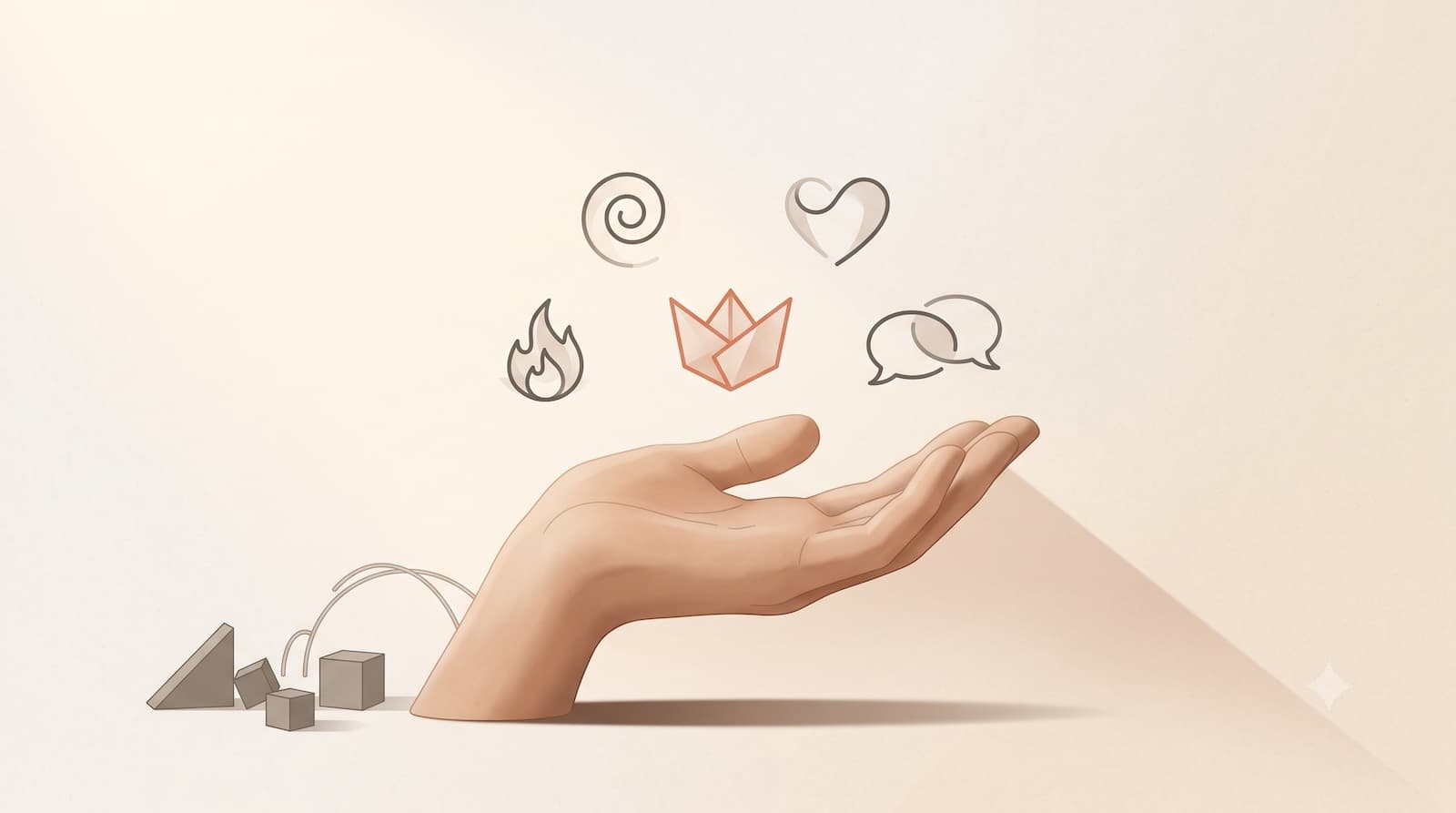
The 5 Cs are five human capabilities AI cannot replicate: curiosity, courage, creativity, compassion, and communication. LinkedIn CEO Ryan Roslansky and Chief Economic Opportunity Officer Aneesh Raman introduced them in their 2026 book Open to Work, after talking to neuroscientists, organizational psychologists, and behavioral economists about what actually makes people irreplaceable at work.
Curiosity. AI can process a pattern. Only a human asks what happens if we try something nobody's tried.
Courage. AI can calculate a risk. Only a human decides which risk is actually worth taking.
Creativity. AI remixes what already exists. Only a human imagines what doesn't exist yet.
Compassion. AI can simulate concern in a sentence. It cannot feel it, and it cannot sit with you in a hard moment the way another person can.
Communication. AI can translate language. Only a human turns language into meaning that moves someone to act. Communication ranked as the number one in demand skill on LinkedIn in 2024.

Does the data actually back this up?
Yes. A Wall Street Journal survey of nearly 900 executives found 92 percent say soft skills are equally or more important than technical skills, as reported by Inc.. LinkedIn's own data shows employees who pair technical skill with strong soft skills get promoted roughly 8 percent faster than technical-only peers, per the LinkedIn Talent Blog.
The World Economic Forum's 2025 Future of Jobs report lists leadership, social influence, resilience, and adaptability among the fastest growing skills employers want through 2030. On LinkedIn's 2026 Skills on the Rise list, conflict mitigation is one of the fastest growing skills in the US, and roughly half the list is human skills rather than technical ones, per CNBC's coverage. AI didn't make soft skills optional. It made them the entire game.
Why doesn't knowing the 5 Cs matter make you good at them?
Because they're built capabilities, not facts you memorize. Roslansky and Raman say it themselves: the 5 Cs don't come from a weekend workshop, they come from time, connection, and getting your teeth kicked in a few times in a room that mattered.
That's not a knock on you. It's just what building any real skill has always required, and it's exactly why we've never treated soft skills like a skill at all. We treat them like a personality trait you either have or don't. You wouldn't tell a new salesperson to just "get better at closing" with no training, no roleplay, no repetition. But that's exactly what most companies do with feedback conversations, boundary setting, and handling a client who's furious at you for something that wasn't your fault.
I trained as an anthropologist before I ended up running client relationships across three continents for twenty years. I watched brilliant, technically excellent people, on teams full of accents and backgrounds that made some of them feel like the underdog before they'd said a single word in the room, getting quietly outperformed by people who were just better at the human part. Not smarter. Not more qualified. Better at being seen and heard as an equal in a hard moment. That gap is coachable. It just needs an actual method, not a pep talk.
Why does building a new habit need coaching instead of willpower?
Because habits stick through repeated, uncomfortable practice with real feedback, not through deciding hard enough. Someone puts you in a slightly uncomfortable situation, on purpose, more than once, and helps you notice what you did under pressure. That's coaching, and it's how every athlete, surgeon, and hostage negotiator on earth actually builds performance under stress.
Nobody becomes calm in a crisis by reading about calm. You practice it while your palms are a little sweaty, with someone watching who can tell you the truth about what just happened. That belief is the entire reason we built a soft skills coaching skill inside our tools: not a chatbot that hands you five bullet points on "how to handle conflict," but a structured method you run, either to prepare for a real conversation you're dreading, or to be coached through your own patterns directly.
What three frameworks does the coaching method use?
Three, and each one traces back to the psychology of performance under pressure: LAER, Never Split the Difference, and The Art of War.
LAER (Listen, Acknowledge, Explore, Respond) is rooted in the same principle every good therapist and negotiator uses: people can't hear your response until they feel heard first.
Never Split the Difference, the negotiation method from former FBI hostage negotiator Chris Voss, adds mirroring and labeling. Naming someone's emotion out loud, calmly, defuses the exact fight or flight response that makes hard conversations go sideways. That's basic threat physiology, not a communication hack.
The Art of War, for genuinely high stakes conversations, builds the muscle of staying aware under pressure instead of just reacting to the last thing someone said. Performance psychologists call this a big part of what separates people who stay sharp under stress from people who freeze.
How does the coaching skill actually work, step by step?
It runs the same four moves every session, in order: ground it in the real situation, name the pattern in two minutes, roleplay the hard conversation for real, then debrief with teeth by asking how you think you did before giving you the honest read.
First it grounds you in the real situation, not the vague version. "My client is driving me insane" turns into the actual email, the actual meeting, the actual words that got said. Then it names the pattern underneath what's happening, fast, no lecture, just a name you can hold onto.
Then it puts you in the room. It plays the difficult counterpart properly, repeats the same complaint the way real people do, doesn't fold just because you said one smart line. Then it debriefs you with teeth. It asks how you think you did before it tells you anything, then it tells you the truth anyway, including the specific moment you apologized for something that was never yours to apologize for.
What happens after the session ends?
Every session gets logged into a personal Growth Log: a dated entry with the framework used, the pattern named, the sound bites that worked, and three practice tasks for the week ahead. The next session opens by checking in on those exact three tasks.
One good roleplay is a nice Tuesday afternoon. A tracked one turns into a habit, because someone, or something, is actually keeping score with you. And if a sound bite or reframe worked well enough to help a teammate too, you can choose to hand it to your team, stripped of the scenario and anyone's name. That part is opt in, every single time, never automatic, because trust is the entire point of coaching someone through their hardest moments.
I would love for you to try the skill and let me know what doesnt work, what work, what could be improved. Lets help each other stay or become more human again. Here is the link to the Github repo.
FAQ
Are soft skills really the new hard skill, or is that just a catchy line? It's backed by data, not just a slogan. A Wall Street Journal survey of nearly 900 executives found 92 percent rate soft skills as equally or more important than technical skills, and LinkedIn's own data shows they get people promoted roughly 8 percent faster.
What are the 5 Cs exactly? Curiosity, courage, creativity, compassion, and communication: the five human capabilities LinkedIn's Ryan Roslansky and Aneesh Raman argue AI cannot replicate, introduced in their 2026 book Open to Work.
Can you actually learn soft skills, or are they just personality traits? They're learned the way any performance skill is learned, through repeated, uncomfortable practice with real feedback, not through a weekend workshop or a personality test.
What's the difference between this and generic communication training? Generic training explains concepts. This runs a structured method, ground it, name the pattern, roleplay it, debrief with teeth, tracks progress in a personal Growth Log, and lets you opt in to sharing what worked with your team.