

67% of Fortune 500 companies now use ChatGPT Enterprise (OpenAI, 2025). Meanwhile, 80% of organizational knowledge lives undocumented in conversations, in intuition, in the stuff nobody bothered to write down (Fast Company, 2024). Most leaders look at that 80% and see a problem to fix. They shouldn't.
The uncomfortable truth is this: in the AI era, what your company deliberately chooses not to document may matter more than what it does. Anything committed to a system accessible to an AI is no longer just internal documentation. It's training data. It's a competitor's cheat sheet. It's the blueprint someone uses to rebuild your business.
This post gives you a framework for the reverse decision most teams never make: what should never touch a formal system.
TL;DR
80% of org knowledge is already undocumented. That's not a bug it's your last real competitive moat (Panopto/YouGov; Fast Company, 2024)
AI tools ingest everything that IS documented. 40% of employees feed sensitive data into them without authorization (Bloomberg Law, 2025)
Three tests tell you what to keep informal: the Vendor Test, the Departure Test, and the Replication Test
Five categories should never be written down: founder mental models, taste judgments, strategic optionality, negotiating intuition, and informal power dynamics
Why Do We Treat Documentation as an Unquestionable Good?
Most companies treat documentation as an unqualified good. More docs = more mature. Write everything down. "If it isn't in the wiki, it didn't happen." This assumption is dangerously outdated.
The instinct comes from legitimate places. Remote work made async documentation essential. Onboarding without docs is chaos. The "bus factor" anxiety, what if the one person who knows the payment system gets hit by a bus, is real. So teams build elaborate Notion hierarchies, Confluence taxonomies, and internal wikis. The goal is to externalize all knowledge from everyone's head into a shared system.
Here's what nobody talks about: 68% of enterprise technical content hasn't been updated in over six months. 34% hasn't been touched in over a year (Zoomin, 2024-2025). 71% of company know-how was never documented to begin with (Scribe, 2025). And 54% of documentation teams can't prove their docs generate any ROI at all (State of Docs Report, 2025).
So you're spending enormous organizational energy on a system where most content is either stale, incomplete, or unmeasurable. But the real problem isn't the waste. The real problem is that documentation was never neutral, and AI just made it actively dangerous.
The assumption that documentation is inherently good misses the point. Every piece of knowledge you write down becomes a fixed artifact. It can be copied. It can be searched. It can be fed into a model. The question isn't "should we document this?, It's what happens when this documentation leaves the building?
What Changes When AI Reads Everything You Write
AI fundamentally changes the documentation calculus. Anything written down is now machine-readable, machine-searchable, and potentially machine-trainable at zero marginal cost. There's no friction between "document exists" and "AI has absorbed it."
Samsung learned this the hard way. In 2023, engineers pasted proprietary semiconductor source code, equipment diagnostic code, and internal meeting recordings into ChatGPT on three separate occasions before the company issued a blanket ban (TechCrunch, 2023). That was three years ago. Today's AI agents don't just wait for you to paste things in; they "click through screens like a human" and pull data themselves (DataCamp, 2026).
And once data is in, it's permanent. As Tom Gillis at Cisco put it, once an AI model learns sensitive data, you cannot delete it. There is no undo (Cisco Built for Trust, 2025). You can't call support and ask them to remove your pricing strategy from the weights. It's not a database. It's a model.
Video: AI Is Quietly Exposing Company Secrets by DataCamp. Jeremy Epling, CPO at Vanta, discusses how AI agents create new attack surfaces for trade secret leakage.
The scale of exposure is already massive. Truffle Security found 11,908 live API keys and passwords in the Common Crawl dataset, the corpus used to train LLMs from OpenAI, Google, Meta, and Anthropic. 63% of those secrets were duplicated across multiple pages, meaning they were ingested repeatedly during training (Truffle Security, 2025).
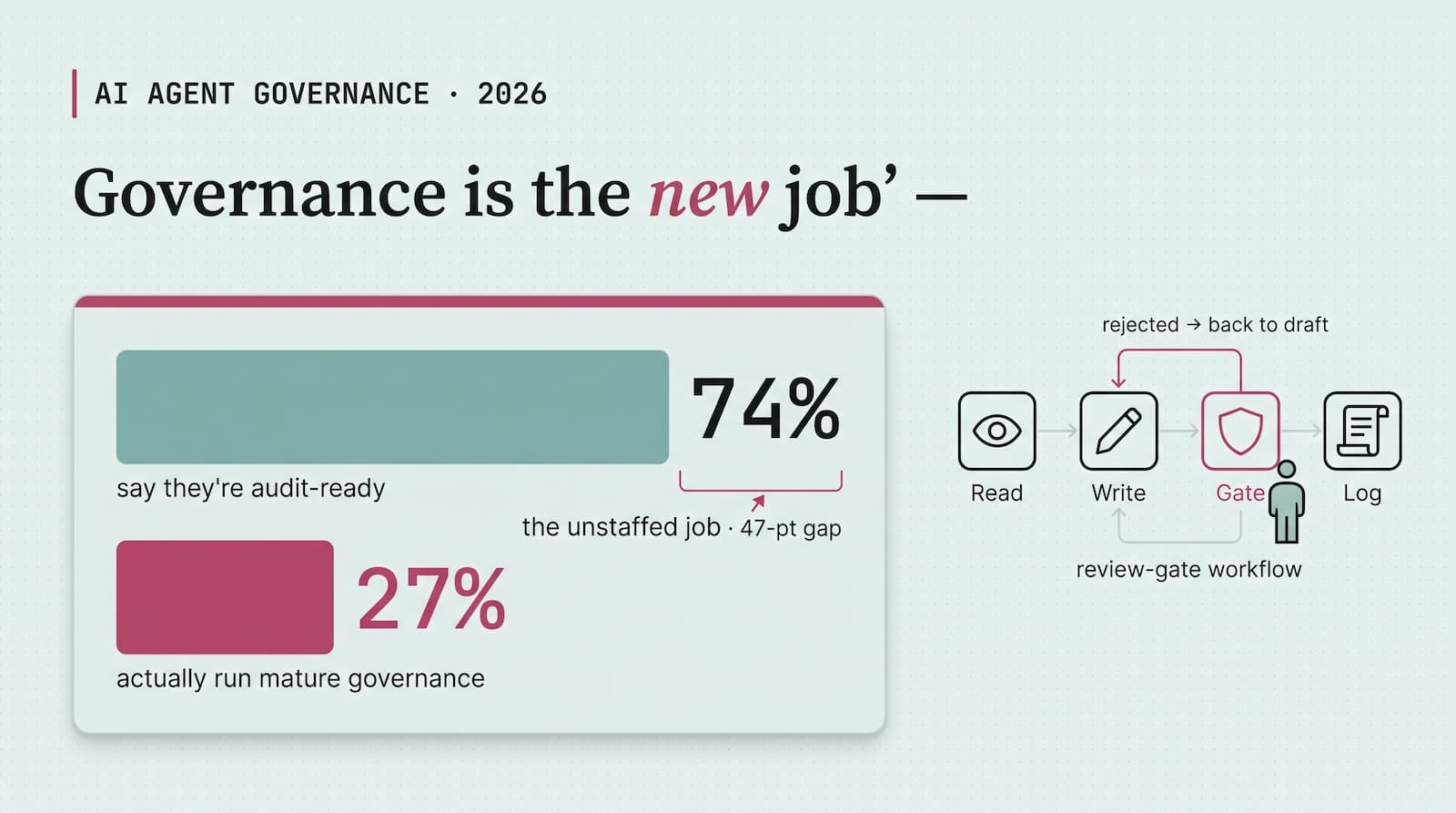
Meanwhile, 13% of organizations reported breaches of AI models or applications, and 97% of those breached lacked proper AI access controls. 63% had no AI governance policy at all. Shadow AI added an average of $670,000 to breach costs (IBM/Ponemon, 2025).
The AI Governance Gap Lollipop chart comparing AI adoption and AI governance failures: 67 percent of Fortune 500 companies use ChatGPT Enterprise (source: OpenAI 2025), 63 percent of AI-breached organizations had no governance policy (source: IBM/Ponemon 2025), 40 percent of employees feed sensitive data into AI tools without authorization (source: Bloomberg Law 2025), 13 percent of organizations reported actual breaches of AI models or applications (source: IBM/Ponemon 2025)

This isn't a theoretical risk. Your documentation strategy now has direct financial consequences. If your internal docs land in a training corpus, the cost isn't embarrassment. It's competitive erosion you can't reverse.
The Three Tests for What NOT to Write Down
Here's the framework. Before you commit anything to a system an AI can access, run it through three gates.
The Vendor Test. If a vendor's AI agent has this knowledge, it would weaken your negotiating position; keep it informal. This covers your actual price floors, your deal patterns, your concession behaviors, and the things that make your commercial relationships profitable. The moment your vendor knows your real walk-away number, every negotiation becomes a one-sided game.
The Departure Test. If a key employee leaving with this knowledge would take six months to recover from, document just enough for business continuity,y but not enough to expose the full playbook. 48% of companies lose institutional knowledge with every departing employee. Knowledge loss accounts for 12% of total turnover costs, averaging roughly $4,300 per departure (SHRM/Gallup, 2024-2025). The goal is continuity, not replication. Write the runbook, not the strategy behind it.
The Replication Test. If documenting this lets a smart competitor rebuild your capabilities, keep it hidden. Job postings alone give competitors 6-12 months of strategic lead time before any public announcement. When OpenAI shifted its hiring from research-heavy (18% GTM roles) to go-to-market-heavy (28% GTM roles) in 2025, competitors could see the commercial pivot months before any press release (Epoch AI, 2025). That was just from job listings. Full documentation provides them with the blueprint, including page numbers.
Most teams default to documenting everything because the cost of NOT documenting is visible (someone asks a question, nobody knows the answer). In contrast, the cost of documentation is invisible (your strategy is to train your competitor's next model). These three tests flip that default. Documentation becomes an active decision with a burden of proof, not an automatic reflex.
Five Things That Should Never Touch a Formal System
Beyond the three tests, five categories of knowledge are so strategic that they should remain deliberately illegible.
Founder mental models. The way your founder thinks about the market isn't replicable and shouldn't be. Writing it down ossifies it. It turns a living, evolving mental framework into a fixed artifact anyone can study. Worse, it hands your strategic lens to competitors. They don't need to figure out how you see the market. You gave them the map.
Taste judgments. An explicit written definition of what "good" looks like in your product is a gift to every competitor. Once documented, taste becomes a checklist anyone can replicate. But taste is what separates your product from a competitor with the same feature set. It's the difference between "the search results are fast" and "the search results feel right." Checklists produce the first one.
Strategic optionality. Potential moves you haven't decided on yet. M&A targets you're watching. Adjacent markets you might enter. Once these are written down, they become discoverable by AI, by departing employees, and by anyone with access. 40% of employees already report feeding sensitive workplace information into AI tools without authorization (Bloomberg Law, 2025). Your strategy doc is one prompt away from becoming public.
Negotiating intuition. Your actual price floors. Deal patterns that worked. Concession behaviors that closed deals. Document these, and every future counterparty can reverse-engineer your approach before the first call. This isn't about hiding from regulators,s it's about not arming the other side of the table.
Informal power dynamics. Who actually makes decisions in your organization? Formal org charts lie, and everyone knows it. But documenting the real influence map creates internal political risk and gives external parties a guide to manipulating your decision-making. Some things belong in conversations, not in Notion.
Notice a pattern? Every one of these categories is something that gives you an edge precisely because it's hard to replicate. Taste isn't valuable if it's a rubric. Strategy isn't valuable if it's a document anyone can read. Power isn't influential if it's mapped. Illegibility isn't a failure mode. It's the feature.
What You SHOULD Document (And How)
This isn't an argument for zero documentation. That would be chaos. Some things must be written down, and those things matter enormously. The distinction is simple: document what helps someone do their job today, not what reveals how you'll win tomorrow.
Write onboarding docs, runbooks, incident postmortems, and compliance requirements. Document processes, not judgment. Document decisions and their rationale after they're made, not your menu of strategic options before you choose. Document your API, not your architecture philosophy.
When we built PromptMetrics, we wrote extensive docs on how the system works, setup, configuration, and troubleshooting. We deliberately never wrote down why we chose certain architectures over others, where we thought the market was heading, or which features we were considering next. New team members could operate the product on day one. Competitors couldn't read our roadmap.
The rule of thumb: if a document helps your team ship faster, write it. If it helps a competitor think like you, don't.
What Walks Out the Door When an Employee Leaves Horizontal bar chart: 80 percent of organizational knowledge lives tacit/undocumented (source: Fast Company/Sugarwork 2024), 71 percent of company know-how is undocumented (source: Scribe ROI Report 2025), 42 percent of workplace knowledge is unique to the individual employee and unrecoverable when they leave (source: Panopto/YouGov)

The Competitive Advantage of Being Illegible
In a world where AI makes all written knowledge instantly retrievable and analyzable, illegibility is the new defensibility. Not secrecy illegibility. The difference matters. Secrecy implies hiding things that exist in written form. Illegibility means they were never written down in the first place.
Look at what's happening right now. AI Overviews cite published content. Competitors train models on public docs. Recruiters reverse-engineer team structures from your documentation. Knowledge management leaders rank AI as their #1 priority for 2025 while simultaneously flagging IP leakage as their fastest-growing concern (APQC, 2025). They're trying to resolve the contradiction by implementing better access controls. They should be solving it by writing less.
The companies that win won't be the ones with the best wiki. They'll be the ones where critical strategic knowledge lives in conversations, in relationships, and in hard-won intuition that was never committed to any system an AI can touch. The most well-documented company in your industry isn't the one you should fear. It's the one where nobody can figure out how they actually operate.
Video: Episode 80: AI Remembers Everything: The Sovereignty Dilemma by Built for Trust Podcast (Cisco). Tom Gillis explains why AI models can never forget sensitive data once ingested.
This is the strategic paradox of 2026: the tools that promise to make your organization smarter by capturing everything are the same tools that make you easier to copy. The most defensible knowledge isn't the knowledge you protect with permissions. It's the knowledge you protected by never writing it down.
When Shouldn't You Use This Framework?
This framework doesn't apply everywhere. If you're in a regulated industry where documentation is a legal requirement, the compliance floor is non-negotiable. Write what the law demands. This framework covers the discretionary layer above that strategy, not audit trails.
If you're a five-person startup, you have bigger problems than documentation strategy. Come back to this when you have something worth protecting. And if your culture already has a knowledge-hoarding problem, people hiding information out of fear or territorial behavior, this advice will make things worse. Fix the sharing muscle first, then get selective.
The real tension: deliberate non-documentation creates key-person risk. Every piece of knowledge keeps walking out the door when someone leaves. The Departure Test is meant to mitigate that, but the tension is real, and you'll feel it. The question isn't whether there's a tradeoff. It's whether you're making it consciously or accidentally.
Frequently Asked Questions
Isn't this just encouraging knowledge hoarding?
No. Knowledge hoarding is accidental, fear-driven, and unstrategic, as people hide things because they feel insecure or territorial. This framework is deliberate, criteria-based, and designed to protect competitive advantage. The difference is intent. Hoarders hide everything. Smart teams hide specific things for specific reasons.
What if we get sued and need documentation for discovery?
Regulatory and legal requirements override this framework. If you're in a regulated industry, document what compliance demands. The five categories above sit above the compliance floor. Your audit trail stays. Your strategic optionality stays informal. These things don't conflict unless you've been writing down things you shouldn't have.
How do I explain this to investors who want to see "process"?
Investors don't want your strategic playbook; they want evidence that you have one. Show outputs, not internals. Share results, metrics, and customer evidence. If an investor demands your pricing decision framework as a condition of investment, that's a conversation worth having in a room, not a document worth sending.
Doesn't remote work make this impossible?
Remote work makes deliberate communication more important, not more documented. Use synchronous conversations for strategy, async docs for execution. The distinction isn't between remote and in-office; it's between strategic and operational knowledge. You can run a fully remote team and still keep your competitive intuition verbal.
What's the first thing I should pull out of our docs?
Your pricing rationale. Not your pricing page, but your customers need that. The internal doc that explains why you priced things that way, what your floor is, and which deals you walked from. That doc is training your competitors' AI for negotiation. Delete it today.
Conclusion
In the AI era, strategic illegibility is a competitive advantage; what you don't write down matters as much as what you do.
Three things to do this week:
Run your existing docs through the three tests. Open your most sensitive internal docs and ask: Does this pass the Vendor Test? The Departure Test? The Replication Test?
Pull anything that fails the Replication Test. If a competitor could rebuild a capability from this document, it doesn't belong in a shared system.
Make non-documentation a deliberate leadership decision. The default shouldn't be "write it down." The default should be "prove this is safe to write down."
The best-protected trade secret is the one that was never committed to paper in the first place. AI didn't change that principle. It just raised the stakes.