
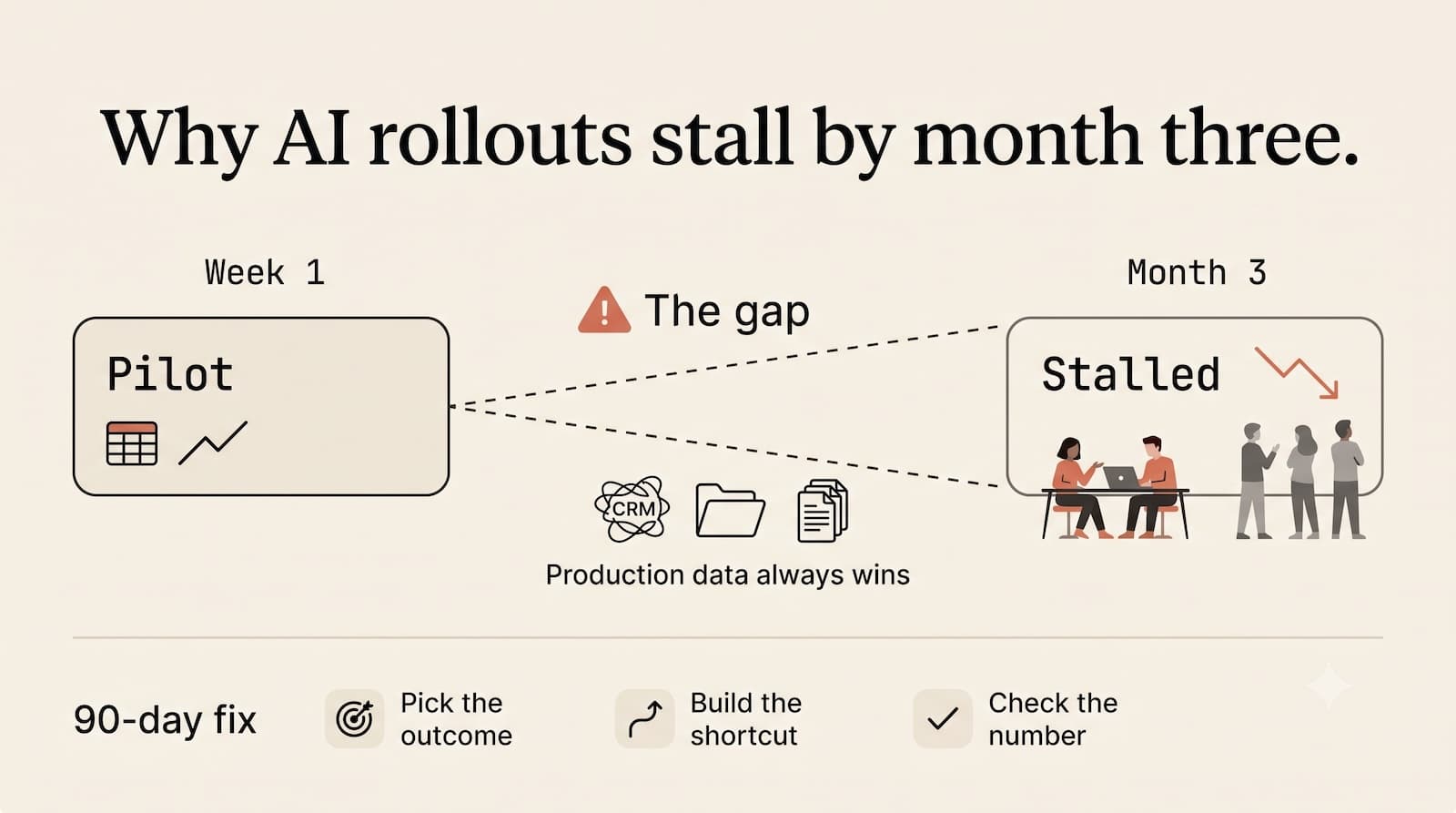
Week one felt good. You picked the tool, got a few teammates trained, and someone in the Monday standup said: "This is actually going to change how we work." Month three looks different. The tool sits half-used. Two people love it, and everyone else opens it once a week, if that. Since you have to measure anything, you don't have a clean answer when someone finally asks. And you championed it, so the silence feels personal.
That gap between week one and month three isn't a fluke. It's a structural pattern that shows up across company sizes, and it happens for reasons that have nothing to do with whether the tool itself is any good. This post walks through why AI rollouts fail at that specific point, using verified reporting on enterprise AI adoption, and lays out what to do differently if you're the person holding the mandate with no playbook.
Key Takeaways
Nearly half of AI licenses go unused, costing large enterprises an average of $80.6 million a year (UC Today, 2026).
Compliance overhead alone can add roughly 17% to total AI system costs, before anything goes wrong (UC Today, 2026).
Rollouts that measure activity (logins, prompts, screenshots) backfire; rollouts that measure outcomes succeed (The Digital Project Manager, 2026).
The fix isn't a better tool. It's picking the right outcome to measure before month one even starts.
What Actually Happens to Your AI Rollout by Month Three?
Pilots succeed because they run on clean, curated data in a controlled setting. Production fails because it has to run on the real mess your company actually has. Mike Leone, principal analyst at Omdia, put it bluntly: "You test on a curated dataset, maybe a few thousand clean documents, the AI looks amazing, everyone's excited. Then you point it at production" (UC Today, 2026).
That production reality is "fifteen years of SharePoint folders. Teams threads nobody's cleaned up since 2021," as Leone describes it. Swap in whatever your version is: a CRM with three years of half-filled fields, a shared drive nobody has organized since a departed hire set it up, a HubSpot instance with four different naming conventions for the same pipeline stage.
Nitin Seth, co-founder and CEO of Incedo, frames the underlying problem this way: "Pilots work because they operate in a controlled reality. Production fails because it has to operate in the real one" (UC Today, 2026). That's the honest answer to "why did this stall." Not that people didn't try hard enough. The tool met your actual data, and your actual data won.
Most explanations for stalled rollouts focus on the tool or the training. What gets missed is that the pilot never tested the thing that eventually breaks it: your own operational mess. A tool that looks flawless on a clean demo dataset tells you nothing about how it handles a CRM your team has been quietly neglecting for two years.
Why Do So Many AI Licenses Go Unused?
Roughly half of AI licenses purchased by large enterprises sit unused, a pattern that costs an average of $80.6 million a year, according to Nitin Seth of Incedo (UC Today, 2026). Seth notes this isn't new: "AI licenses like Copilot are the latest chapter in a pattern that has existed for years."
You don't need an $80 million budget for this pattern to hit you. If you bought seats for a team of eight and three people use it daily while five have forgotten the login exists, you're looking at the same shape of waste, just at your scale. The dollar figure changes. The behavior doesn't.
This matters because unused licenses are often the first hard evidence anyone points to when a rollout gets questioned. Nobody asks "was the strategy sound?" They ask "why are we paying for a tool three-quarters of the team ignores?" That's a fair question, and it's usually a symptom of something upstream: the rollout never defined what "using it well" looked like, so people defaulted to not using it at all.
Read How to Prove AI ROI in 6 Weeks (No Data Team Required) for a way to fix that without a data team.
The Hidden Governance Tax Nobody Budgeted For
Compliance overhead alone can add roughly 17% to total AI system costs, before a single violation ever happens, per Nitin Seth of Incedo (UC Today, 2026). That's not a fine. That's the baseline cost of doing this responsibly, and most rollout budgets never account for it.
The visibility problem compounds it. Seth also cites data showing "one in five organizations has already experienced a breach linked to unauthorized AI use... while 86 percent of organizations lack visibility into how AI is moving through their systems" (UC Today, 2026). You don't need a compliance department to feel exposed by that stat. If you're the only person who set up the tool and nobody else has looked under the hood since, you already have a visibility gap.

This is where the human-in-the-loop question gets real, even for a team with no formal governance function. Every AI action that touches customer data or a live deal needs a person who can see and stop it. That doesn't require a compliance department. It requires a habit, covered in Human-in-the-Loop Without a Compliance Department.
If you're in the EU, there's a regulatory clock running alongside this too. Requirements tied to the EU AI Act start landing for smaller teams later this year, and "we didn't have a compliance department" won't be a defense worth much. See The EU AI Act for Small Teams: What Actually Lands August 2, 2026 for the precise scope.
Why Do Only a Few People Actually Use the Tool?
A small group of power users adopts fast while everyone else quietly avoids the tool, and Jake Canaan, Chief Product Officer at Quantum Metric, names the real reason: time, not resistance. "The struggle is the average user who doesn't have the time to dig into a platform and understand the ins and outs. This leaves them confused and frustrated that they have one more system to learn" (UC Today, 2026).
That's a different diagnosis than "people don't want AI." Most people are fine with AI. What they don't have is thirty spare minutes this week to figure out where a new tool fits into a day that's already full. Your power users found that time, or made it, because they were curious or motivated early. Everyone else is waiting for someone to hand them the shortcut.
A company rolls out a new AI tool and trains everyone on everything it can do. But training on everything isn't the same as showing one person the three clicks they need for the one task they do every day. A few curious people figure it out on their own. Everyone else needs someone to show them exactly what to click.
Is Your Rollout Measuring the Wrong Thing?
Rollouts that measure activity tend to backfire, while rollouts that measure outcomes tend to succeed. That's the pattern researchers found across leaders running AI mandates (The Digital Project Manager, 2026), and it's exactly what's playing out right now with the metric most companies default to: token consumption.
Token consumption- how many tokens a team burned this month, whether usage went up quarter over quarter- has become the default stand-in for "AI adoption" at a lot of companies. Cognizant's CEO, Ravi Kumar S., called that out directly at Fortune's COO Summit in June 2026: "For the past two years, tracking AI token use was just a vanity metric" (Memeburn, 2026). Cognizant has 350,000 people. If their own CEO is saying the number most companies report doesn't mean what people assume it means, that's worth taking seriously at any size, including yours.
This isn't a new mistake, just a new unit. Token leaderboards are this decade's version of "lines of code" and "commits per week," two metrics engineering teams already learned don't measure real output; they just look rigorous in a slide (Hoola Hoop, 2026). Someone can run up their token count by re-running the same prompt or stuffing extra context in. None of that means the work got better or faster.
The same failure shows up in how mandates get written, not just how usage gets reported. Andrea Sommer, Founder and CEO of Hive Founders, saw it firsthand: "The mandates that backfire are the ones measured by activity... turns into people gaming a metric rather than doing better work" (The Digital Project Manager, 2026). Neal J. McLeod, Founder of CTK Industries, puts it the same way: mandates backfire "when they reward visible usage instead of measurable operational improvement" (The Digital Project Manager, 2026).
If you've been reporting token counts, logins, or messages sent as your proof that the rollout "worked," that's worth revisiting now, before month six arrives and the number still doesn't mean anything. We go deeper on how to redesign the mandate itself, and what to measure instead, in The AI Mandate Paradox: Why Measuring Usage Kills the Rollout You're Trying to Save.
The 90-Day Fix: A Playbook for Mandate-Carriers
The fix isn't a bigger training budget or a stricter mandate. It's picking one operational outcome- proposal turnaround, ticket resolution time, revision rounds on a deliverable- and building the rollout around moving that number, not around proving people opened the app. Every pattern above traces back to this same root cause: measuring the wrong thing, or measuring nothing at all.
Weeks 1 to 3: Pick the outcome, not the activity
Choose one metric that already matters to your team's day-to-day, something like time-to-first-draft or average handling time. Don't invent a new dashboard. Use whatever you already track in HubSpot, Salesforce, or your helpdesk tool. If you can't name the number today, that's the first problem to solve, before you touch adoption at all.
Weeks 4 to 8: Build the shortcut for the average user, not the power user
Take Canaan's point seriously. Document the three-click version of the single task your average person needs most, not the full feature tour. In our experience, one well-mapped workflow for the most common task beats a full training deck nobody finishes.
Weeks 9 to 12: Check the number, not the login count
Go back to the outcome you picked in week one. Did proposal time drop? Did resolution time drop? If yes, you have a real result to point to, not a usage report. If no, you've learned that in eight to nine weeks, which is a lot faster than finding out at month six when someone asks why the licenses are half-used. The full six-week version of this check is in How to Prove AI ROI in 6 Weeks (No Data Team Required).
FAQ
Why do AI rollouts fail after the pilot stage specifically? Pilots run on clean, curated data, and production runs on years of messy CRM records and unstructured files. Nitin Seth of Incedo describes this as pilots operating in "a controlled reality" while production has to operate in the real one (UC Today, 2026).
Is it normal for most people to ignore a new AI tool after rollout? Yes. It's less about resistance and more about time. Jake Canaan of Quantum Metric attributes it to average users lacking time to learn a new platform on top of existing work (UC Today, 2026). Build the shortcut for them instead of waiting for curiosity to kick in.
Do I need a compliance department to manage AI governance risk? No, but you do need a habit of human review. Compliance overhead adds roughly 17% to AI system costs even before anything goes wrong, and most organizations, 86% by one estimate, lack visibility into how AI moves through their systems (UC Today, 2026). A regular review habit closes most of that gap without a formal function.
Should I track logins or prompts sent to prove the rollout is working? No. Rollouts that measure activity tend to backfire, turning into what Andrea Sommer of Hive Founders calls people "gaming a metric rather than doing better work" (The Digital Project Manager, 2026). Pick one operational outcome instead, like resolution time or proposal turnaround.
How long should I give a rollout before deciding if it's working? Our recommended practice is 90 days, split into three phases: pick the outcome metric in the first three weeks, build the average-user shortcut by week eight, and check the number by week twelve. Ankita Pathak's team learned their activity-based mandate wasn't working within eight weeks (The Digital Project Manager, 2026), which is roughly the same window.
The Takeaway
Month three isn't the moment your rollout failed. It's the moment the gap between what you measured and what actually mattered became visible. The tool didn't stall because it was weak. It stalled because nobody defined what "working" meant before week one, and because production data always tests a rollout harder than a pilot ever will.
You don't need a data team, a board deck, or a compliance department to fix this. You need one outcome metric, one shortcut built for your average user, and a 90-day check-in that looks at real numbers instead of usage logs. Start with the metric. Everything else in this series builds from there.
Sources
Kieran Devlin, "AI Pilot Purgatory: Why Enterprise AI Rollouts Fail to Scale and How to Fix the ROI Trap," UC Today. https://www.uctoday.com/productivity-automation/ai-pilot-purgatory-enterprise-scaling/
Kristen Kerr, "AI Mandates: Hit or Miss? Leaders Tell All," The Digital Project Manager. https://thedigitalprojectmanager.com/pmo/ai-mandates-hit-or-miss-leaders-tell-all/
Jennie Pham, "Cognizant CEO Calls AI Token Metrics Vanity and Still Hires 20,000," Memeburn. https://memeburn.com/cognizant-ceo-calls-ai-token-metrics-vanity-and-still-hires-20000/
Leigh Newsome, "Tokenmaxxing: The Vanity Metric Eating Your AI Budget," Hoola Hoop. https://hoolahoop.io/articles/cto-coaching/tokenmaxxing-ai-vanity-metric/